• TalkBass has been independent since 1998. Add your voice.
    Create a free account to reply to discussions, view embedded media, and browse with fewer display ads.
    Join freeLog in
    Want zero display ads or expanded classifieds tools? Compare plans.

New mesa subway amps and cabs!

@RudyTardy You might want to try lowering the E and A side of your pickups a bit. If they're too close to the strings they can produce a "chorusy" sound. Easy potential fix and highly reversible.
This phenomena is frequent for people who sing or speak in a microphone listening their voice with headphones, the difference of phase between what the ear hear and the vibration coming from somewhere else in the body create a kind of aliasing that mix up the auditive nerve. (sorry a specialist could explain this more accurately than me)
 
  • Like
Reactions: chupacerveza
@agedhorse forgive me if you have answered this question already, but which tube does the WD800 ship with? The 12AT7 or 12AU7? Is the only difference in their gain?
The amp ships with a 12AT7, the difference isn't gain, the difference is in the ability to drive the reactive tonestack load. This is one of the benefits of using the 12AT7, it very closely tracks some (overall) unique tonal properties that the Walkabout had with regard to the passive mid integrated tonestack. The 12AU7 is not very different in practice but IMO the 12AX7 sounds kind of flat and lifeless by comparison.

The tube that the amp ships with has a predicted life of over 10,000 hours (maybe as high as 20,000 hours but prediction math become somewhat inaccurate that far out) so I discourage changing it without a definitive reason.
 
I love my Tech 21 Dug pedal, it adds a great modern grind when I want it in front of my D-800, I also have Tech 21 VT bass that I set for when I want kind of an old school flat wounds vibe (as close as I can get with an active J bass with rounds). Both sound great in front of my D-800. Although I must admit the VT sounds better in the mix than soloed. The key at least for me is the D-800 with my Sadowsky gets the exact base tone I'm looking for, the sound that works for 90% of what I play. And I use my pedals for color on certain tunes.
 
The amp ships with a 12AT7, the difference isn't gain, the difference is in the ability to drive the reactive tonestack load. This is one of the benefits of using the 12AT7, it very closely tracks some (overall) unique tonal properties that the Walkabout had with regard to the passive mid integrated tonestack. The 12AU7 is not very different in practice but IMO the 12AX7 sounds kind of flat and lifeless by comparison.

The tube that the amp ships with has a predicted life of over 10,000 hours (maybe as high as 20,000 hours but prediction math become somewhat inaccurate that far out) so I discourage changing it without a definitive reason.
Thanks man! Wasn’t planning on changing it anytime soon. Was simply curious if there were tonal differences between the two. Either way, that tube stage sounds absolutely killer through the DI to the console. Is that lower order harmonic distortion?
 
Thanks man! Wasn’t planning on changing it anytime soon. Was simply curious if there were tonal differences between the two. Either way, that tube stage sounds absolutely killer through the DI to the console. Is that lower order harmonic distortion?
Not just distortion but amplitude non-linearities combined with a distortion spectrum modeled after the WA (which is loosely related to the 400/400+)
 
I'm interested in getting a better understanding of how the changes in the preamp tube in the WD800 effects the sound.
First off, I am typically not a player who messes with his amp guts. If it works and I can get a good tone out of it ... thats good for me.

In the case of my WD800 (which has unseated my much beloved Walkabout as my go-to gigging amp), it started with a microphonic tube issue (which I probably caused by dropping :eek: my WD800 during one load-out ... geez!, I never do that ...) Immediately afterwards, while the amp would work, it did start to make some odd noises on startup (crackling, "breathing" noise) and any touch to the front panel or knobs would result in a ringing/ping-y sound ... so of course the stock 12AT7 tube had become microphonic.

So, as I happen to have some spare 12A_7 tubes around the place, I replaced it with another 12AT7, a NOS Mullard ... which turned out to be microphonic as well .. dang!, after a few swaps, I ended up with a JJ 12AU7 and I liked that quite a bit. I come to understand that the 12AU7 has a much lower gain factor (20 vs 60 for AT7's and 100 for AX7's) .. but as I rarely need to run the WD800 gain above 10:00 to get the volume I need, even with the lower gain JJ in there, that does not seem to be much of a factor for me.

So, what I am interested in knowing (at least something about) is aside from the lower gain ratings of the AT7 and AU7 tubes, and the resulting great headroom (I think), what else do these tubes do the over all tone, function of the amp. FWIW, I like the stock Mesa 12AT7 fine, and Mesa sent me a replacement (thanks guys!) but now this has got me pondering the differences in these preamp tubes.

can anyone enlighten me on this topic ?

thanks
 
"Gain factor" is a term that needs to be abandoned without considering the circuit topology itself.

There are circuits where a 12AT7 will exhibit higher voltage gain due to the way loading and feedback combine to affect the overall response.

The 12AX7 family will work but does not have adequate current gain and capacity to drive the tone stack circuit that emulates and tracks the original Walkabout. Because of this, the 12AX7 will experience a reduction in the overall dynamics and may lack the depth/detail of the 12AT7. The 12AU7 will also work fine though it might be a little more clean and clinical than the AT.
 
So I’ve been loving my new amp! I had a Tonehammer 500 for 7 years - this is a nice upgrade! I have two questions - with the HPF where is 40hz? Is it 10 o’clock? My second question is with parametric eq flat - is the passive mid control considered flat at 12 o’clock or maxed? The manual suggests maxed but it doesn’t sound right (flat) like that.
This amp sounds great - loving the powerful eq options. Can this amp power and iPad via USB port?

9657B010-AEDA-4254-BDFC-269481E73506.jpeg
 
It's strange to think that a "dip only" @250Hz (according to spec) in the passive mids wouldn't dictate "flat" be fully clockwise, but whatever tilt/gain compensation magic @agedhorse engineered into this amp, flat mids really do vary according to the input gain structure and timbre of the signal coming in. My Sadowsky sounds flat at noon(ish) and my P bass sounds flat at 2pm. This concept goes against everything I know, but it really does seem reactive to the input gain and HPF.
 
  • Like
Reactions: chupacerveza
I would think 40Hz is closer to the 9:00 position.

"Flat" is with the passive mid around noon to 2:00.

Thank you!

It's strange to think that a "dip only" @250Hz (according to spec) in the passive mids wouldn't dictate "flat" be fully clockwise, but whatever tilt/gain compensation magic @agedhorse engineered into this amp, flat mids really do vary according to the input gain structure and timbre of the signal coming in. My Sadowsky sounds flat at noon(ish) and my P bass sounds flat at 2pm. This concept goes against everything I know, but it really does seem reactive to the input gain and HPF.

Yes the passive mid control sounds great wherever I set it. Even without the parametric eq this amp would very flexible. I must admit I haven’t got my head around the interaction with the passive mid and the parametric mid eq. But that’s okay. It took me a while to figure out the TH500. Letting my ears be the judge.
 
Thank you!


Yes the passive mid control sounds great wherever I set it. Even without the parametric eq this amp would very flexible. I must admit I haven’t got my head around the interaction with the passive mid and the parametric mid eq. But that’s okay. It took me a while to figure out the TH500. Letting my ears be the judge.
IME the TH500 (which I own and like) is a bit more complex to learn to operate well than the WD even though the WD has more controls. The semi-parametric EQ is there to help when needed.

With all the lower controls (with the dB scale) at noon, the semi-parametric EQ is having no impact. After you get the basic voicing you're after with the other EQ controls and HPF, you can use the semi-parametric EQ controls to bring out a little extra and/or cut back on overly- emphasized frequency range that is preventing you from sitting well in the mix.

For me a semi-parametric EQ section is a tool for fine-tuning once I have the tone I'm after with the "typical EQ controls". An HPF is also a great tool especially for dealing with difficult acoustics, but I also often find myself using it in combination with the bass EQ to do basic tone shaping.

The good news is that there are no right or wrong answers here and using your ears is IMO the best approach. We are all playing in different venues, with different bands/mixes, using different basses and possibly even effects pedals. The highly versatile controls on the head are there to allow us all to find the right tone for our own situation.
 
Last edited:
"Gain factor" is a term that needs to be abandoned without considering the circuit topology itself.

There are circuits where a 12AT7 will exhibit higher voltage gain due to the way loading and feedback combine to affect the overall response.

The 12AX7 family will work but does not have adequate current gain and capacity to drive the tone stack circuit that emulates and tracks the original Walkabout. Because of this, the 12AX7 will experience a reduction in the overall dynamics and may lack the depth/detail of the 12AT7. The 12AU7 will also work fine though it might be a little more clean and clinical than the AT.

As I recall, the 12AU7 is similar in properties to the 12AT7, while the 12AY7 is similar to the 12AX7, but the two families have quite significant differences between them. If I am not mistaken, the AT and AU are higher current tubes? Not sure if I am remembering the correct terminology.

Even though an AT or AU can often be used in place of an AX or AY, that's doesn't mean you should, and vice versa.

That being said, I am using 12AU7s in V1 & V2 of my Mesa F-50, and like the way they sound. I've also used them in a Mesa V-1 Bottle Rocket and liked them. I plan on getting some 12AY7s to see if I prefer those.

I've never cracked open my Walkabout, but maybe I'll try a lower gain tube in there.
 
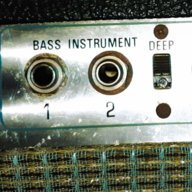
@agedhorse just a quick question. I see the D/Plus have a deep switch and the WD does not. Any specific reason for this?
Yes, the native voicing of the WD is much closer to the Walkabout which already has additional low frequency character.