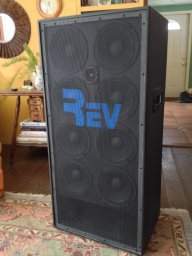
My Titan can go down to 2 ohms. But not having any 8 omhs version is a big limitation for me. Any 8 omhs version in the future?
No plans for an 8 ohm 410 that I am aware of. If that's a big limitation for you then you should probably look at a different cabinet.
Although considered a hardwood it is around the same hardness as Okoume and only a third as hard as Baltic Birch at two thirds the weight/ sq ft. It is mostly void free and quality depends on the supplier. It's screw holding properties are weak and It dents easily but if the cabinet is braced and fastened properly it will not come apart and should provide years of service if taken care of. It should never be used for a baffle on a large cabinet. And, that is not a guess. It comes from 50 years of making cabinets; sometimes with anything I could get my hands on.
While there can be generalizations made about Popular, there are many species of Poplar with different properties. The reason Poplars in general tend to be void free is due to the way the tree grows, the fineness of the grain/fibers and the location of branches in the trees grown for wood (timber, not pulp). Like I mentioned before, you get what you pay for and this holds true for Poplar. Screw holding properties really don't matter since no cabinet manufacturers that I know of use screws to hold their cabinets together, and quality companies use T-nuts or some form of threaded insert to mount the drivers. As far as denting easily, the hardness of the Poplar that we use isn't all that different from Douglas Fir, below is a hardness chart of American Poplar but we use an even harder Italian Poplar. Since we cut everything we build with a precision CNC system, the plywood that we must be very uniform and a special grade is required to guarantee flatness. Hardness is one of many characteristics of a wood that I might consider when selecting a cabinet material, I also consider resonance, resistance to skew and twist, glue line properties, Young's modulus, X-Y stiffness, etc. Fixating on a single property is a very small component of a speaker system.
My experience goes back over 15 years using Italian Poplar, first with the Shuttle and some Shenandoah cabinets (there are many, thousands out there in the real world without any hardness issues) and later with the Subway cabinets. If you know what you are doing with cabinet design and finishing, Poplar is an outstanding material to build cabinets out of. If I hadn't done it, and there weren't many of you with experience using these very cabinets, I wouldn't state this as fact.
The Janka Hardness Values for some common Wood Species
Wood Hardness
(N)
Brazilian Ebony 16420
Ipe 16390
Cumaru 15470
Ebony 14300
Golden Teak 10400
Merbau 8560
Hickory 8100
Rosewood 7900
White Oak 6000
Birch 5600
Teak 5140
English Oak 5000
Burmese Teak 4600
Black Walnut 4500
Cherry 4200
Mahogany 3600
Douglas Fir 2900
Alder 2600
Chestnut 2400
Poplar 2400
Hemlock 2200
White Pine 1900
Balsa 440
Hey Andy, I know the Rosetta is for the acoustic , but would the plus pedal work for acoustic guitar? Just curious
It will work ok, but lacks the notch filter and the phase switch, both of these are quite useful for an acoustic guitar IMO.
Andy, someone is going to ask might as well be me. And I this is an honest question (I am not claiming to be an expert in this area). What was the reasoning for going with the 12At7? Was it to reduce the noise? Can someone replace the 12at7 with a 12ax7 or will that foul the amp up some how?
The 12AT7 in t he WD-800 better matched the 12AX7 in the Walkabout in the most crucial aspect of maintaining current drive without impacting tone. The circuit properties depend on both voltage and current, maintaining the dynamic properties between the two is part of the way feel and dynamics control are maintained. A 12AX7 will work, but skews well away from the curve that best matches the original Walkabout's intent. You could use a 12AX7, but nobody that worked on the listening panel early in the development cared for it, the 12AT7 was the clear winner, closely followed by the 12AU7.
I happen to really like the official WD800 video – that’s how I play bass. I sometimes feel like I’m the only bassist who doesn’t slap & pop constantly.And I thought the tones sounded pretty good on my PC desktop speakers
Maybe you folks can help me decide between the 800+ and the WD800. The price delta is a non-issue. I play in a rock cover band that plays everything but mostly album cuts – songs people know but never hear anymore. Beatles, Cream, Doors, Cheap Trick, Kinks, Grand Funk, Cars, REM, Mountain, etc. I play mostly clean but have started to include some mild OD. 5-string active for that band, but I will use my passive Fender 1975 Jazz 4 a lot too.
Important-to-me specs both amps have:
- 2 ohm support
- Lots of tones possible
- Lightweight
- DI volume independent of master volume
- Would sound heavenly with my Eden cabs
- A known quantity (Mesa quality and reputation, and US made)
Some advantages in the WD800:
- rack mountable but still super lightweight
- tube OD tone
- power amp damping
Thanks @agedhorse & Mesa!!
I strongly encourage you to play both amps and see which one suits your preference better. It's not a "one is better" scenario, they are just different amps that are likely to appeal to different tastes. Some players might like both amps for different reasons too.