• TalkBass has been independent since 1998. Add your voice.
    Create a free account to reply to discussions, view embedded media, and browse with fewer display ads.
    Join freeLog in
    Want zero display ads or expanded classifieds tools? Compare plans.

"No dead spots"... WHAT???

  • Thread starter Thread starter Deleted member 271037
  • Start date Start date
Depends on what you mean by dead. I have two Zon's that seriously have no dead spots (the fretless especially so) and all the notes are really clear and even. Maybe a spot that might be slightly lackluster if I was gonna be really picky, but not dead spots like on a Fender G string between the 3rd and 7th fret where the note just dies or is 10db quieter?
That said, everlasting sustain is not something I would consider to be a necessity (or even desirable) on a bass, otherwise why would we put chicken greased 100 year old flats with half a diaper underneath the bridge of a Pbass? It's nice to have it when it's there, sucks when you don't want it.

I should add, I've owned many Fenders, ALL had dead spots to one extent or another on the Gstring (it actually makes me wonder where the idea of the singing fender fretless even came from, cuz I haven't ever played it ever (Jaco, I know but, there is some kinda voodoo going on there with the epoxy and such))

And, definitely all Zon's are not created equal. My Fretted Zon has a truss rod (it's threaded, but not doing anything) and hence a hollow (chambered) neck which I would guess is to allow the truss to work at all. The neck feels like it isn't even really there (to go any further I'd start gushing). It's a weird feeling. My fretless doesn't have a truss rod and is noticeably different. Not better or worse, just different. A little woodier feeling than my other Zon. Meatier.

So here's a real question, how quickly does a note need to die to be considered dead comparatively to the rest of the board? What is an acceptable amount of sustain to call something a sustain monster?

And honestly, since my original post, I just ran every note on my fretted Zon (to make sure I wasn't full of it) and every note is a ringer. The E string gets kinda wooly past the 14th fret, but there isn't a single note that just packs it in a goes home. So to those who say it doesn't exist, I guess I got a unicorn:cool:.
I'll literally post a video of me playing every note on the thing if there are enough non believers, but it will end up looking like a Zon fan boy video.
 
I agree, it’s physically impossible to not have dead spots, but most of the time they aren’t noticeable. Even my graphite bass has them to a degree. The way I’ve found them is to use an OC-2 type octaver with the octave down soloed, and play every note. The tracking will tell you where the dead spots are. But like I said, most of the time you won’t notice them so I don’t worry about them. I’ve never had a bass with a dead spot that’s big and noticeable though.
 
I currently own over 30 basses. Some are cheap entry level stuff or quirky vintage models but most of them are quite expensive, top-of-the-range or custom made instruments.

I must have owned more than 50 basses over the years.

Counting the basses I've played in stores or borrowed... I must have played HUNDREDS of basses.

EVERY SINGLE ONE of them had dead spots. Some were less noticable that others and the exact location on the neck could vary. But they ALL had dead spots. Bolt-on, neck through, set neck, graphite rods... they ALL have dead spots in my experience.

Looking at the physics behind dead spots I don't understand how it would even be possible to design a resonating wooden instrument such as the bass guitar without any deadspots. Even a device like the Fatfinger, which is designed to "tune out" deadspots, doesn't really remove them. The deadspots are simply moved to other notes.

Yet, hardly a week goes by without reading a NBD thread here on Talkbass where someone says their new bass has "no dead spots".


Which leaves me with these two options:

1) I'm the most unlucky guy ever when it comes to basses and dead spots (plus I must have gotten the science behind deadspots all wrong).

or

2) Lots of people don't really understand what dead spots are. I asked a friend who is a guitar player about this and he thought a dead spot was simply a bad fret. Is this a common misconception?

Anyway, I'm genuinely baffled by the number of claims about "no dead spots" around here, even on the cheapest entry level basses.

So which one is it, 1) or 2)?

Ya I think people don't notice the difference, it might be theoretically possible for the dead spot to be between half steps but typically these deadspots span 2-3 frets so maybe not.
 
Ok, I startet this mess so I guess dinner will have to wait a while longer, lol. I get the impression that some of you aren't exactly sure what dead spots really are so I did a quick recording of one of my worst examples. This is possibly THE worst dead spot on every bass I own. This dead spot is at the 7th fret on the G-string.

In the attached clip I played the offending note twice + two frets up for comparison. Then the dead spot again twice + one octave down for comparison. And finally the dead spot again twice. As you will hear the other notes have normal sustain but the dead spot dies into an overtone almost immediately. This fret is completely useless for any sustaining notes. With this particular bass it was bad enough that I had to stop using it live. D is not the best note to be "missing" for live performances. And deadspots get FAR more pronounced on stage through a powerful PA. When you hit a dead spot like this one through a PA it feels like all the air get sucked out of you and the room is about to implode (well sort of...).;)

The attached clip is of course totally unprocessed, just a completely dry signal directly to a clean DI. No notes have been deliberately muted.

Laptop speakers not recommended.

And please note that I chose the WORST bass I could think of for best illustrating what a dead spot is. Most basses aren't nearly as bad as this but in my experience they all have dead spots to some extent.

(Oh, and apart from this one dead spot it's actually a nice bass!)

It's not that bad. That is why some people don't hear it and you say this is the worst example. If it's sub one second to the end of the note decay, then I would call it a dead spot. That can even be fixed with a compressor . To really illustrate you have to play the adjacent notes flat and sharp. Plus people who play with foam and dead flats or pizzicato double bass with upright with guts or 20 year old Spirocores, this would not even matter.
 
I am one of those people who has never experienced a dead spot on a bass. I currently own 24 basses. (By the way, selling off.) Over the years, I've owned at least 50 different basses. Never had a problem or even experienced a dead spots. I don't even know what a dead spot is! "Dead spots? What dead spots?"

But, I'm also a person who is not into a ton of sustain and bright snappy sound and I use flats exclusively.

I dunno. I ain't pointing no fingers but are some bass owners just looking for faults with their bass guitars?

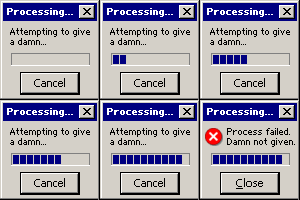
I found this on Google images.

everythingisbeautifulwhenyoustoplookingforflaws-14612968914cp8l.jpg
 
It's not that bad. That is why some people don't hear it and you say this is the worst example. If it's sub one second to the end of the note decay, then I would call it a dead spot. That can even be fixed with a compressor . To really illustrate you have to play the adjacent notes flat and sharp. Plus people who play with foam and dead flats or pizzicato double bass with upright with guts or 20 year old Spirocores, this would not even matter.

Hm... not that bad? We must hear this very differently. Are you listening through speakers with proper lows? When listening on laptop speaker the clip I posted may give the impression of sustaining longer than it actually does because you only hear the overtones, not the fundamental. But on headphones or decent speakers it just goes "ploink" and drops of almost immediately, like a fraction of a second.

I get what you're saying about foam and double bass but most of the time I need sustained notes. And the clip I posted can most definitely NOT be fixed using compression. It's not just a volum drop. The fundamental goes out the window too. Every time I hit that fret the bass will leave a "hole" in the mix. And dead spots usually get more apparent in the context of a mix. And a LOT more apparent when playing live through a PA. It's not acceptable to me that the bass goes "ploink" and then disappears in the PA on slow, sustained passages. The bass in the clip I posted was bad enough that I couldn't use it live anymore. And it wasn't just me, I got funny looks from the other bandmembers every time the bass "disappeared" on the high D.
 
I am one of those people who has never experienced a dead spot on a bass. I currently own 24 basses. (By the way, selling off.) Over the years, I've owned at least 50 different basses. Never had a problem or even experienced a dead spots. I don't even know what a dead spot is! "Dead spots? What dead spots?"

But, I'm also a person who is not into a ton of sustain and bright snappy sound and I use flats exclusively.

I dunno. I ain't pointing no fingers but are some bass owners just looking for faults with their bass guitars?

I found this on Google images.

View attachment 3618602

If a song you play calls for a particular note (sustained) and your instrument can’t produce it for more than a second, you’ll notice it.
 
If a song you play calls for a particular note (sustained) and your instrument can’t produce it for more than a second, you’ll notice it.

It's not just sustain. The entire timbre of the note is different, as can be heard in the OP posted example. You don't have to be playing whole notes for this to be a problem.
 
As far as I can tell all basses have a dead spot. It's simply a matter of where it occurs and how deep is the "sink".

You try to forget it's there and play through it. Most in the audience will never notice the difference unless you're constantly on it.

If you try to play around it, i.e. play the same note at a different string or on an other octave it will screw with your musicianship.
 
  • Like
Reactions: ACWild
After listening to the clip on headphones, I do think this is something that can be fixed with compression. The fundamental is there, the tone is very well rounded (quite nice, just like all the other notes). It’s just lower volume.
 
Hm... not that bad? We must hear this very differently. Are you listening through speakers with proper lows? When listening on laptop speaker the clip I posted may give the impression of sustaining longer than it actually does because you only hear the overtones, not the fundamental. But on headphones or decent speakers it just goes "ploink" and drops of almost immediately, like a fraction of a second.

I get what you're saying about foam and double bass but most of the time I need sustained notes. And the clip I posted can most definitely NOT be fixed using compression. It's not just a volum drop. The fundamental goes out the window too. Every time I hit that fret the bass will leave a "hole" in the mix. And dead spots usually get more apparent in the context of a mix. And a LOT more apparent when playing live through a PA. It's not acceptable to me that the bass goes "ploink" and then disappears in the PA on slow, sustained passages. The bass in the clip I posted was bad enough that I couldn't use it live anymore. And it wasn't just me, I got funny looks from the other bandmembers every time the bass "disappeared" on the high D.

I used good headphones. And then just know through proper 12 inch woofers. If I had to use your bass today , I would still use even with that damping on that note. I would choose another string position or I may tune it down and then transpose everything. Since this is the worst example, your other basses must be good. Even worse are wolf tones, meaning there will be a sub harmonic that comes out with the intended note.

I agree, not all strings will sustain as long as you want to but do not qualify those positions as a dead spots for the others. MAybe a shorter scale or a 35 36 inch fiver would eliminate that.
 
I currently own over 30 basses. Some are cheap entry level stuff or quirky vintage models but most of them are quite expensive, top-of-the-range or custom made instruments.

I must have owned more than 50 basses over the years.

Counting the basses I've played in stores or borrowed... I must have played HUNDREDS of basses.

EVERY SINGLE ONE of them had dead spots. Some were less noticable that others and the exact location on the neck could vary. But they ALL had dead spots. Bolt-on, neck through, set neck, graphite rods... they ALL have dead spots in my experience.

Looking at the physics behind dead spots I don't understand how it would even be possible to design a resonating wooden instrument such as the bass guitar without any deadspots. Even a device like the Fatfinger, which is designed to "tune out" deadspots, doesn't really remove them. The deadspots are simply moved to other notes.

Yet, hardly a week goes by without reading a NBD thread here on Talkbass where someone says their new bass has "no dead spots".


Which leaves me with these two options:

1) I'm the most unlucky guy ever when it comes to basses and dead spots (plus I must have gotten the science behind deadspots all wrong).

or

2) Lots of people don't really understand what dead spots are. I asked a friend who is a guitar player about this and he thought a dead spot was simply a bad fret. Is this a common misconception?

Anyway, I'm genuinely baffled by the number of claims about "no dead spots" around here, even on the cheapest entry level basses.

So which one is it, 1) or 2)?

I only started noticing dead spots after getting here into playing with an octave pedal and distortion; these are unforgiving of dead spots.

I did recently find a stock Fender American Pro P that had no dead spots (I noticed as I was using it to audition an octave pedal). I probably should’ve bought the bass - it was really good and well-set-up.
 
I'd heard about dead spots but not encountered any, or gone looking for them, until I was playing a sub gig and had to play a slow walk down of sustained notes from D on the G string. The D was fine but when I hit the C# it died away in no time, the B as good as the D (can't remember the song).

I'd never noticed this with my main band because I can't recall any song where I've used C#, in fact I rarely get onto the G string so it's not a problem to me.

My other basses may have dead spots but I haven't found any yet and am not inclined to go looking (ignorance is bliss).
 
Yeah, I've hear that claim about non-wood necks too but I've never tried one. But how exactly does that work? They must still have a resonant frequency right? Or does the materials you mentioned somehow shift the resonant frequency out of hearing range?

I've had aluminum necked Kramers - they had a minor dead spot on the open A string, but nothing noticeable on the G string. There is more than one vibrational mode in a neck - where the antinodes of a mode coincide with a fret with a string tuned to that note, the neck will steal vibration from the string fairly fast - the string is "dead" at that note. If you retune a bass (tune it to D standard), you can sometimes avoid the worst of the G string (now F string) F spot. Reducing mass on the end of the neck and/or stiffening the neck (the Kramers did a lot of stiffening) will move the dead spot on he G string up the neck, and make it less objectionable. But, doing that also brings into play the whole neck mode, which can intrude on the open A string - I had a bass tune in D standard, and lowering the open A to G made that dead spot worse, so...heavier tuners it was.

Its not as much of the non-wood necks that kill the dead spots. Its the headless design that eliminates the string vibrations above the nut that cancel out some on the neck, that in turn drops that frequency.

A headless design is not an absolute panacea for dead spots - headless just means you've reduced the mass loading on the headstock end by a lot. Worst dead spot I ever ran into was a traveller headless bass - the open A string on that thing was SERIOUSLY dead - the whole bass shook for a tiny fraction of a second when you played that note, with none of it going out the output jack.