Think of it like a high frequency tap. Counter-clockwise to open the tap and let more trebles out. Clockwise to close the tap.

Enjoy the benefits of a premium membership!
Upgrade Account
-
TalkBass has been independent since 1998. Add your voice.
Create a free account to reply to discussions, view embedded media, and browse with fewer display ads.
Join free Log in
Want zero display ads or expanded classifieds tools? Compare plans.
You are using an out of date browser. It may not display this or other websites correctly.
You should upgrade or use an alternative browser.
You should upgrade or use an alternative browser.
Official Barefaced Bass Cab Club
- Thread starter Stumbo
- Start date
More options
Who Replied?

Question: would it be possible to split a Big Twin II (into basically a BBII and a SM in a single enclosure) by adding a separate input for the bottom 12XN? Ideally adding an output as well so I could connect them if I wanted a BTII and unplug if I wanted to use one amplifier for each. I know it would change the impedance, and that's fine.
Question: would it be possible to split a Big Twin II (into basically a BBII and a SM in a single enclosure) by adding a separate input for the bottom 12XN? Ideally adding an output as well so I could connect them if I wanted a BTII and unplug if I wanted to use one amplifier for each. I know it would change the impedance, and that's fine.
No, not possible. Both drivers are in a shared airspace so they both have to operate at all times.
Yeah, that makes sense. Thanks!No, not possible. Both drivers are in a shared airspace so they both have to operate at all times.

I believe he said that repairman only re-sold
The previous owner was in contact with the Barefaced crew, but the problem was very very strange (some kind of feedback loop between cabinet and amplifier). From what I've been told, the repairman only re-soldered some contacts which resolved the issue.I'd be very surprised if there was any issue in the wiring. Without knowing what this repairman did, my guess is that he didn't know what he was dealing with and has made changes he shouldn't.
The first thing on your To Do list should be to email @alexclaber at BF and get the correct info.
So this is actually by design and it makes sense - the knob only shifts the crossover point left and right.Think of it like a high frequency tap. Counter-clockwise to open the tap and let more trebles out. Clockwise to close the tap.

I was contemplating on going that route but a) seemed overkill (without hearing the cabs first) and b) i want a modular thing with a small(er) and bigg(er) possible setup2 BTs would be even better
Herwig

Agree. im all for a 1 cab setup, ergo I have Super Compact and Super Twin. If i want to do structural damage I could bring them both .I was contemplating on going that route but a) seemed overkill (without hearing the cabs first) and b) i want a modular thing with a small(er) and bigg(er) possible setup
Herwig

I was contemplating on going that route but a) seemed overkill (without hearing the cabs first) and b) i want a modular thing with a small(er) and bigg(er) possible setup
Herwig
I was definitely joking. One is more than enough for almost any gig.

alexclaber
Commercial User
So what happens is that with knob on minimum (anti clock-wise) position there is much more high end than with knob turned to maximum position (clock-wise).
Full anti-clockwise is maximum HF. Full clockwise is minimum HF. So that's working as it's meant to. You could have emailed us instead of getting confused! ;-)
I suggest you download the manual if it is available. This is exactly how it is supposed to work. The knob at the back is not an attenuator in the traditional sense, instead it adjusts the crossover frequency. Great cab, you won't regret buying it.I bought a second-hand Big Baby 2 from a friend. The cabinet had some problems with crossover, and he had it fixed by a local repairman before the sale. He plays double bass so he couldn't have noticed that either the horn isn't working, or the crossover regulator pot is wired backwards.
So what happens is that with knob on minimum (anti clock-wise) position there is much more high end than with knob turned to maximum position (clock-wise). Understanding that bass guitar isn't the best tool to diagnose it properly, I connected my phone to aux-in on my amp, and using the frequency generator app sweeped the frequencies through the whole range. This is what I've found:
My understanding is that it was supposed to be the other way around - hear the extended frequency range with knob fully open, and limited range with knob on minimum. Or the speaker that is supposed to go up to 4kHz is able to go higher than that and the horn doesn't work.
- Knob turned fully to left (anti clock-wise): I can hear the sound up to 15-16 kHz (with some dips in betweeen due to my hear loss). I leaned my ears to the grill and I think I can hear horn taking over at around 3 kHz.
- Knob turned fully to right (clock-wise): I can hear the sound up to around 4.5 kHz.
Or I got it totally wrong and it is supposed to be like this?
Is there anyone willing to repeat the test I did and let me know what you hear?
Thank you!!
I bought a second-hand Big Baby 2 from a friend. The cabinet had some problems with crossover, and he had it fixed by a local repairman before the sale. He plays double bass so he couldn't have noticed that either the horn isn't working, or the crossover regulator pot is wired backwards.
So what happens is that with knob on minimum (anti clock-wise) position there is much more high end than with knob turned to maximum position (clock-wise). Understanding that bass guitar isn't the best tool to diagnose it properly, I connected my phone to aux-in on my amp, and using the frequency generator app sweeped the frequencies through the whole range. This is what I've found:
My understanding is that it was supposed to be the other way around - hear the extended frequency range with knob fully open, and limited range with knob on minimum. Or the speaker that is supposed to go up to 4kHz is able to go higher than that and the horn doesn't work.
- Knob turned fully to left (anti clock-wise): I can hear the sound up to 15-16 kHz (with some dips in betweeen due to my hear loss). I leaned my ears to the grill and I think I can hear horn taking over at around 3 kHz.
- Knob turned fully to right (clock-wise): I can hear the sound up to around 4.5 kHz.
Or I got it totally wrong and it is supposed to be like this?
Is there anyone willing to repeat the test I did and let me know what you hear?
Thank you!!
If memory serves me well, the knob is like an attenuator of high frequencies... so when set at minimum you get the maximum high frequency, and they attenuate progressively as you turn the knob clockwise.
This is what I recall from my BB2, but I haven't had those cabs for years now so I might be mistaken. Someone else may be able to confirm.
edit: for some reason I saw no further messages but it looks lik eit was answered already...
Last edited:

New grilles to get the stack lined up perfectly. Nice

.
Fantastic!
Fantastic!
I know you're super busy, and I'm not an original owner so I didn't want to bother you.Full anti-clockwise is maximum HF. Full clockwise is minimum HF. So that's working as it's meant to. You could have emailed us instead of getting confused! ;-)
Oh, it's absolutely superb. I used it on rehearsal yesterday and I never heard so much clarity. I will post my full impressions after I play it a few more times, and compare it to Super Compact that I own.I suggest you download the manual if it is available. This is exactly how it is supposed to work. The knob at the back is not an attenuator in the traditional sense, instead it adjusts the crossover frequency. Great cab, you won't regret buying it.
Yes, that's itIf memory serves me well, the knob is like an attenuator of high frequencies... so when set at minimum you get the maximum high frequency, and they attenuate progressively as you turn the knob clockwise.
This is what I recall from my BB2, but I haven't had those cabs for years now so I might be mistaken. Someone else may be able to confirm.
edit: for some reason I saw no further messages but it looks lik eit was answered already...
.Well, thank you all, then I have nothing to worry about. But I have to say that manual isn't very clear about min/max, here's an excerpt:
"With the HF control at max you hear everything upwards of ~2kHz coming from the HF driver, which makes the sound extremely clean, true and accurate - basically like a really good PA loudspeaker. Turn the HF control down and the crossover point gradually shifts from 2kHz to 10kHz, so more and more of your tone comes from the 12" driver."
It doesn't state that the max is fully anti clockwise, and min is fully clockwise so that's what got me confused.

Hi, question for @alexclaber or anyone else that knows about using multiples of these cabs. And/or sonic interactions between speakers angled towards each other. Essentially cross-firing the speaker.
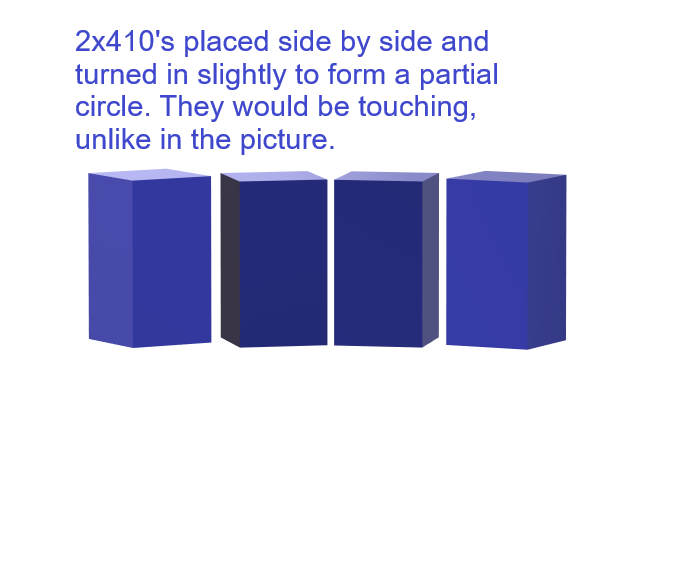
I'm curious about using a combination of 4xTwo10 Barefaced bass cabinets. Stacked in 1 of 3 potentially "alternative" positions…. and what your opinion is on it. I've created and attached 3d models to this post for visual reference. Although not the best quick and dirty effort, they should suffice and serve to demonstrate my purpose.
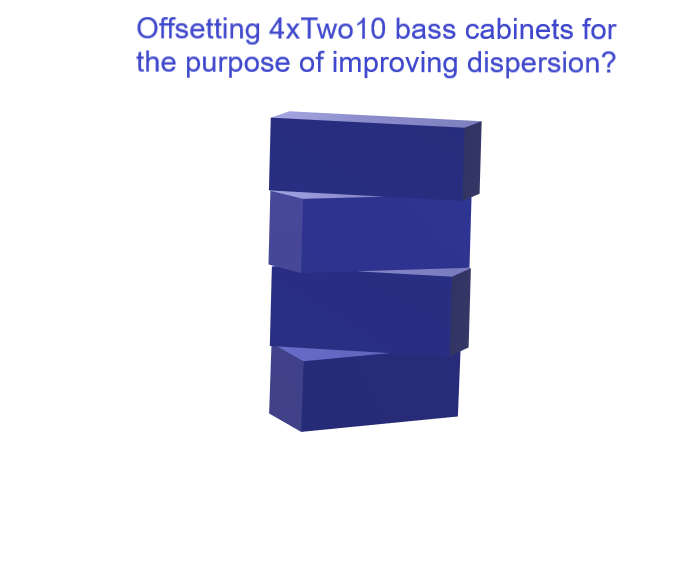
-The first, is an alternating horizontal arrangement. Each consecutive cabinet is slightly turned upon an opposite angle of the one below it. Never mind things being off balance, I have devised a simple way to support the cabinet overhang weight issue.
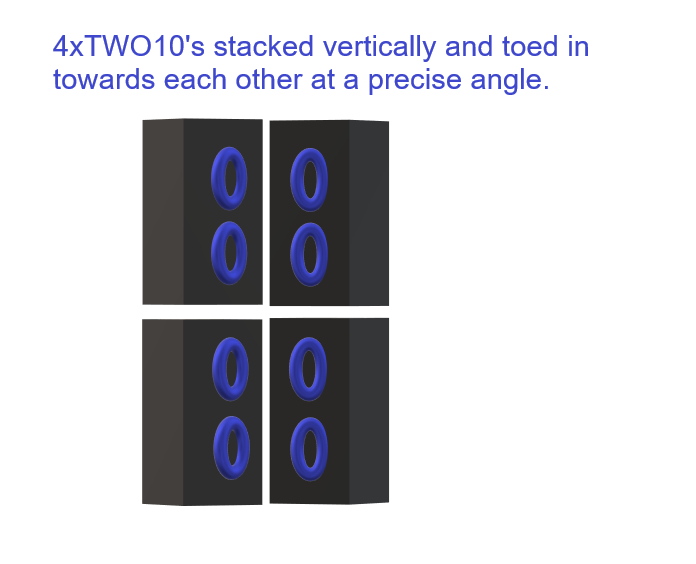
-The second, (and probably the most viable solution) would be to stack the cabinets vertically side by side and two high (total 4 cabinets). Then toe in each stack towards each other at a slight angle to have them firing towards one another for a cross-fire effect. What would be the best angle for this?
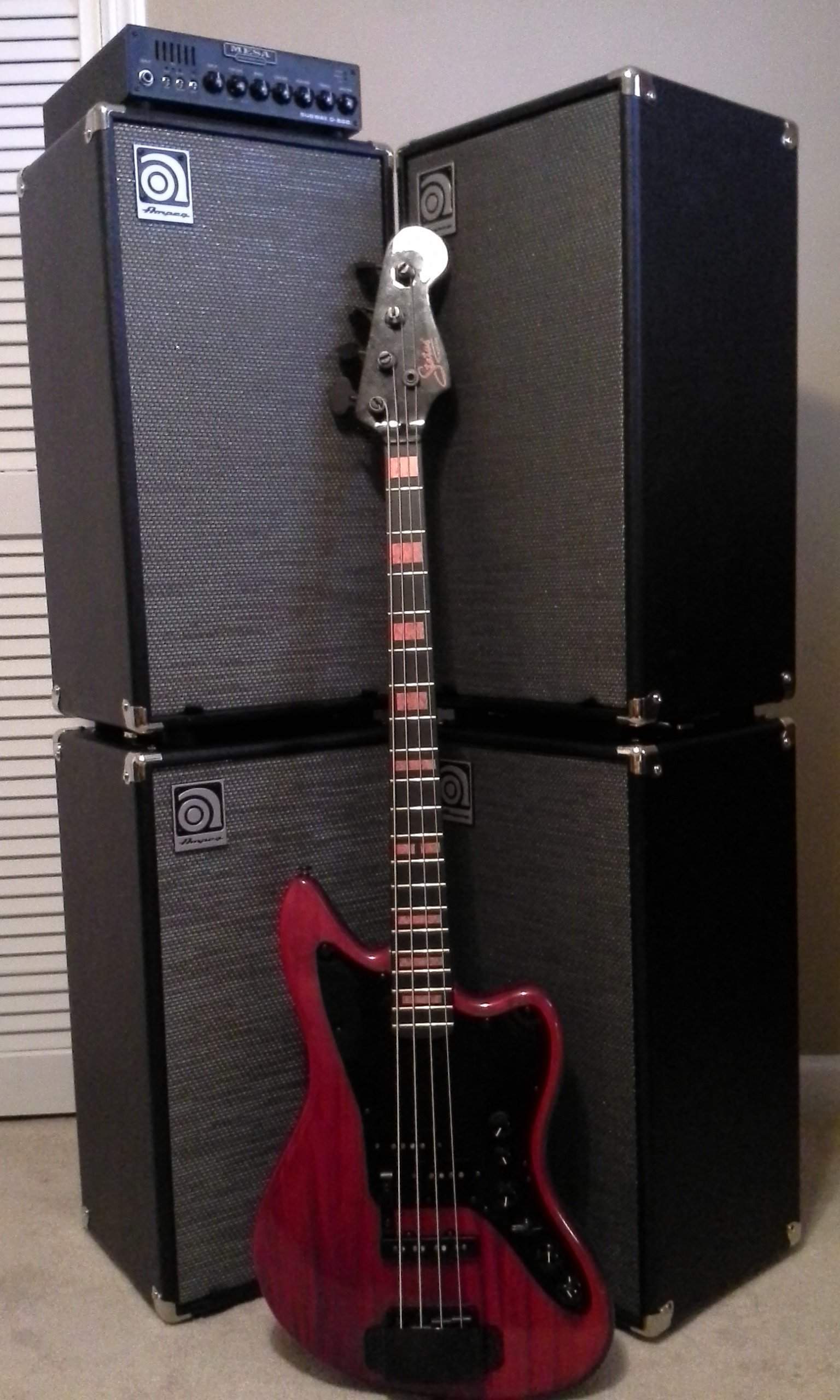
This is what my old rig used to look like.
-The third, each speaker cabinet placed vertically side by side on the floor, then turned at a slight angle into each other to form a partial circle.
-Could any of these arrangements produce better sound or dispersion in a room? Maybe enhance the on stage experience, by allowing farther stage "ear distance to speaker" travel and better off axis hearing?
-Might "different" speaker positioning involving The 4XTwo10 model be better for filling a room with sound null/sans PA support? Or, could this just simply have a detrimental effect? Experiment and find out?
-I'm wondering about your opinions on this topic, as I'm considering purchasing 2 more Two10 cabinets in order to accomplish this endeavor.
-One last curiosity here.
Since the Two10s cabinets are designed with a crossover for a line array effect when placed horizontally.
Would it make sense to place feet on the top of 2 cabinets and flip them with the resonator ports firing up when stacking cabinets vertically side by side. Essentially recreating the line array in a vertical stack position. Then also doing the cross-firing idea with that.
-Or is all of this just an overly complicated, obsessive thought process. When simply stacking 4 cabinets horizontally would be just fine. Do I just need to simplify thing's this way, so I can shut up and play?
Rock on,
J L
I'm curious about using a combination of 4xTwo10 Barefaced bass cabinets. Stacked in 1 of 3 potentially "alternative" positions…. and what your opinion is on it. I've created and attached 3d models to this post for visual reference. Although not the best quick and dirty effort, they should suffice and serve to demonstrate my purpose.
-The first, is an alternating horizontal arrangement. Each consecutive cabinet is slightly turned upon an opposite angle of the one below it. Never mind things being off balance, I have devised a simple way to support the cabinet overhang weight issue.
-The second, (and probably the most viable solution) would be to stack the cabinets vertically side by side and two high (total 4 cabinets). Then toe in each stack towards each other at a slight angle to have them firing towards one another for a cross-fire effect. What would be the best angle for this?
This is what my old rig used to look like.
-The third, each speaker cabinet placed vertically side by side on the floor, then turned at a slight angle into each other to form a partial circle.
-Could any of these arrangements produce better sound or dispersion in a room? Maybe enhance the on stage experience, by allowing farther stage "ear distance to speaker" travel and better off axis hearing?
-Might "different" speaker positioning involving The 4XTwo10 model be better for filling a room with sound null/sans PA support? Or, could this just simply have a detrimental effect? Experiment and find out?
-I'm wondering about your opinions on this topic, as I'm considering purchasing 2 more Two10 cabinets in order to accomplish this endeavor.
-One last curiosity here.
Since the Two10s cabinets are designed with a crossover for a line array effect when placed horizontally.
Would it make sense to place feet on the top of 2 cabinets and flip them with the resonator ports firing up when stacking cabinets vertically side by side. Essentially recreating the line array in a vertical stack position. Then also doing the cross-firing idea with that.
-Or is all of this just an overly complicated, obsessive thought process. When simply stacking 4 cabinets horizontally would be just fine. Do I just need to simplify thing's this way, so I can shut up and play?
Rock on,
J L
Last edited:
Overthinking. Just stack them normally. BF cabs are designed that both drivers handle low end and only one driver handles the top end. Here are no issues in projecting the sound from BF cabs with multiple 10's.
alexclaber
Commercial User
-Or is all of this just an overly complicated, obsessive thought process. When simply stacking 4 cabinets horizontally would be just fine. Do I just need to simplify thing's this way, so I can shut up and play?
This!
 Also, I doubt you'll need four Two10S cabs unless you're very very loud and that four Ampeg 2x10" stack is nowhere near loud/fat/deep enough!
alexclaber
Commercial User
Hi, question for @alexclaber or anyone else that knows about using multiples of these cabs. And/or sonic interactions between speakers angled towards each other. Essentially cross-firing the speaker.
I'm curious about using a combination of 4xTwo10 Barefaced bass cabinets. Stacked in 1 of 3 potentially "alternative" positions…. and what your opinion is on it. I've created and attached 3d models to this post for visual reference. Although not the best quick and dirty effort, they should suffice and serve to demonstrate my purpose.
-The first, is an alternating horizontal arrangement. Each consecutive cabinet is slightly turned upon an opposite angle of the one below it. Never mind things being off balance, I have devised a simple way to support the cabinet overhang weight issue.
View attachment 4639811
-The second, (and probably the most viable solution) would be to stack the cabinets vertically side by side and two high (total 4 cabinets). Then toe in each stack towards each other at a slight angle to have them firing towards one another for a cross-fire effect. What would be the best angle for this?
View attachment 4639812
This is what my old rig used to look like.
View attachment 4639895
-The third, each speaker cabinet placed vertically side by side on the floor, then turned at a slight angle into each other to form a partial circle.
View attachment 4639813
-Could any of these arrangements produce better sound or dispersion in a room? Maybe enhance the on stage experience, by allowing farther stage "ear distance to speaker" travel and better off axis hearing?
-Might "different" speaker positioning involving The 4XTwo10 model be better for filling a room with sound null/sans PA support? Or, could this just simply have a detrimental effect? Experiment and find out?
-I'm wondering about your opinions on this topic, as I'm considering purchasing 2 more Two10 cabinets in order to accomplish this endeavor.
-One last curiosity here.
Since the Two10s cabinets are designed with a crossover for a line array effect when placed horizontally.
Would it make sense to place feet on the top of 2 cabinets and flip them with the resonator ports firing up when stacking cabinets vertically side by side. Essentially recreating the line array in a vertical stack position. Then also doing the cross-firing idea with that.
-Or is all of this just an overly complicated, obsessive thought process. When simply stacking 4 cabinets horizontally would be just fine. Do I just need to simplify thing's this way, so I can shut up and play?
Rock on,
J L
I truly cannot imagine anyone ever requiring that many BF cabs as a single rig.
But I do admire the thought process and it would look pretty badass.
I think a 410+210 would be an ideal modular stack which could handle small, medium, or large venues with appropriate FOH. How often would you need more than an efficient 610 with 1200-1500 watts to hear yourself on stage? Since all six 10's would handle the lows and low mids while a vertical column of three 10's would project upper mids and treble, dispersion should be good. I'd like a stack like that!
I'm curious how well a bright boost in the 7-10kHz region found on a number of amps translates into audible treble extension? I don't go for a sizzly Marcus tone but like the clarity that a good treble extension to about 7kHz provides.
I'm curious how well a bright boost in the 7-10kHz region found on a number of amps translates into audible treble extension? I don't go for a sizzly Marcus tone but like the clarity that a good treble extension to about 7kHz provides.
Last edited:


