• TalkBass has been independent since 1998. Add your voice.
    Create a free account to reply to discussions, view embedded media, and browse with fewer display ads.
    Join freeLog in
    Want zero display ads or expanded classifieds tools? Compare plans.

One More Time: Running Distorted Tones Through a Tweeter

Then what would you recommend for me for a modestly priced DI that I can run between my amp and cab?? The Radial JDX maybe??


The JDX 48 has the same problem except the power limit is 300W. So it probably depends how hard you plan to push the amp. If you are going to push it into total saturation it will probably exceed 300W. If you plan to use mild drive you're probably fine.

From the Radial FAQ

What is the difference between the original Radial JDX™ and the JDX 48?
The new JDX 48 can be phantom powered, is equipped with a low frequency extension and can handle more power.


Some Talkbass users report good results with the JDI and prefer it over the JDX. The JDI has a built in speaker emulator that is designed to sound like a 12" guitar speaker, so it will cut some lows and highs. Also the proper way to use the JDI at speaker level is to connect it in parallel with the speaker instead of running the speaker through it, then engage both the -15dB pad and the speaker emulator. Unfortunately the manual and tech data I have found do not specify the overload voltage limit. Max input is listed at 21dBu which equates to ~9.5W at 8 ohms and ~19W at 4 ohms, so that's obviously not with the device configured for speaker level use. I would suggest contacting the manufacturer on this one as well.
 
For very heavily distorted bass guitar, I don't think you would want tweeters at all because what they would reproduce (if they were sufficient specified to survive) would not be something most players (by far) would find very useful. This is just my opinion, but is seems to hold true in the real world.

As far as voicing an amp, speakers, etc., I generally find it just as easy to rely on experience. Being a FOH guy, I get (or got) to hear a lot of world class bass players and while each is different in their own way, there are plenty of similarities too.


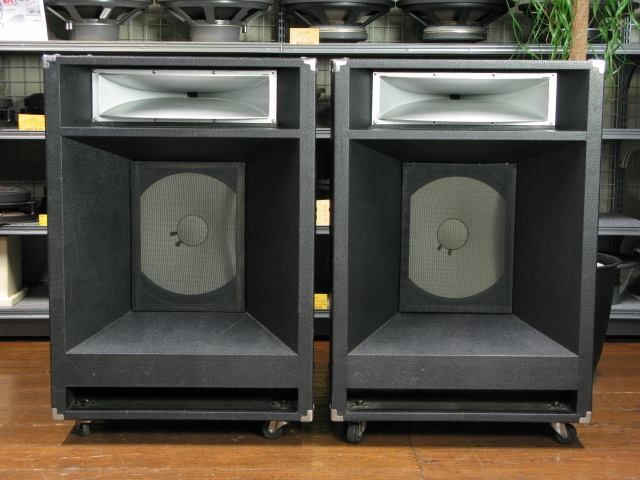
Back in high school, a bass player I knew played in a band that covered Van Halen and similar. One of the guitarist used a pair of these.

918fbf959a50f53f769b3dca04ac2cfd.jpg


I thought it was a bit odd, but it sounded fabulous. He did have to be careful with power levels to avoid frying the compression drivers. I think they were fairly low powered drivers. This was around 1980.

A few years later I used a pair of the same type cabs for a clean sound with my SVT in a big band setting. I did have to dial the horns down considerably, but I thought the rig sounded incredible.
 
The JDX 48 has the same problem except the power limit is 300W. So it probably depends how hard you plan to push the amp. If you are going to push it into total saturation it will probably exceed 300W. If you plan to use mild drive you're probably fine.

From the Radial FAQ

What is the difference between the original Radial JDX™ and the JDX 48?
The new JDX 48 can be phantom powered, is equipped with a low frequency extension and can handle more power.


Some Talkbass users report good results with the JDI and prefer it over the JDX. The JDI has a built in speaker emulator that is designed to sound like a 12" guitar speaker, so it will cut some lows and highs. Also the proper way to use the JDI at speaker level is to connect it in parallel with the speaker instead of running the speaker through it, then engage both the -15dB pad and the speaker emulator. Unfortunately the manual and tech data I have found do not specify the overload voltage limit. Max input is listed at 21dBu which equates to ~9.5W at 8 ohms and ~19W at 4 ohms, so that's obviously not with the device configured for speaker level use. I would suggest contacting the manufacturer on this one as well.


How do you connect it in parallel?


The reason I’d like to run it between my amp and cab is so it mimics mic’ing the cab. I don’t normally pummel the amp. In that, I don’t run it so hot it overdrives or saturates the power section. I probably don’t even run it hot enough to drive the pre tubes. I run it pretty clean but I do in fact run a boosted signal into. I guess insisting on a mic to my cab may be the best way to go for me.


What about something Torpedo makes? Or a Neve RNDI? I wanted an RNDI for a while and kinda just gave up on that though. Would that RNDI work for what I’d want to do running it between the amp and cab or will I again run into the same issue with possibly exceeding power/voltages/wattage?


Thank you
 
Wow, I'm confused by this thread and have never heard any of this before. So if you're overdriving your tube to distortion it's hard on your tweeter or sounds bad? Not to me. Once in a while, I use a little dirt out of a VT deluxe and clang and grind are pretty important to my tone. I like a lot of high end.

No tweeter? I don't run mine full up, but it's an always on thing for me. Never blown a tweeter. And maybe I'm missing the whole thing....maybe I don't understand what is being referred to here as distortion. ???
 
Wow, I'm confused by this thread and have never heard any of this before. So if you're overdriving your tube to distortion it's hard on your tweeter or sounds bad? Not to me. Once in a while, I use a little dirt out of a VT deluxe and clang and grind are pretty important to my tone. I like a lot of high end.

No tweeter? I don't run mine full up, but it's an always on thing for me. Never blown a tweeter. And maybe I'm missing the whole thing....maybe I don't understand what is being referred to here as distortion. ???

It’s not always as pronounced on some amps/cabs and the way you run anything else, like the EQ on your amp or the VT, it def has an impact on all this. Try bumping the treble and gain up on the VT and try turning your horn up around 9 o’clock, but keep your overall volume low on everything. See how your dist sounds then. Just to see what it can sound like. It’s a good learning exp.
 
  • Like
Reactions: klokker
Anybody have an example where the artist went for high end and distortion?
Listen to Steve Albini’s guitar tone with Shellac.

Not sure if he’s using full-range cabs with dirt, but it sure sounds like it!

This is a guy with the audio knowledge to create ANY tone he wants, but he’s making an artistic statement by using an intentionally-abrasive tone.
 
How do you connect it in parallel?


The reason I’d like to run it between my amp and cab is so it mimics mic’ing the cab. I don’t normally pummel the amp. In that, I don’t run it so hot it overdrives or saturates the power section. I probably don’t even run it hot enough to drive the pre tubes. I run it pretty clean but I do in fact run a boosted signal into. I guess insisting on a mic to my cab may be the best way to go for me.


What about something Torpedo makes? Or a Neve RNDI? I wanted an RNDI for a while and kinda just gave up on that though. Would that RNDI work for what I’d want to do running it between the amp and cab or will I again run into the same issue with possibly exceeding power/voltages/wattage?


Thank you


There are a couple of ways you can make the parallel connection. When you use the thru in the DI, it's actually a parallel connection, but the JDI is not rated for high current to pass through the device. If your amp has two speaker outputs, you can connect the speaker to one of the outputs and the DI to the other. Also, if your speaker has parallel inputs or a thru, connect a cable between the amp and speaker, and then connect the DI to the parallel input or thru on the speaker.


I do think running a speaker level DI gets you a bit of the organic interaction that goes on between the amp's output transformer and the speaker. What you don't get is the filtering of the speaker, which is obviously why your are interested in speaker-level speaker sim. My personal preference would be to use a mic, but some audio tech are opposed to this.

I don't know anything about how well it sounds but the Two Notes Torpedo Cab M is rated for an max input of 40dBu. That translates to over 740W at 8 ohms and over 1480W at 4ohms.
Two Note Torpedo CAB M

Here's a thread I believe you have already read Two Note Torpedo CAB M
 
  • Like
Reactions: gregmon79
There are a couple of ways you can make the parallel connection. When you use the thru in the DI, it's actually a parallel connection, but the JDI is not rated for high current to pass through the device. If your amp has two speaker outputs, you can connect the speaker to one of the outputs and the DI to the other. Also, if your speaker has parallel inputs or a thru, connect a cable between the amp and speaker, and then connect the DI to the parallel input or thru on the speaker.


I do think running a speaker level DI gets you a bit of the organic interaction that goes on between the amp's output transformer and the speaker. What you don't get is the filtering of the speaker, which is obviously why your are interested in speaker-level speaker sim. My personal preference would be to use a mic, but some audio tech are opposed to this.

I don't know anything about how well it sounds but the Two Notes Torpedo Cab M is rated for an max input of 40dBu. That translates to over 740W at 8 ohms and over 1480W at 4ohms.
Two Note Torpedo CAB M

Here's a thread I believe you have already read Two Note Torpedo CAB M

Thanks man!! Good info. What about the RNDI?? I think I want that one again actually...
 
  • Like
Reactions: Wasnex
Thanks man!! Good info. What about the RNDI?? I think I want that one again actually...

The Website for the RNDI says it can handle a 1000W amp. The actual spec is +41.5dBu or 92VRMS so you could calculate the actual wattage if you want.

I don't believe the RNDI includes any filtering or speaker SIM capabilities, so I don't think it does what you are asking for...but it is highly regarded.
 
  • Like
Reactions: gregmon79
The Website for the RNDI says it can handle a 1000W amp. The actual spec is +41.5dBu or 92VRMS so you could calculate the actual wattage if you want.

I don't believe the RNDI includes any filtering or speaker SIM capabilities, so I don't think it does what you are asking for...but it is highly regarded.

Thank you much for your feedback. I know you know your stuff when it comes to sound and some of the mathematics of this stuff.
 
  • Like
Reactions: Wasnex