Invalid Link Removed
Citroen DS - 1955
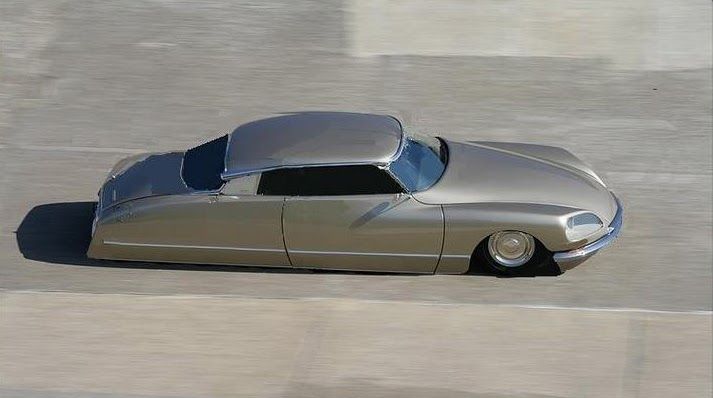
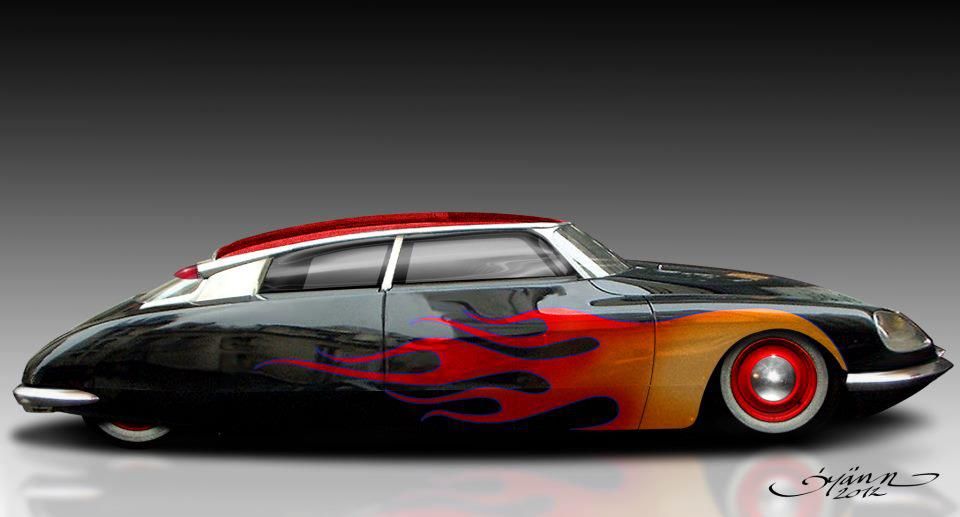
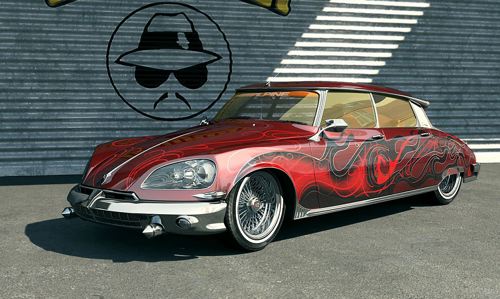
Citroën DS is a front-engine, front-wheel-drive executive car that was manufactured and marketed by the French company Citroën from 1955 to 1975 in sedan, wagon/estate and convertible body configurations. Italian sculptor and industrial designer Flaminio Bertoni and the French aeronautical engineer André Lefèbvre styled and engineered the car. Paul Magès developed the hydropneumatic self-levelling suspension.
Noted for its aerodynamic, futuristic body design and innovative technology, the DS set new standards in ride quality, handling, and braking and was the first mass production car equipped with disc brakes).
Citroën sold 1,455,746 examples, including 1,330,755 built at the manufacturer's Paris Quai André-Citroën production plant.
The DS placed third in the 1999 Car of the Century poll recognizing the world's most influential auto designs and was named the most beautiful car of all time by Classic & Sports Car magazine.
After 18 years of secret development as the successor to the Traction Avant, the DS 19 was introduced on 5 October 1955 at the Paris Motor Show. In the first 15 minutes of the show, 743 orders were taken, and orders for the first day totalled 12,000. During the 10 days of the show, the DS took in 80,000 deposits; a record that stood for over 60 years, until it was eclipsed by the Tesla Model 3 which received 180,000 first day deposits in March 2016.
Contemporary journalists said the DS pushed the envelope in the ride vs. handling compromise possible in a motor vehicle.
To a France still deep in reconstruction after the devastation of World War II, and also building its identity in the post-colonial world, the DS was a symbol of French ingenuity. The DS was distributed to many territories throughout the world.
Turn indicators were mounted in the upper corners of the rear window.
It also posited the nation's relevance in the Space Age, during the global race for technology of the Cold War. Structuralist philosopher Roland Barthes, in an essay about the car, said that it looked as if it had "fallen from the sky". An American advertisement summarised this selling point: "It takes a special person to drive a special car".
Because they were owned by the technologically aggressive tire manufacturer Michelin, Citroën had designed their cars around the technically superior radial tire since 1948, and the DS was no exception.
The car featured a novel hydropneumatic suspension including an automatic leveling system and variable ground clearance, developed in-house by Paul Magès. This suspension allowed the DS to travel quickly on the poor road surfaces common in France.
In addition, the vehicle had power steering and a semi-automatic transmission (the transmission required no clutch pedal, but gears still had to be shifted by hand), though the shift lever controlled a powered hydraulic shift mechanism in place of a mechanical linkage, and a fibreglass roof which lowered the centre of gravity and so reduced weight transfer. Inboard front brakes (as well as independent suspension) reduced unsprung weight. Different front and rear track widths and tyre sizes reduced the unequal tyre loading, which is well known to promote understeer, typical of front-engined and front-wheel drive cars.
As with all French cars, the DS design was affected by the tax horsepower system, which effectively mandated very small engines. Unlike the Traction Avant predecessor, there was no top-of-range model with a powerful six-cylinder engine. Citroën had planned an air-cooled flat-6 engine for the car, but did not have the funds to put the prototype engine into production.
The DS placed third in the 1999 Car of the Century competition, and fifth on Automobile Magazine's "100 Coolest Cars" listing in 2005. It was also named the most beautiful car of all time by Classic & Sports Car magazine after a poll of 20 world-renowned car designers, including Giorgetto Giugiaro, Ian Callum, Roy Axe, Paul Bracq, and Leonardo Fioravanti.
Citroen DS - 1955
Citroën DS is a front-engine, front-wheel-drive executive car that was manufactured and marketed by the French company Citroën from 1955 to 1975 in sedan, wagon/estate and convertible body configurations. Italian sculptor and industrial designer Flaminio Bertoni and the French aeronautical engineer André Lefèbvre styled and engineered the car. Paul Magès developed the hydropneumatic self-levelling suspension.
Noted for its aerodynamic, futuristic body design and innovative technology, the DS set new standards in ride quality, handling, and braking and was the first mass production car equipped with disc brakes).
Citroën sold 1,455,746 examples, including 1,330,755 built at the manufacturer's Paris Quai André-Citroën production plant.
The DS placed third in the 1999 Car of the Century poll recognizing the world's most influential auto designs and was named the most beautiful car of all time by Classic & Sports Car magazine.
After 18 years of secret development as the successor to the Traction Avant, the DS 19 was introduced on 5 October 1955 at the Paris Motor Show. In the first 15 minutes of the show, 743 orders were taken, and orders for the first day totalled 12,000. During the 10 days of the show, the DS took in 80,000 deposits; a record that stood for over 60 years, until it was eclipsed by the Tesla Model 3 which received 180,000 first day deposits in March 2016.
Contemporary journalists said the DS pushed the envelope in the ride vs. handling compromise possible in a motor vehicle.
To a France still deep in reconstruction after the devastation of World War II, and also building its identity in the post-colonial world, the DS was a symbol of French ingenuity. The DS was distributed to many territories throughout the world.
Turn indicators were mounted in the upper corners of the rear window.
It also posited the nation's relevance in the Space Age, during the global race for technology of the Cold War. Structuralist philosopher Roland Barthes, in an essay about the car, said that it looked as if it had "fallen from the sky". An American advertisement summarised this selling point: "It takes a special person to drive a special car".
Because they were owned by the technologically aggressive tire manufacturer Michelin, Citroën had designed their cars around the technically superior radial tire since 1948, and the DS was no exception.
The car featured a novel hydropneumatic suspension including an automatic leveling system and variable ground clearance, developed in-house by Paul Magès. This suspension allowed the DS to travel quickly on the poor road surfaces common in France.
In addition, the vehicle had power steering and a semi-automatic transmission (the transmission required no clutch pedal, but gears still had to be shifted by hand), though the shift lever controlled a powered hydraulic shift mechanism in place of a mechanical linkage, and a fibreglass roof which lowered the centre of gravity and so reduced weight transfer. Inboard front brakes (as well as independent suspension) reduced unsprung weight. Different front and rear track widths and tyre sizes reduced the unequal tyre loading, which is well known to promote understeer, typical of front-engined and front-wheel drive cars.
As with all French cars, the DS design was affected by the tax horsepower system, which effectively mandated very small engines. Unlike the Traction Avant predecessor, there was no top-of-range model with a powerful six-cylinder engine. Citroën had planned an air-cooled flat-6 engine for the car, but did not have the funds to put the prototype engine into production.
The DS placed third in the 1999 Car of the Century competition, and fifth on Automobile Magazine's "100 Coolest Cars" listing in 2005. It was also named the most beautiful car of all time by Classic & Sports Car magazine after a poll of 20 world-renowned car designers, including Giorgetto Giugiaro, Ian Callum, Roy Axe, Paul Bracq, and Leonardo Fioravanti.