• TalkBass has been independent since 1998. Add your voice.
    Create a free account to reply to discussions, view embedded media, and browse with fewer display ads.
    Join freeLog in
    Want zero display ads or expanded classifieds tools? Compare plans.

Preamp + power amp club?

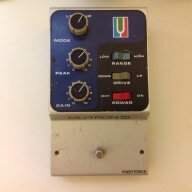
Does anyone know how the new ART Pro Channel II compares to this old "Tube Channel"?

I am assuming you mean the old 1 RU Tube Channel model #259 vs. the 2 RU Pro Channel II. The Pro has many features the #259 doesn't have, most notably an adjustable HPF, bandwidth selectors (narrow/wide) on parametric EQ, more compressor controls, and a nice front panel instrument input.

It is bigger and heavier. :cool:
 

Attachments

  • Like
Reactions: BasturdBlaster
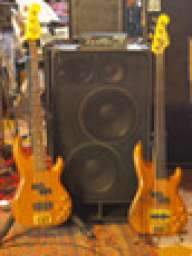
Demeter HPB1 with Crown XTI - 2002 bridged into various cabs. It's shown with a Fearless F110.
IMG_3984.JPG
 
View attachment 1024342
Used the Demeter 400 as a preamp into the Quilter BB800 and it was fantastic.

I'm using the Aguilar tone hammer on my pedal board for my preamp needs. Barring the Demeter pre, how do you like the genzler/quilter combination? Do you still get those room filling lows everyone raves on the arrays about? Any cons? I'm very interested in that exact speaker /amp set up.
 
So crest prolite users, a few questions. I have a 3.0 non dsp. It has two inputs. I noticed that when in parallel mode with one preamp plugged into the A input, both channels seem to get power as indicated by the signal led lighting up both channels on the front display. Now i completed my second fearful 12/6 and decided why not try stereo mode. I thought that would also power channel b, but i guess it doesnt. Channel a worked with the two cabs daisy chained. Do i need to use a second preamp into input b to get power to channel b to use both cabs plugged into both channels in stereo? If that makes any sense
 
So crest prolite users, a few questions. I have a 3.0 non dsp. It has two inputs. I noticed that when in parallel mode with one preamp plugged into the A input, both channels seem to get power as indicated by the signal led lighting up both channels on the front display. Now i completed my second fearful 12/6 and decided why not try stereo mode. I thought that would also power channel b, but i guess it doesnt. Channel a worked with the two cabs daisy chained. Do i need to use a second preamp into input b to get power to channel b to use both cabs plugged into both channels in stereo? If that makes any sense
I believe you can use a single to dual splitter (xlr or 1/4", whatever you use) to send the signal to both channels. That's how used to run my Crown in stereo. Amazon.com: Hosa YXM-121 XLR3F to Dual XLR3M Y Cable, 6 inch: Musical Instruments
 
As an Amazon Associate, TalkBass may receive commissions from qualifying purchases made via links on this site.
So crest prolite users, a few questions. I have a 3.0 non dsp. It has two inputs. I noticed that when in parallel mode with one preamp plugged into the A input, both channels seem to get power as indicated by the signal led lighting up both channels on the front display. Now i completed my second fearful 12/6 and decided why not try stereo mode. I thought that would also power channel b, but i guess it doesnt. Channel a worked with the two cabs daisy chained. Do i need to use a second preamp into input b to get power to channel b to use both cabs plugged into both channels in stereo? If that makes any sense
Stereo Mode needs an input in both channels. Parallel mode (or Input Y) is your best bet. That signal will be sent to both outputs. All is needed is a single input. Plug your second cabinet in the second output. You will have individual volume control over each cab. You would use a Y cable if the amp didn't have Parallel mode.
 
  • Like
Reactions: Jim Carr
Stereo Mode needs an input in both channels. Parallel mode (or Input Y) is your best bet. That signal will be sent to both outputs. All is needed is a single input. Plug your second cabinet in the second output. You will have individual volume control over each cab. You would use a Y cable if the amp didn't have Parallel mode.
This is correct. I run the 3.0 into two 4 ohm Berg cabs in parallel mode with one input from a Demeter VTBP-201. Works as advertised.
 
  • Like
Reactions: Jim Carr
Stereo Mode needs an input in both channels. Parallel mode (or Input Y) is your best bet. That signal will be sent to both outputs. All is needed is a single input. Plug your second cabinet in the second output. You will have individual volume control over each cab. You would use a Y cable if the amp didn't have Parallel mode.
This is correct. I run the 3.0 into two 4 ohm Berg cabs in parallel mode with one input from a Demeter VTBP-201. Works as advertised.
This is one of the reasons I chose the Crest. No Y cable needed. Just use parallel mode.
 
  • Like
Reactions: Jim Carr
I'm using the Aguilar tone hammer on my pedal board for my preamp needs. Barring the Demeter pre, how do you like the genzler/quilter combination? Do you still get those room filling lows everyone raves on the arrays about? Any cons? I'm very interested in that exact speaker /amp set up.
The lows are there. There is a certain tight sweetness with this set up while keeping the fullness. The quilter and the arrays on their own are pretty good though..no loss in bottom fullness at all..do recommend.
 
  • Like
Reactions: mg15
So stereo ouput needs stereo input, makes sense. What does the "stereo" mode change when switched from parallel, just individual channel volume control?

Not exactly.

If you use stereo mode, and only connect an input to channel A, then only channel A will need a speaker. Channel B will not and can not be used as it has no input.

Parallel mode uses both sides (A & B channels) and drives them with the same single input. Naturally, you will need a cabinet for each channel.

Parallel mode is just a way to send a single input to both channels. Stereo mode requires a separate input for each channel. In stereo mode, it is possible to drive your bass cab with one channel, and then run say a keyboard or vocal monitor from the PA mixer, i.e., anything, at the appropriate input voltage level through the second channel to another suitable, perhaps very different, type cabinet.

Bridge mode adds both channels together into a single output.

Just be sure your Crossover Mode switch is in the Full Range position.
 

Attachments

Last edited: