

Enjoy the benefits of a premium membership!
Upgrade Account
-
TalkBass has been independent since 1998. Add your voice.
Create a free account to reply to discussions, view embedded media, and browse with fewer display ads.
Join free Log in
Want zero display ads or expanded classifieds tools? Compare plans.
You are using an out of date browser. It may not display this or other websites correctly.
You should upgrade or use an alternative browser.
You should upgrade or use an alternative browser.
Rattle Can Refinish Club
- Thread starter redlikejazz
- Start date
-
- Tags
- club
More options
Who Replied?
Crown Royal Purple from ReRanch..waiting for it to gas off before wet sanding and buffing.

Cheers.
Cheers.


You must be rockin' quite a buzz between the Crown Royal and the paint fumes. 
Great color. Is that a custom or an Ibanez Destroyer?
Great color. Is that a custom or an Ibanez Destroyer?
Crown Royal Purple from ReRanch..waiting for it to gas off before wet sanding and buffing.

Cheers.
You must be rockin' quite a buzz between the Crown Royal and the paint fumes.
Great color. Is that a custom or an Ibanez Destroyer?
Hey Winston...she's all Warmoth.Iceman.
Cheers.

My entry to the rattle can paint club.
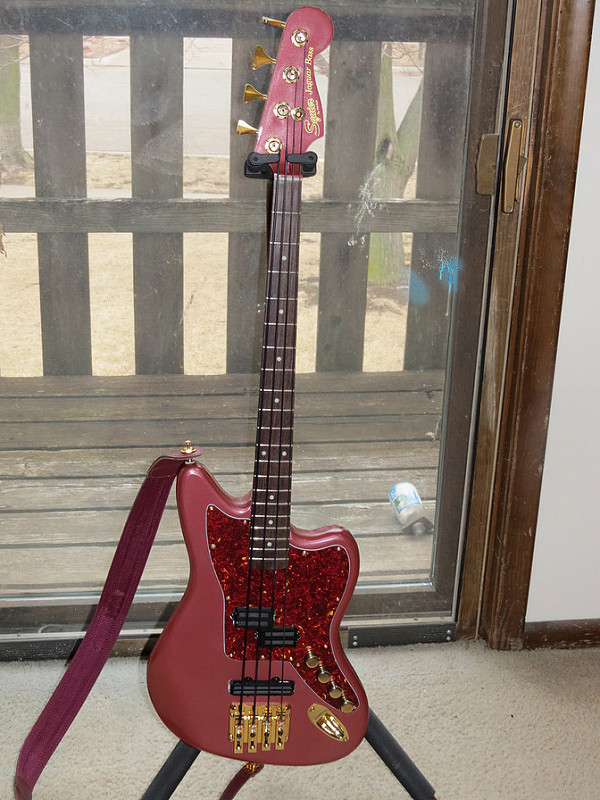
That's awesome. Where did you get a Squier Jaguar decal?

Thanks, it came out very good and sounds better than it looks.
Link Removed
The quality of their decals is second to none. I've used them for a few decals and they all were perfect. My luthier said they were the bet quality he's ever seen.
Link Removed
The quality of their decals is second to none. I've used them for a few decals and they all were perfect. My luthier said they were the bet quality he's ever seen.



Hey KRYLON users. Can you tell me if these products are compatible with each other? I want to refinish this lefty P-bass Special. Was looking for Daphne blue or close to it...how does the Blue Ocean Breeze compare? Seems like it would be nice color for a refinish. If the primer and paint are compatible but the clear coat is not, what brand is recommended? Any tips or suggestions?
so does primer replace grain filling?
so does primer replace grain filling?
I sent Reranch pics of this bass and asked if this bass was ready for priming and their answer was yes. This bass was not taken down to bare wood so grain filling is not necessary. Originally this was a sunburst and the top coats were taken down to the golden finish (not bare wood; although there are a few places where the bare wood was sanded to). Sunburst is one of the few color choices that lefty models come in and so I wanted to customize this bass a bit with an atypical lefty color option.
So, can anyone tell me about the Krylon products listed above in my last post with pics...? Are these compatible?
Attachments

Danelectro Right to Lefty Conversion.
Nice job! I'm a lefty too!

Well, it's a guitar, but it was a rough top natural Gibson BFG and now it's a sanded top, brown stained and rattle canned lacquer BFG. I have a P style bass I need to finish but have been lazy, will be a solid color. more than likely blue.
[Invalid or Expired Link Removed]
[Invalid or Expired Link Removed]
I'm currently finishing up a bass with rattle-can clear lacquer. What is a decent cure time for the lacquer and is there anything else (wax?) to apply to the lacquer? Thanks.

Well, it's a guitar, but it was a rough top natural Gibson BFG and now it's a sanded top, brown stained and rattle canned lacquer BFG. I have a P style bass I need to finish but have been lazy, will be a solid color. more than likely blue.
[Invalid or Expired Link Removed]
That's awesome. Much nicer looking than the original finish!

I'm currently finishing up a bass with rattle-can clear lacquer. What is a decent cure time for the lacquer and is there anything else (wax?) to apply to the lacquer? Thanks.
So Lacquer does not cure technically, the solvents outgas of the finish and that continues to happen for a very long time. Most guys say to keep your guitar hanging and drying for at least 30 days, depending on what Lacquer you used and how the drying is going in your area. Two indicators would be 1) when you can no longer smell the Nitro in the finish and 2) when it is hard enough to prevent being dented by your finger nail (in a non-conspicuous area).
Once hard, then comes wetsanding with several progressivly finer grits of sandpaper: 800, 1000, 1500, 2000. You want to keep sanding with 800 grit til all orange peel is gone (small bumps) and each successive grit til the scratches from the previous grit cannot be seen.
Then comes polishing. Best method I have used is using and orbital polisher:
3M Perfect It II Rubbing Compound #39002
Followed by:
3M Finesse It Finishing Machine Polish #39003
Finished off with:
3M Imperial Hand Glaze #39007
So Lacquer does not cure technically, the solvents outgas of the finish and that continues to happen for a very long time. Most guys say to keep your guitar hanging and drying for at least 30 days, depending on what Lacquer you used and how the drying is going in your area. Two indicators would be 1) when you can no longer smell the Nitro in the finish and 2) when it is hard enough to prevent being dented by your finger nail (in a non-conspicuous area).
Once hard, then comes wetsanding with several progressivly finer grits of sandpaper: 800, 1000, 1500, 2000. You want to keep sanding with 800 grit til all orange peel is gone (small bumps) and each successive grit til the scratches from the previous grit cannot be seen.
Then comes polishing. Best method I have used is using and orbital polisher:
3M Perfect It II Rubbing Compound #39002
Followed by:
3M Finesse It Finishing Machine Polish #39003
Finished off with:
3M Imperial Hand Glaze #39007
Wow! I had no idea it required that much follow-up after the lacquer. Thanks for the response kbakerde. WW
That's awesome. Much nicer looking than the original finish!
Thanks! The BFG (Barely Finished Guitar) had some from the factory rough spots on it, so when I first finished it the guitar was too clean, and it wasn't until I looked at pictures that I figured out why. I went after the edges and semi-faux binding sanded it unevenly and clear lacquered it again, and it fit the instrument much better. Go figure.
Oh no, I may draw attention from the anti-relic zealots!


OK, so this may or may not be the right place to ask these questions, and some of them may have already been answered, but here we go…
I’m in the finishing process of a bass I’m rebuilding. For those interested, that thread is here http://www.talkbass.com/forum/f57/p-bass-build-rebuild-950513/
I bought all the nitro paint & clear from reranch in hopes of having good chemical compatibility (1 can primer, 1 can color & 2 cans clear). I also bought the sand paper supplies including grits 400, 600, 800, 1000, 1200, 1500 & 2000.
I have now sprayed my first couple coats of primer, and have found a few small flaws that I’ve had to go back and touch up, and I’ll be likely spraying my last coat of primer today.
Questions:
Dry time, how long before the primer is dry enough to start spraying color?
Do I sand between the primer and color coat? If so, what grit of sand paper?
How long before the color coat is dry enough to recoat?
Do I sand between color coats? Again, what grit paper?
How long before the color coat is dry enough to spray clear?
Do I sand between color & clear? Grit?
And lastly, do I sand between coats of clear? Every coat? or just certain ones? Grit?
What's the best technique for sanding in and around the "horns"?
I know these questions make me appear to be a “noob”….well let’s be honest…I AM (when it comes to painting basses).
I thought about starting a thread over on the reranch forum, but after reading all the threads here, and the knowledge I’ve gained from them…I think I’ll just stay over here.
I’m in the finishing process of a bass I’m rebuilding. For those interested, that thread is here http://www.talkbass.com/forum/f57/p-bass-build-rebuild-950513/
I bought all the nitro paint & clear from reranch in hopes of having good chemical compatibility (1 can primer, 1 can color & 2 cans clear). I also bought the sand paper supplies including grits 400, 600, 800, 1000, 1200, 1500 & 2000.
I have now sprayed my first couple coats of primer, and have found a few small flaws that I’ve had to go back and touch up, and I’ll be likely spraying my last coat of primer today.
Questions:
Dry time, how long before the primer is dry enough to start spraying color?
Do I sand between the primer and color coat? If so, what grit of sand paper?
How long before the color coat is dry enough to recoat?
Do I sand between color coats? Again, what grit paper?
How long before the color coat is dry enough to spray clear?
Do I sand between color & clear? Grit?
And lastly, do I sand between coats of clear? Every coat? or just certain ones? Grit?
What's the best technique for sanding in and around the "horns"?
I know these questions make me appear to be a “noob”….well let’s be honest…I AM (when it comes to painting basses).
I thought about starting a thread over on the reranch forum, but after reading all the threads here, and the knowledge I’ve gained from them…I think I’ll just stay over here.

In my experience, nitro is almost dry as it leaves the gun, so extended drying times aren't necessary.
If you can touch it and leave no marks in it or getting your finger dirty, then it's OK to apply the next coat.
Remember the nitro will do some re-melting into the previous coat.
If you can touch it and leave no marks in it or getting your finger dirty, then it's OK to apply the next coat.
Remember the nitro will do some re-melting into the previous coat.


