
Ric5
Inactive
- Jan 29, 2008
- 29,772
- 30,452
- Disclosures
- I like 5, 8, 10, and 12 string basses
Well let's have a listen then.....
When you listen to the isolated bass it may surprise some how much different it is from the guitar line.

TalkBass has been independent since 1998. Add your voice.
Create a free account to reply to discussions, view embedded media, and browse with fewer display ads.
Join free Log in
Want zero display ads or expanded classifieds tools? Compare plans.
Well let's have a listen then.....
Are you serious? A pedal held throughout a phrase is contrapuntal? This is supposed to debunk my description of classic rock as texturally homophonic? It doesn't get more homophonic than that!When you listen to the isolated bass it may surprise some how much different it is from the guitar line.
Are you serious? A pedal held throughout a phrase is contrapuntal? This is supposed to debunk my description of classic rock as texturally homophonic? It doesn't get more homophonic than that!
Look at what I wrote earlier about runs & filling material--doesnt make rock any less HOMOPHONIC!Except there's a lot more to the composition than the main hook, isn't there?
Did you listen to the posted video? He's doing fills and runs all over the place, completely independent of the guitars, keys, and vocals.
Look at what I wrote earlier about runs & filling material--doesnt make rock any less HOMOPHONIC!
Are you serious? A pedal held throughout a phrase is contrapuntal? This is supposed to debunk my description of classic rock as texturally homophonic? It doesn't get more homophonic than that!

Are we even talking about the same thing???
And that is a rhetorical question that does not require another post about contrapuntal homophonic bass lines.
What I was talking about is the bass line does not mimic the guitar line note for note.
Yes this can be easily understood without hyperbolic polysyllabic rhetoric.
There are widely varying levels of homophony & polyphony. Homophony is usually defined as melody over chordal accompaniment. In theory that includes Show tunes that actually built the foundation if the big band era. However, in Swing instrumental pieces these tunes are highly syncopated and the walking bass lines become fluid & enough by contrast to be regarded as MORE polyphonic than your run of the mill Broadway show tune & way more polyphonic than Classic rock.I won't argue against the fact that tons of rock music is homophonic, but as I and numerous others have pointed out, "Smoke on the Water" is a very bad example. A stationary pedal tone against a moving melody is actually the basis of early polyphony. In this case, the bass staying on a low G forms different harmonies with the movement of the guitars and keys, and in doing so, bolsters the impact of the chords at the end of the phrase when the bass finally moves to C and then Bb. And during the chorus, while the bass and keys play similar parts, they aren't even really close to the guitar line at all.
Any time you have musical lines deviating from each other, that is polyphony.
Much better examples would have been "Whole Lotta Love" or "Heartbreaker" by Led Zeppelin. Or "Iron Man" by Black Sabbath.


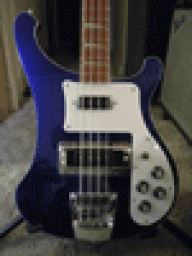
So. Rickenbacker's secret. Where were we?...
Indeed. I'm coming at this from a music history perspective.I dunno what they were teaching you upstairs in the composition department, but in the sub-basement where they kept the electronic music department we learned that homophony (from the Greek homos - the same - and phone - sound - i.e. making the same sound) is when all the voices in a phrase are articulating the same notes - the EXACT same notes (like the earliest examples of Gregorian chant), and polyphony is when the voices play different notes. Note that the terms purely describe characteristics of pitch and tonality - rhythmic emphasis, variation, or lack thereof has NOTHING to do with the classification.
I see little value in ranking polyphonic music in terms of its homophonic-"ness."
Going back to the actual topic, I totally agree on this.The secret of Rickenbacker tone ...
1 - pickup positions
2 - maple construction
3 - single coil pickups
4 - a finished bubinga fretboard
These and other factors give the Ric a distinctive high mid bark.
But a RIC sounds like a RIC....unplugged!Indeed. I'm coming at this from a music history perspective.
In fact, polyphony was created by taking older, homophonic chants, and stretching out each note of the old chant enough that you could fit a whole phrase, sung by a separate voice, above it, with the old chant's line acting basically as a pedal tone. The statement that a pedal line doesn't constitute polyphony is simply incorrect.
And, as you mention, polyphony/homophony describe harmony, not rhythm. The rhythm of a piece has nothing to do with whether it is homophonic or polyphonic.
Going back to the actual topic, I totally agree on this.
The pickup positions used by Rickenbacker play a huge part in how these basses sound. I haven't seen those positions used on very many other instruments, which why there's the idea that nothing else sounds like them. Most other manufacturers use pickup positions more similar to the Fender ones.
There's nothing mystical about it, it's just these basses are built with a combination of factors not seen in many other basses. If you build a bass out of hard maple, use something like finished bubinga for the fretboard, and put single coil pickups in the same positions Rickenbacker uses, you'll get something that sounds very much like a Rickenbacker. As you've so often demonstrated.


