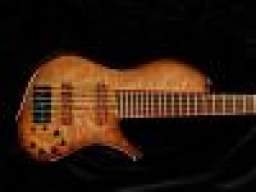
So right before heading out on vacation this weekend, Sheldon sent out a new set of pictures. These ones continue the body carving.
-First off, you may note that the routing for the neck joint is complete as are the pickup routes (before it was just the topwood that had been excised and retained). Also, the routing for the bridge 'sub plate' has been done.
Invalid Link Removed
See? Now it's like a bass, not a bass-shaped block of wood! Now the bridge sub plate gets through body bolts, which explains why you see 4 drill holes rather than 5, the number of strings. The individual bridge pieces will mount to the top of the aluminum plate.
Also note, that unlike some of the basses shown from this batch, mine has a less complex control layout. The three switches toward the bottom of the lower bout are for each pickups' parallel/series internal switching. The third will be a passive/active switch. The mounting holes above those will be for the tone controls and the 4 way switch.
Because this bass is spec'd with an OBP-1, it means that there's no mid control, only bass and treble. This was my choice as well as a shop suggestion. As my main gigs are reggae, I'm looking for warm smooth lows. The OBP-1 is perfect. I usually roll off the highs and possibly some mids, so instead of the usual boost-only treble control, the spec is for Sheldon's proprietary hybrid treble control. It rolls off the treble in one direction and boosts treble in the other. No need to a VTC style second roll off! Back when I ordered this bass, the Shop was just playing with this idea. I'm glad it worked out!
If you haven't seen it, the switching on most Dingwalls is a 4 way bridge/series/parallel/neck switch. It doesn't have some of the tonal trade offs that multi volume or blend circuits have, and after having one on my AB, I can attest to the fact that it works wonderfully and I don't miss the Jazz style setup in the least.
That one little hole out there in deep space I believe to be the volume's home. We all need volume!