• TalkBass has been independent since 1998. Add your voice.
    Create a free account to reply to discussions, view embedded media, and browse with fewer display ads.
    Join freeLog in
    Want zero display ads or expanded classifieds tools? Compare plans.

Short-scale basses are no substitute for long-scale basses?

Can a short-scale bass substitute for a long-scale bass?

  • Yes

    Votes: 322 83.6%
  • No

    Votes: 63 16.4%

  • Total voters
    385
  • Poll closed .
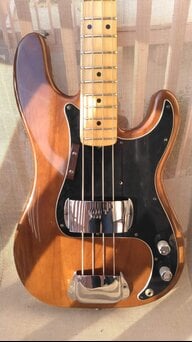
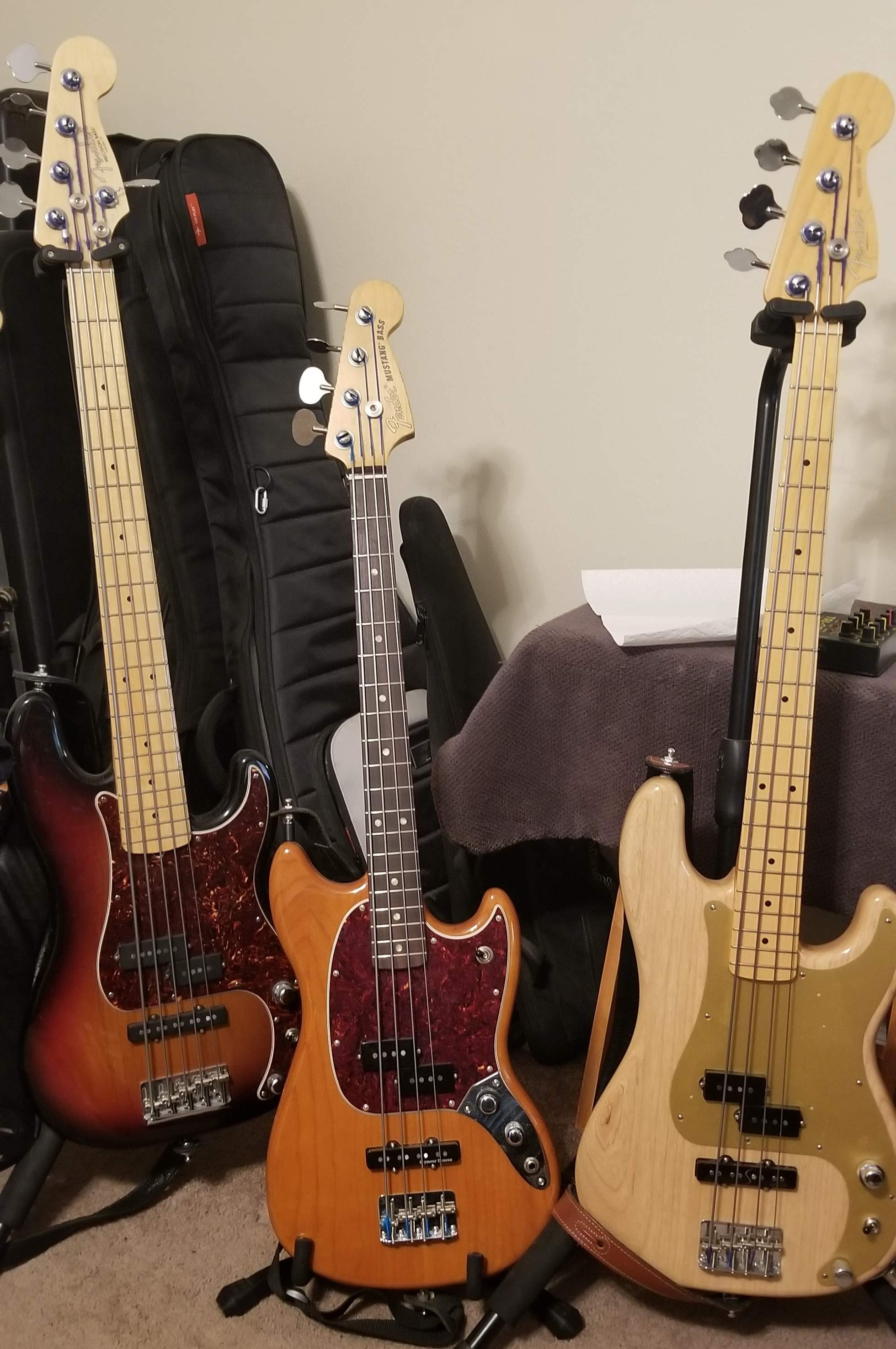
I literally turned around and took this pic, seeing this thread. No glamour pic, this!
I have the same issue with my thumbs. So, same solution. Same configuration on all three. PJ with Hum Cancelling Jazz, 3 way switch, Chromes. I've tried three necks on the Mustang (albeit for feel mostly) 5 different pickups, and 3 sets of strings. Action high, action low. It's still in the rotation. It sounds like a bass, and plays true and easy. But it does NOT sound like the other two. Of course you shouldn't expect it to. I'm keeping it. The lower tension is certainly easier on my hands. And nobody but me will know the difference.

But, I voted no.
20211121_220618.jpg
 
Last edited:
Fender Player series Mustang, Sterling Sting Ray, G&L Tribute Fallout, Squier Jaguar, Epiphone EB-0, Sire U5, Guild Starfire. All stringed with flatwounds.

All great instrments in their own right but just don't deliver what my Squier (also w/ flatwounds) delivers through the same amp (Orange Crush 50).

You should try:
1) Epiphone Woody Allen
B) Ibanez TMB-30 Talman
and thirdly, the $299 Gretsch;)

I would go into battle with any of them. Maybe not straight out of the box, but that's true of nearly all instruments.
 
Last edited:
Because I have a somewhat painful degenerative osteoarthritis at the base of my left thumb I've been playing bass mostly with short-scale basses. However, when comparing the "sound" of my rather ordinary Squier PJ long-scale bass against any of the other half dozen or so short-scale basses of various makes and models I've aquired and played it seems that it's becoming clear to me that any short-scale bass CANNOT substitute for the "sound" of a long-scale bass. What are your thoughts / insights / comments?
these guys would probably disagree with you

 
Each bass type has its own sound,non is made to substitute another.
The short scale is not some kind of bass for the handicapped,its just another bass.
If you like the full scale better its your decision.
I have a mustang and a SG gibson I dont miss the full scale and no one I played with has had any problem with it,actually they dont care as long the notes are right.
 
Hmmmm, no, as sort of a purist, with strictly analog ears, I don't think that EQ, analog or digital, can make up for any fundamental deficiency, sorry. It can enhance, yes, but not replace.
Speaking of fundamentals, if I'm not mistaken, shorter scales have less overtones and you hear more of the fundamental. Perhaps you prefer more harmonic content. So then, that may be what you are missing with the short scale.
 
  • Like
Reactions: wiscoaster
A bass I haven't seen mentioned here is the Gibson Les Paul Triumph or "recording bass." I have one of the second version ones with the built-in transformer, but I have added a Jensen transformer in a box with input and output jacks to substitute. To me the clarity and richness of tone from those pickups (while still sounding 'vintage') is amazing. The sustain profile is still somewhat short-scale-like, but with newish strings (half-round on this one for me) I think it has lots of sustain. It weighs 11.5 pounds which is nuts for a short scale but it feels very comfy to me on a good wide strap- all the weight is in the body. Obviously it is its own thing but I think it comes closer to 'substitute for long scale' than other 30" basses I've played.
 
  • Like
Reactions: leftybass54
I have a somewhat painful degenerative osteoarthritis at the base of my left thumb. ...it seems that it's becoming clear to me that any short-scale bass CANNOT substitute for the "sound" of a long-scale bass. What are your thoughts / insights / comments?

It's your thumb and they're your ears. It may very well be that you'll have to choose whether to be happy playing a bass that doesn't hurt v. playing one that sounds the way you want it to.
 
I had a short scale thing a few years ago (sold my almost perfect road worn P for a modded musicamaster with lace sensors). But, because I mostly play latin music, I bought a 5 string Stingray HH in 2019. Comparing both I can say that the Ray sounds bigger with more highs and lows (the preamp doesn´t hurt), the shortscale has a more "compact" and narrow sound. Also shortscales need to be played a bit more carefully; due to the lower tension if you pluck the string hard they tend to bottom out and fret out.
I still have a shortscale in my quiver, they have a different voice and strung with flats they are great for classic rock and pop. I had a wedding in Tijuana yesterday and I didn´t want to risk my stingray bass so I brought my beater Memphis shortscale P copy strung with Chromes. Nobody complained about it´s sound. I even got compliments from my singer!
 
Because I have a somewhat painful degenerative osteoarthritis at the base of my left thumb I've been playing bass mostly with short-scale basses. However, when comparing the "sound" of my rather ordinary Squier PJ long-scale bass against any of the other half dozen or so short-scale basses of various makes and models I've aquired and played it seems that it's becoming clear to me that any short-scale bass CANNOT substitute for the "sound" of a long-scale bass. What are your thoughts / insights / comments?

You asked, and answered, your own question.

Well done! :thumbsup:;):bassist:
 
  • Like
Reactions: thunesBARROW
Use a capo on your squier.
Tune dgcf and capo on 2nd fret.
Instant short scale, minimal cost and you get the closest possible to what you already have.
If it works you can stay this way or look for a short scale with confidence that it can work.
The fret markers would throw me off.
 
  • Like
Reactions: Jazz Ad

Latest posts