

Enjoy the benefits of a premium membership!
Upgrade Account
-
TalkBass has been independent since 1998. Add your voice.
Create a free account to reply to discussions, view embedded media, and browse with fewer display ads.
Join free Log in
Want zero display ads or expanded classifieds tools? Compare plans.
You are using an out of date browser. It may not display this or other websites correctly.
You should upgrade or use an alternative browser.
You should upgrade or use an alternative browser.
Short scale semi-hollow body build
- Thread starter Jisch
- Start date
More options
Who Replied?
Generally speaking I agree with you, I have two basses with ghost piezo bridges. One of them only has the piezo, it sounds great, but I'm not sure I couldn't replicate this sound with mag pickups - that is if you heard it I'm not sure you'd say "that's piezo". The other one has both mag and piezo and I much prefer the sound of the mag pickup solo'ed.Furthermore, I got my first bass with a piezo bridge last year, and honestly I wouldn't miss it if I didn't have it.
Generally speaking I agree with you, I have two basses with ghost piezo bridges. One of them only has the piezo, it sounds great, but I'm not sure I couldn't replicate this sound with mag pickups - that is if you heard it I'm not sure you'd say "that's piezo". The other one has both mag and piezo and I much prefer the sound of the mag pickup solo'ed.
On my Supro, different combos of the piezo and mag pickups can certainly be used for some interesting tones that otherwise might be hard to achieve, but ultimately I find it's more of a gimmick than anything else... possibly useful in the studio, but in a live context I don't think anyone would ever notice the difference, or care enough to say "WOW that piezo bridge really made your tone shine!".
Know what I mean? Like, it's fine having it there, it's no burden, but if I'd paid extra for it I might have been disappointed.
Last edited:
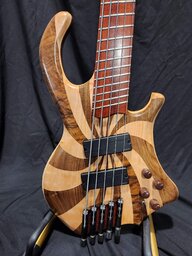
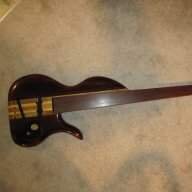
Yes I have looked at that particular piezo bridge and they are low end of the scale. I suspect the buffer is not a high end unit either. Piezos from Graphtech or RMC will give best results and I will be using Richter piezo preamps. I am also checking out Schattens piezo buffer but may prefer the Richter due to invividual string volume control for balanced sound. Piezos give flat response over a wider range then available with any mag pickup. So to get a particular sound the signal needs to be eq'ed. Most onboard or amp based EQ systems are not enough. I am thinking a programmable parmetric eq and graphic multichannel. and once a sound is dialed in it can be stored and recalled anytime. Having said that I am not having sounds issues with the last five string I built (pictured) expect for a preamp with too much gain as the graphtech piezos overpower it.Supro Huntington II
View attachment 3240028
Yes I have looked at that particular piezo bridge and they are low end of the scale. I suspect the buffer is not a high end unit either. Piezos from Graphtech or RMC will give best results and I will be using Richter piezo preamps. I am also checking out Schattens piezo buffer but may prefer the Richter due to invividual string volume control for balanced sound. Piezos give flat response over a wider range then available with any mag pickup. So to get a particular sound the signal needs to be eq'ed. Most onboard or amp based EQ systems are not enough. I am thinking a programmable parmetric eq and graphic multichannel. and once a sound is dialed in it can be stored and recalled anytime. Having said that I am not having sounds issues with the last five string I built (pictured) expect for a preamp with too much gain as the graphtech piezos overpower it.
Thanks for the insight. I'm admittedly just flailing around in the dark when it comes to piezo. But on that note... sometimes beauty is just in the ear of the beholder.

- Apr 18, 2008
- 16,021
- 1
- 31,743
- Disclosures
- I'm highly opinionated and extremely self-assured
I have a bit of experience with piezo; here are my cheapskate views:

- The piezo element itself need not be expensive. Lots of DIYers have had great success with Radio Shack buzzers, and even piezos made for instruments can be found for less than $20. I’ll be using an Artec on my winter build.
- An impedance matching buffer is key. I like the Link Removed
- Once you have the buffer in place, you can then route that signal into any normal preamp, onboard or outboard, just as you would a magnetic pickup.
- Depending upon placement and physical isolation, a piezo can pick up body handling noise/bumps and bonks/etc. I’ve actually used this to my advantage, pounding out a drum pattern in a verse then switching back to notes for the chorus.


Oy!.....You do the bass building and I'LL do the derailing.....Ok???I have a bit of experience with piezo; here are my cheapskate views:
Dang it, I’m derailing again!
- The piezo element itself need not be expensive. Lots of DIYers have had great success with Radio Shack buzzers, and even piezos made for instruments can be found for less than $20. I’ll be using an Artec on my winter build.
- An impedance matching buffer is key. I like the Link Removed
- Once you have the buffer in place, you can then route that signal into any normal preamp, onboard or outboard, just as you would a magnetic pickup.
- Depending upon placement and physical isolation, a piezo can pick up body handling noise/bumps and bonks/etc. I’ve actually used this to my advantage, pounding out a drum pattern in a verse then switching back to notes for the chorus.


Since I'm considering piezos, this is not even a derail, you guys need to try harder. :-D
I'll take that as a challenge!.....Since I'm considering piezos, this is not even a derail, you guys need to try harder. :-D

I modded a Schaller bridge back in 1985 with elements rifled from an acoustic piezo saddle pickup (they actually have six little piezo elements in them) and they worked fine with a preamp I built but had some of the handling issues you mention. Presently I have the graphtech saddles in an inexpensive five string bridge (two reasons: they fit with one small hole drilled through for the wire and the bridge gives me the narrow spacing I want) and the natural damping of the graphtech material they imbed the elements into virtually eliminated that problem. If I smack right on top of the saddle yes there will be noise. Smack your string off your mag pickup! Schatten sells their "micropre" buffer for around $40 give or take so its a viable option. I have one I am trying to get around to wire up to my five string as the installed buffer was for undersaddle PU and the graphtechs overpower it. Maybe I'll do that and check it out today. No promises. If it works they also have a two channel model that may be useful as I have found "B" strings lack the output of the others so the "B" could have its own volume. That consideration is why I forked out the dough for a Richter six channel buffer for my upcoming 6 string.
Last edited:
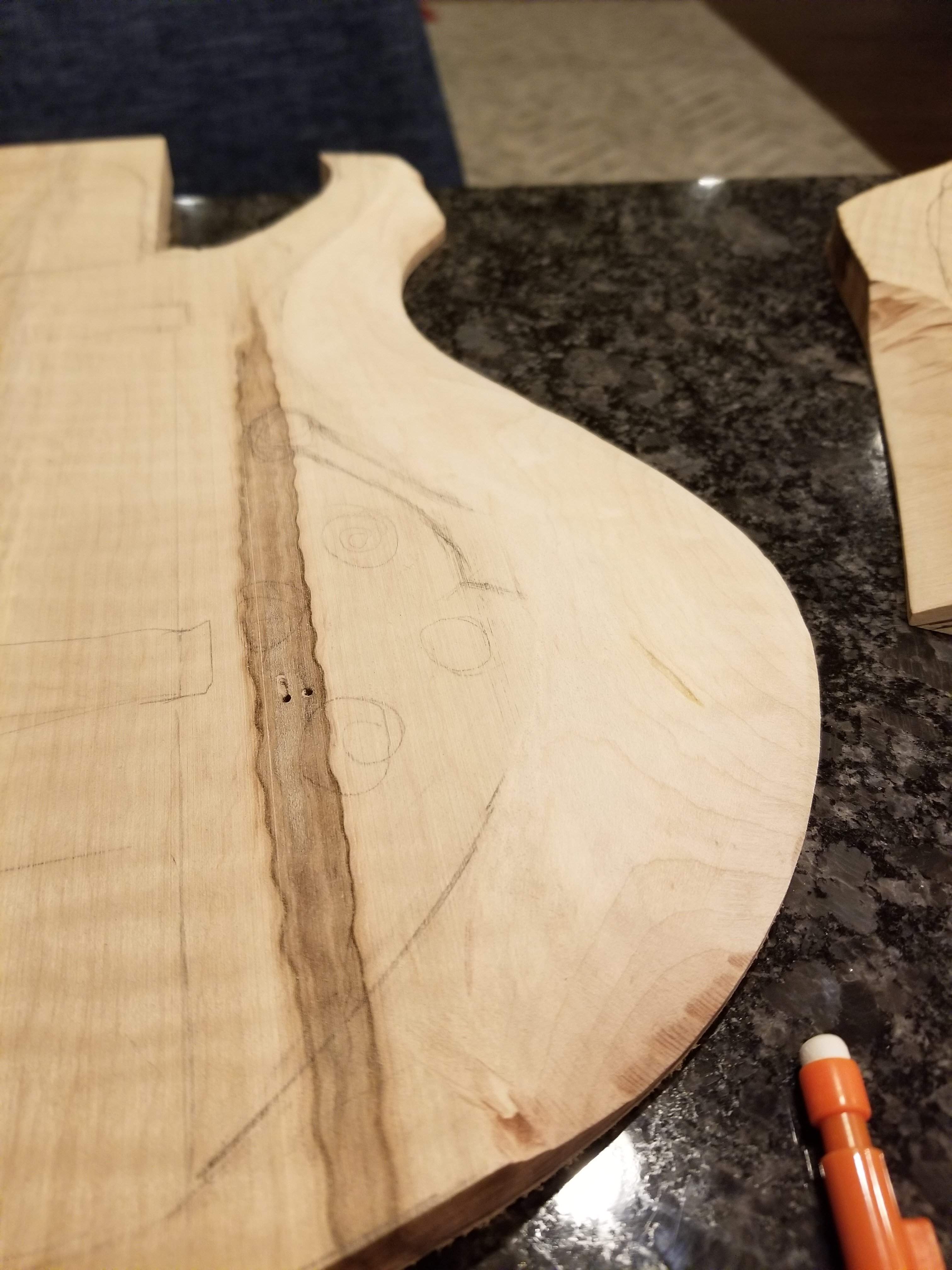
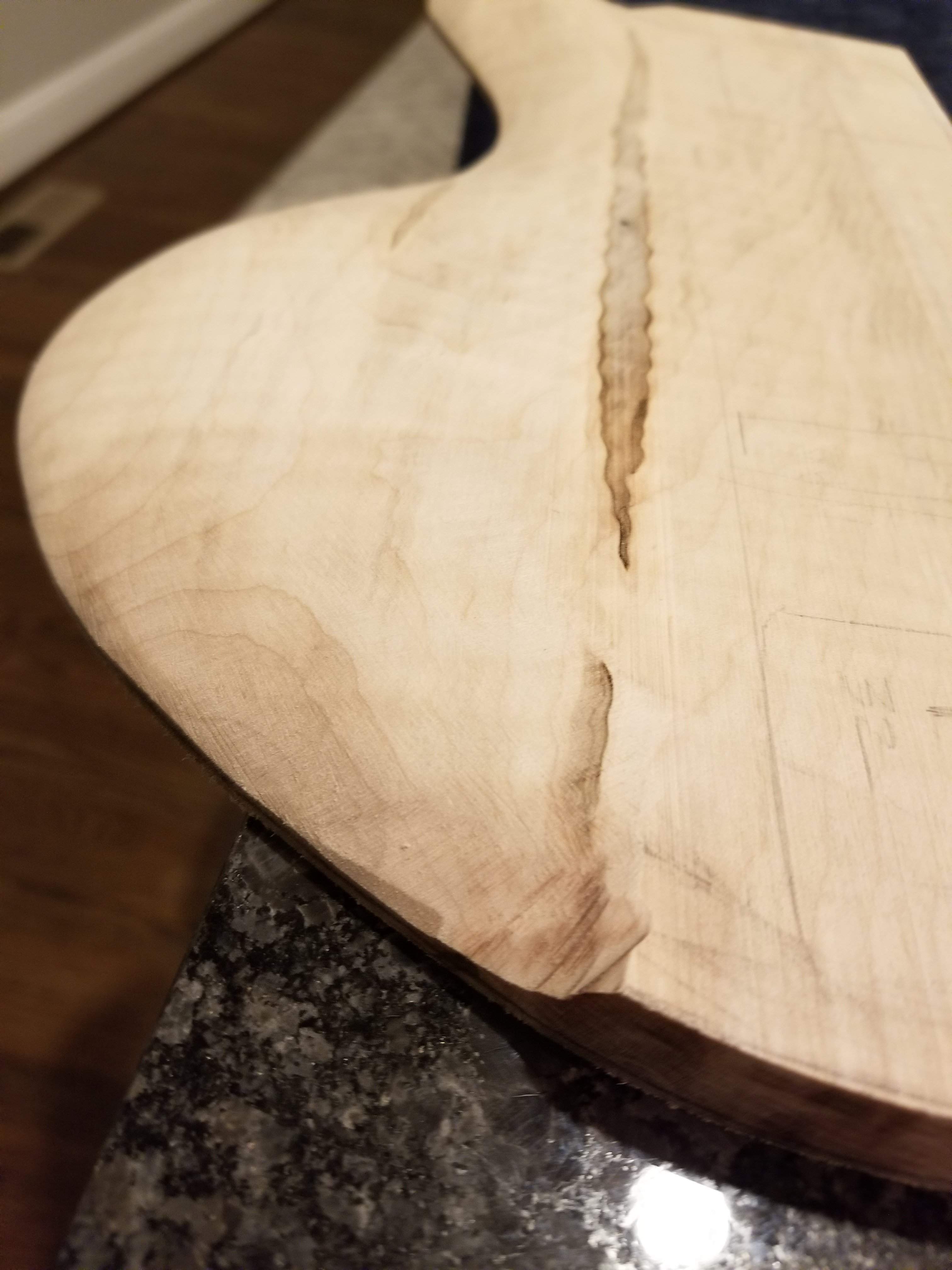
I started with a gouge, but that would have taken forever. I quickly charged up to the angle grinder, yeah that worked great. I went slow and left room, but I feel good with the results so far.

The Richter individual-string preamp/buffer is awesome IMO, I got the PPX4 in my piezo-only build, no volume or tone to keep the look knoblessly clean 

Glad the angle grinder worked out. I’m going to try the same thing, if I ever get caught up and can get started on something new.
The one warning with the angle grinder is that it creates a ton of fine dust that's hard to control. My workbench looked like it was out in a snow storm. I think I'll do it outside next time. I used an 80 grit wheel, I think I'd use a 120 grit next time.
Those sanding wheels can take off a lot of material in a hurry.
I got the bridge last night, so I could finish the body carving, I mostly finished this with the shinto and sandpaper. I'll finalize it more as I go.
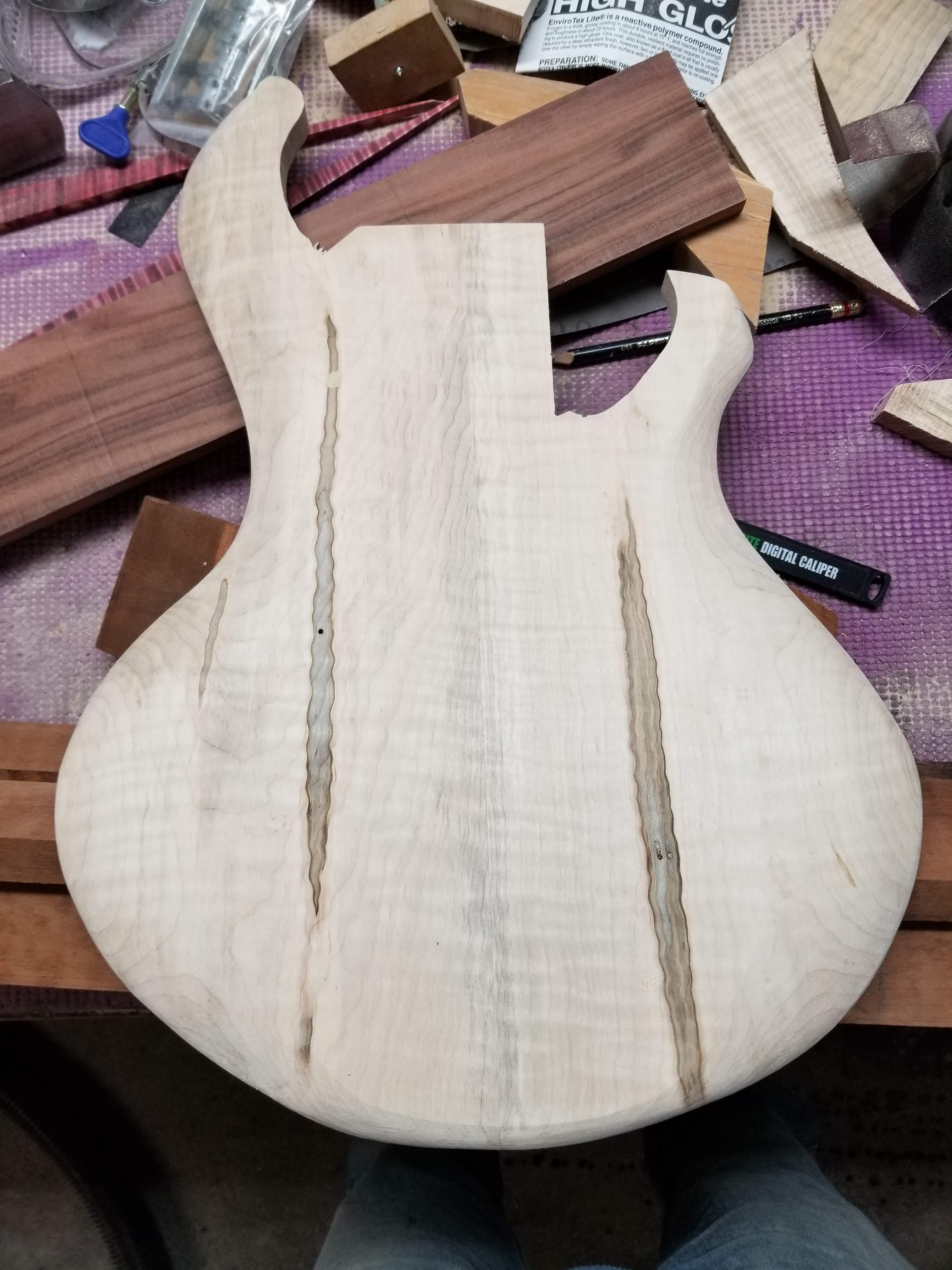
I found two pieces of ash that looked complementary, thicknessed them (nice even resaw on the bandsaw!) and got them glued up.
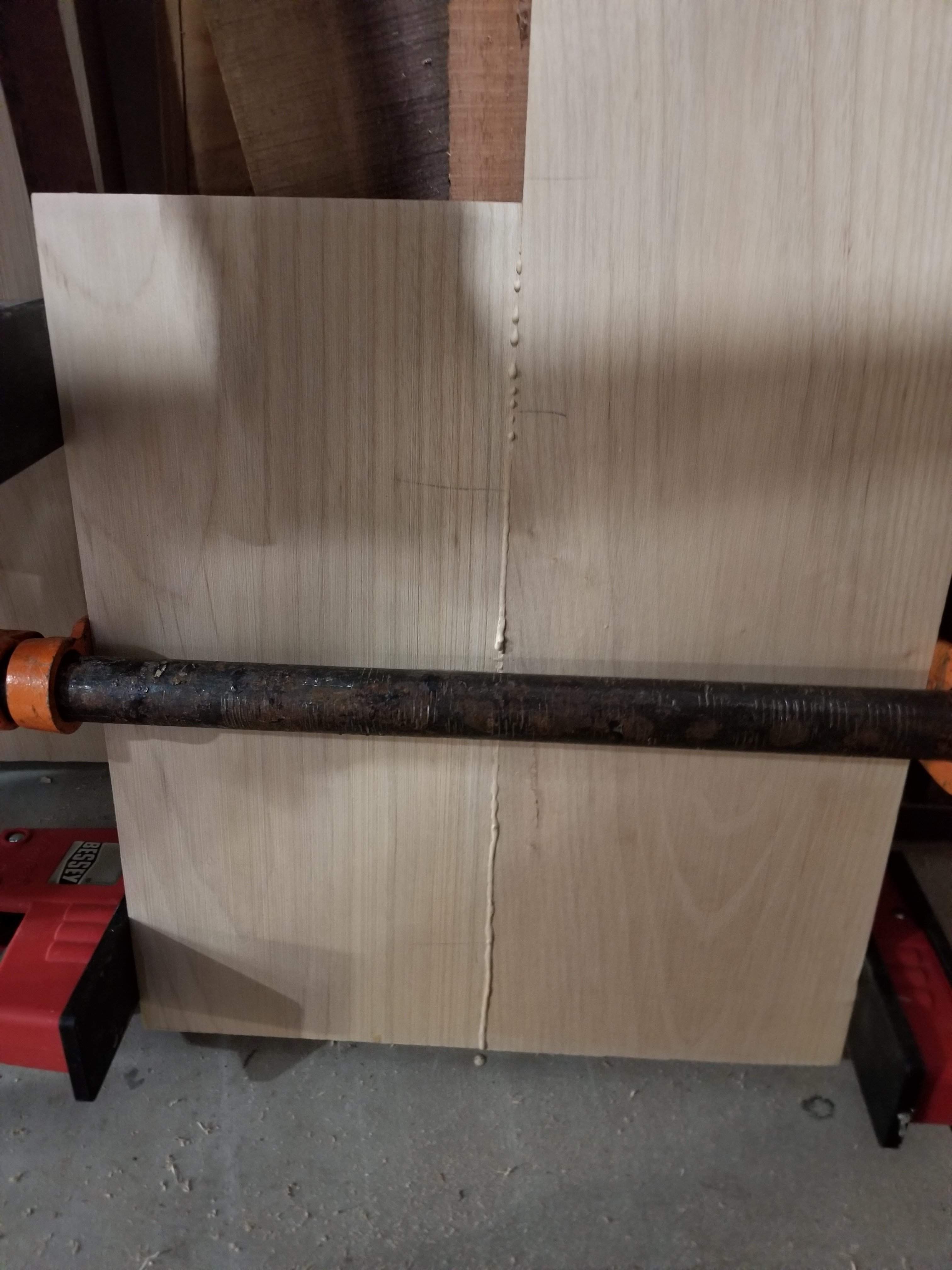
I got the neck roughed in, another good cut on the bandsaw, I guess I'm getting that thing figured out thanks to all the advice here. I'll need to thickness the back of the neck, I guess I can use the router sled to do that. The bandsaw cut is good, but it's not perfect, of course. That piece of pau ferro is for the build off bass, not this one (I think). I'm using a piece of macassar ebony for this one, it's got nice grain patterns (that mostly disappear once you apply oil). It's slotted for 34" and radiused. I'll cut off the first fret and add one at the end so it will 24 frets at 32" scale. My build off bass template is lying on the ground there. I had so many things figured out on that build, I hope I remember them when I get back to it.
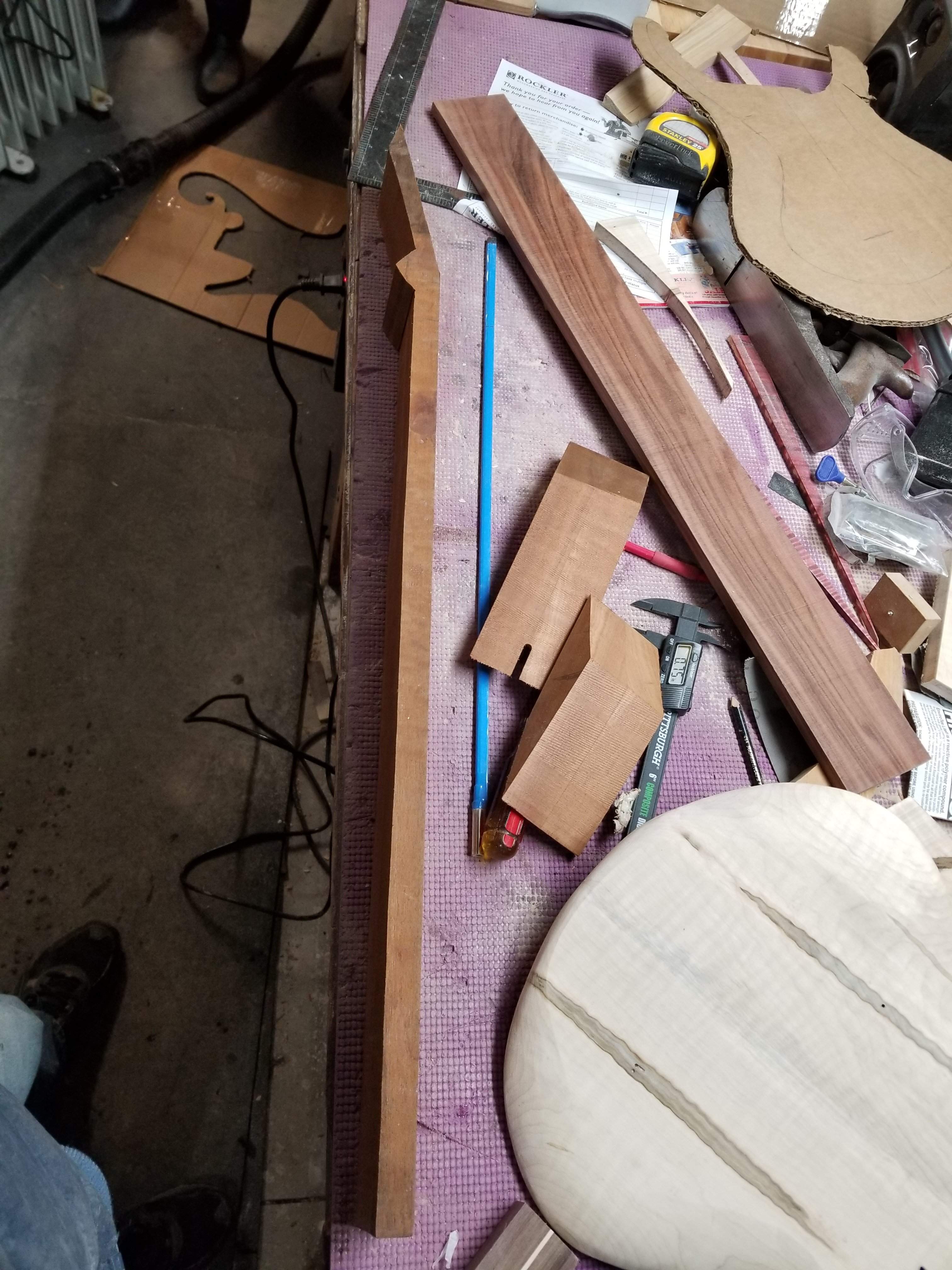
I was trying to figure out the neck width in a stupid way after futzing about for 20 minutes at the end of the day, I decided 1) it was a stupid way to do it and 2) I was getting tired, so I have a measurement I'll validate in the morning. I had a minor freak out when checking placement, I meant to add 8" to the last fret to find the scale length, instead I added 12 (no idea why). Things looked really weird for a minute.
When I went upstairs the Lace pickups were sitting on my back steps. These look great, I'm 95% sure I'll be using these and not piezos. My only grip is the mounting ears. I might have to figure out an alternative or how to hide them.
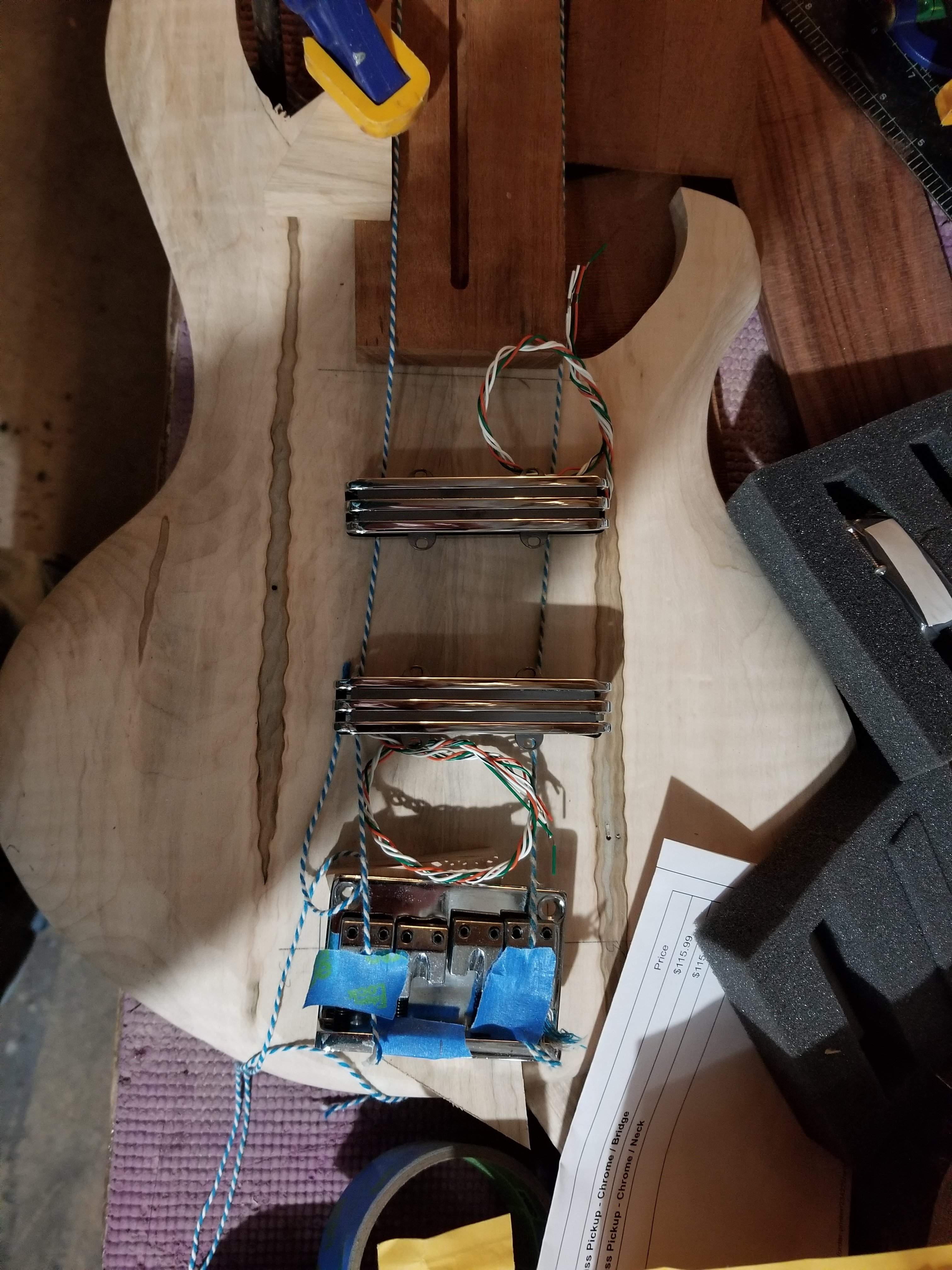
Next I'll carve out the back of the front and chamber the ash. As stated above this will be a 1.75" thick instrument, it's looking like I'm just a bit over that right now.
I found two pieces of ash that looked complementary, thicknessed them (nice even resaw on the bandsaw!) and got them glued up.
I got the neck roughed in, another good cut on the bandsaw, I guess I'm getting that thing figured out thanks to all the advice here. I'll need to thickness the back of the neck, I guess I can use the router sled to do that. The bandsaw cut is good, but it's not perfect, of course. That piece of pau ferro is for the build off bass, not this one (I think). I'm using a piece of macassar ebony for this one, it's got nice grain patterns (that mostly disappear once you apply oil). It's slotted for 34" and radiused. I'll cut off the first fret and add one at the end so it will 24 frets at 32" scale. My build off bass template is lying on the ground there. I had so many things figured out on that build, I hope I remember them when I get back to it.
I was trying to figure out the neck width in a stupid way after futzing about for 20 minutes at the end of the day, I decided 1) it was a stupid way to do it and 2) I was getting tired, so I have a measurement I'll validate in the morning. I had a minor freak out when checking placement, I meant to add 8" to the last fret to find the scale length, instead I added 12 (no idea why). Things looked really weird for a minute.
When I went upstairs the Lace pickups were sitting on my back steps. These look great, I'm 95% sure I'll be using these and not piezos. My only grip is the mounting ears. I might have to figure out an alternative or how to hide them.
Next I'll carve out the back of the front and chamber the ash. As stated above this will be a 1.75" thick instrument, it's looking like I'm just a bit over that right now.
Maybe you can trim the ears and do a Danelectro style back mount?
Quick question from a non-builder. In your first post you said you were going to cut the first fret off of a pre-slotted 34 inch fretboard to make it 32 inch scale. Will the spacing be correct? I thought the distance from fret to fret was tighter on shorter scale necks.
Basically its like capoing a 34" at the first fret. The first fret on a 34" scale neck is virtually at 32" from the bridge which is why this will work for him. He will of course be using medium scale strings for correct string tensions and EADG tuning on the 32"Quick question from a non-builder. In your first post you said you were going to cut the first fret off of a pre-slotted 34 inch fretboard to make it 32 inch scale. Will the spacing be correct? I thought the distance from fret to fret was tighter on shorter scale necks.


