Sorry for the delay, I have been trying to reduce my online-time …
You're one of the few who seem to be using this unit. Thoughts on it? Did you ever own a Shure GLXD16 and if so, how would you compare the two?
I never compared it to the Shure directly or over longer stretches of time, but I like the Sennheiser. I got it because our guitarist got one, and, well, it just worked for him. So I figured let's give it a try, it’s not too expensive. Reception with the two of us using Sennheisers is a non-issue, even with also an iPad and four cell phones battling for frequency range in our rehearsal space. Sound quality on bass is excellent, indistinguishable from plugging it in with a short cord – very distinguishable though compared to using a 10' cord with passive basses, there’s much more high-end. It’s like the 10' cord rolls off my Tone dial, in comparison. No perceptible delay, or drop-outs so far, three months in.
What could be better:
- Battery life is on the short side, compared to devices with larger packs such as the Shure. I can get through two 2.5h rehearsal sets max. EDIT: But you can pair the receiver with up to six different senders, so if range anxiety is an issue, you could get a second (or third) sender and switch on the fly.
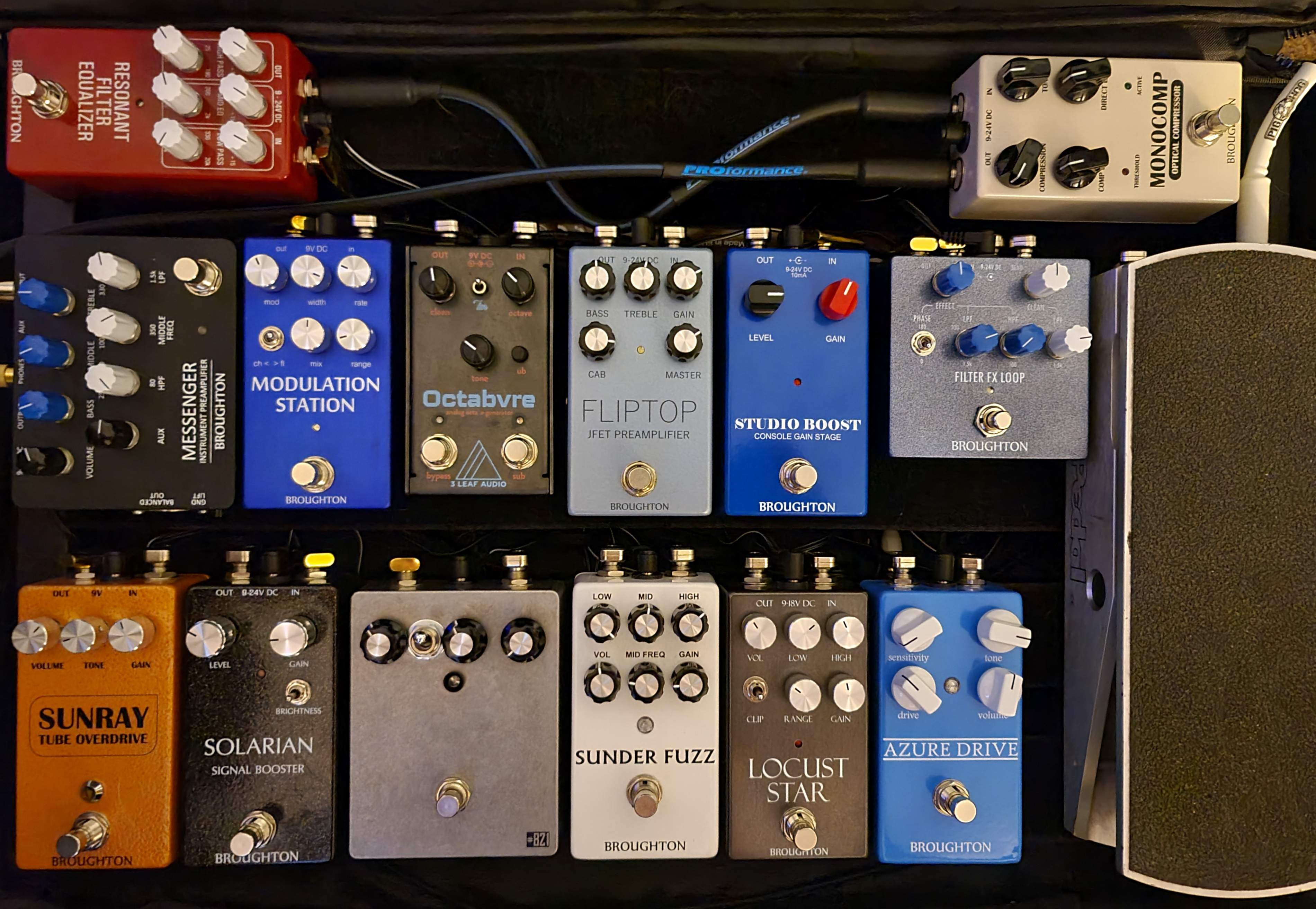
- There’s no wired input on the receiver, so should the sender drop out during a gig or the like, creative spontaneous rewiring is asked for. That’s why on the board above, I put the HPF where it is. (Remove one patch cable, enough room to easily plug in an instrument cable.) AFAIK the Shure offerings also don’t come with an emergency input.
- The tuner is very slow, compared to a PolyTune or a StroboTuner – or the Shure units I was able to play a couple of times on loan. Hasn’t been an issue so far, but should you be into altered tunings in live situations / need to retune often between songs, you’ll need an additional tuner. It’s certainly not as precise as a StroboStomp, but I didn’t see much difference from the Sennheiser’s readings to the PolyTune’s.
- The belt clip is flimsy on the sender-side. Meaning, it grips nicely to the belt, but the sender might slip out. I plan to use Gaffa once gigging is back in the game.
What is especially nice, in turn:
- USB-C! You can charge the sender on pretty much anything, including the receiver itself, as it has a USB-C charge port.
- For a digital pedal, the receiver isn’t too finicky. It works perfectly well on one of the 500 mA ports of TrueTone CS6 I use under the board. I wouldn’t use the Sennheiser daisy-chained, though. The guitar player keeps to the included power supply, even.
- Plug-and-play. Even with two receivers in range, pairing is a non-issue. For once, the “it just works” shtick is actually true.
- If you don’t want to use the belt clip, no problem unless you play a bass with a recessed port (Ibanez SoundGear for example) – the plug’s angle on the sender is adjustable, so it fits with many instruments without a cable. Our guitar player just plugs it straight into his guitar.
Hope this helps,
-Sascha