
Enjoy the benefits of a premium membership!
Upgrade Account
-
TalkBass has been independent since 1998. Add your voice.
Create a free account to reply to discussions, view embedded media, and browse with fewer display ads.
Join free Log in
Want zero display ads or expanded classifieds tools? Compare plans.
You are using an out of date browser. It may not display this or other websites correctly.
You should upgrade or use an alternative browser.
You should upgrade or use an alternative browser.
Soloing When You're Not Good At Soloing
- Thread starter JimmyM
- Start date
More options
Who Replied?

Sorry gang, got all caught up in buying a couple scales and obsessively weighing all my basses and hardware wondering whether it's actually possible to make a 6 lb P style bass that sounds the same as a 9 lb P style bass. I've come to the conclusion it's not, but I do think under 7 lbs is doable. And we all know that gear is way more important than the music itself 
Many bass solos should be bass and drums only. But many shouldn't, especially in jazz I'm finding out. At least comp lightly, huh?
Both equally valid IMHO. Time and place for everything.
I can't say I ever minded when everyone drops out, except the drummerTo me, what's really strange about bass solos is the tendency for the rest of the band to just completely drop out.
Bass is usually a supportive instrument, so by that definition, they are also the least likely to be the best candidates for solos. But, ironically, when it comes time to take a solo you're completely on your own with no support.
This usually isn't such a big problem in jazz ensembles where people know how to comp no matter who is soloing - and it's also not unusual for the bass to have a solo spot.
My best advice, if you're playing Top 40, rock, country, or other music where you don't typically solo but may be occasionally called on to do one, is train your band-mates on how to support you.
You will be a much, much better soloist if you have something to play against. The guitarist can drop their volume and maybe turn off the overdrive and play simple chords behind you. If you have a keyboardist, have them play some soft pads that you can hear. Have the drummer keep a consistent, but not too complex pattern going.
Sometimes people just don't know what to do, and bass frequencies can get kinda muddy or washed out on stage so they think they're doing you a favor by all dropping out, but in reality it makes it much more difficult.
Many bass solos should be bass and drums only. But many shouldn't, especially in jazz I'm finding out. At least comp lightly, huh?And then there's this POV as wellI usually like the band to completely drop out for my solos (except the drums), so no comping from anyone, and I’ll often start by just grooving out on the regular bass line for a little while and see where it goes. It’s very organic and patient, and it leaves lots of room to build it up. It also gives you some time to think of where you want to actually go with it, so the solo comes more from your head and not all muscle memory chops. I mean, let’s face it, most people in the crowd aren’t particularly listening to us anyway, so having the other instruments drop out and simply shifting their focus to the already moving bass line is a literal bass solo, even if you don’t change what you’re already doing at all. It sounds cool.
A lot of guys feel like they must immediately launch bass rockets at the crowd from the very first note. I know I tended to do that in my earlier years, and I eventually realized that I usually did it not because it sounded better, but just because I was being put on the spot, and I didn’t feel comfortable yet. So I needed to figure out a way to calm myself down, and this led to much better (and longer) solos that take more of a journey, than just a blast of “look how fast my fingers can move”.
Both equally valid IMHO. Time and place for everything.
amateurs practice until they get it right, professionals practice until they can't get it wrong.
Sig worthy!

I mean, let’s face it, most people in the crowd aren’t particularly listening to us anyway, so having the other instruments drop out and simply shifting their focus to the already moving bass line is a literal bass solo, even if you don’t change what you’re already doing at all. It sounds cool.
This x2
Most of what I play has a variety of blues style walking lines, it sounds ok as is for a solo, but it's also easy to add triplets, more connecting licks, slide the "1 up to the 1" etc... just to liven it up.
Heck, sometimes the best guitar solo of the night is a one or two note deal with a lot of bending.

Start on the 5 or 9
Start on the & of 2 or 3
Play no more than 8 notes, then let it breath
Play at least 50% scale tones.
If you dont know what you are doing, use 100% scale tones.
Repeat as necessary
Listen to Miles Davis's trumpet solo on So What 100 times and copy it. Yes, Miles kicked it off as octave, dom 7, root, but he was just jammin on a dorian mode.
Start on the & of 2 or 3
Play no more than 8 notes, then let it breath
Play at least 50% scale tones.
If you dont know what you are doing, use 100% scale tones.
Repeat as necessary
Listen to Miles Davis's trumpet solo on So What 100 times and copy it. Yes, Miles kicked it off as octave, dom 7, root, but he was just jammin on a dorian mode.
Last edited:

Start on the 5 or 9
Start on the & of 2 or 3
Play no more than 8 notes, then let it breath
Play at least 50% scale tones.
If you dont know what you are doing, use 100% scale tones.
Repeat as necessary
Listen to Miles Davis's trumpet solo on So What 100 times and copy it. Yes, Miles kicked it off as octave, dom 7, root, but he was just jammin on a dorian mode.
In that vein I'd check out upright jazz guys, then look at how Latin jazz upright guys break that heavy atmospheric clear statement ethic to get all wordy.
....or just say you don’t want to take a solo and have fun doing what you’re comfortable with. Improvising or soloing should be an extension of your musical self and things you naturally hear. If you don’t hear music that way cool. If you want to expand into that listen to soloists you really like and learn their vocabulary. Shed on it for as long as it takes and then forget about all that and just play. There’s nothing magical to it.

I’ve never transcribed a solo but I try and mimic my favorite singers. Every inflection of their voice so that it sounds like I’m singing. All the technical stuff is rad but if there is no depth or emotion then all those expensive notes won’t move anybody.

I enjoy soloing, but it takes up a lot of time. The more practicing at soloing the better, and it can be at the expense of groove and rhythm. I tend to practice things down to the finest detail until I build up a library of things I call devices. Maybe you could them Motif, not sure. But anyway, Say it - Play it.
Admittedly I didn't read all 8 pages but this topic really interests me as an advanced beginner. So I apologize if this has been addressed somewhere.
On the specific topic of playing the melody as a solo...would someone be willing to show a detailed example? As in, pick a simplish song with a simplish bass line and then tab out what a melodic solo would look like? Like maybe a 4-bar solo?
Thanks.
On the specific topic of playing the melody as a solo...would someone be willing to show a detailed example? As in, pick a simplish song with a simplish bass line and then tab out what a melodic solo would look like? Like maybe a 4-bar solo?
Thanks.
This isn’t a bash or ‘how to the right way.Admittedly I didn't read all 8 pages but this topic really interests me as an advanced beginner. So I apologize if this has been addressed somewhere.
On the specific topic of playing the melody as a solo...would someone be willing to show a detailed example? As in, pick a simplish song with a simplish bass line and then tab out what a melodic solo would look like? Like maybe a 4-bar solo?
Thanks.
You can’t remember a melody well enough to play it? Oh boy.
I would memorize it in my head and then learn to play it. Pick any song you know well and play that lyric.
There must be a ton of places on the web where you can get sheet music. Perhaps hire a local teacher to tab it out?
Hope that gives some insight into my methods and a couple of possibilities, at least.

Admittedly I didn't read all 8 pages but this topic really interests me as an advanced beginner. So I apologize if this has been addressed somewhere.
On the specific topic of playing the melody as a solo...would someone be willing to show a detailed example? As in, pick a simplish song with a simplish bass line and then tab out what a melodic solo would look like? Like maybe a 4-bar solo?
Thanks.
The solo starts at measure 25. Look out for the clef change! It starts at 12 on the G string...
Attachments

I don't think most musicians are making up much on the spot. They are basically playing a stream of consciousness, but they are drawing on a library of licks they have worked up previously. Even if they are playing over the changes of a tune they
Agree 100%.
When most of us journey into the complete musical unknown, we do it alone and in private. After that we bring what treasures we discovered back to share and display.
Musical improvisation is as much a display of your experience as it is your creativity.
(Or so I think anyway.
 )
)IMHO people have the wrong idea about just how impromptu solos actually are. I don't think most musicians are making up much on the spot.
Exactly.
I'm pretty sure it works that way for everything. Rappers probably rap in their heads all day long waiting for an opportunity to say certain phrases, etc. I know I definitely think of walking basslines and guitar licks in my head all day long that I eventually end up using because I hear that one place in the middle of a phrase where this lick I thought of the other day just slides in perfectly.
Any time I've relied solely on just letting my fingers do whatever pops into my head, it always just devolves into what basically amounts to scale practice.
Exactly right.Hey Jimmy
Based on your post, I'd say this makes you a really GOOD soloist! Melodic speed is amazing, and I love it. But Melodic non-speed is also amazing, and much more challenging to do well because EVERY NOTE COUNTS
I'm impressed by both equally, as long as it's done well.
I'm slowing down as I age - and can't wank as effectively any more (no jokes please ;-) ). I have always enjoying improvising melodies, and building a solo up.... it takes real focus though... and by no means do I always do it well.
Good choices, and happy it's working out so well for ya!

Sour notes stand out so much more when you're playing slower melodic pieces. You can fudge a bad note when you're doing things fast if you can hear it and slide quickly enough.
I guess the same can be said for the slower ones, but I feel like it's easier to sound bad when you're playing slower, more deliberate phrases.
I also find that when it happens I'm more disappointed in myself. "I had all that time to think of the next note and I chose THAT one... Dammit..."
I also find that when it happens I'm more disappointed in myself. "I had all that time to think of the next note and I chose THAT one... Dammit..."
LoL, absolutely - and after soloing for nearly my entire life, it still happens, damnit

The key to my soloing success was learning bass chords and as many inversions as possible. The "Bass Guitar Chords" book by Ron Middlebrook was particularly useful, especially the back page. When I solo, I want to give the audience as much of the instrument's sounds as possible, so I build my solos vertically, starting on the first few frets and then scale-tone linking my way up the fretboard as high as feels good, and then an oppositional descending line to wrap things up. Easy to do in eight bars, and with 16 bars there's a lot that can be done in this vein. I don't particularly like a bass solo to go more that 16 bars anyway.
I started by memorizing all the Dorian scale patterns/linkages, and then applying them to the diatonic 7th chords in a particular key, often within a 2-5-1 structure. Takes some practice, but made a huge difference for me. I can end up with a solo that sounds like me within any key center, and it generally wows the audience.
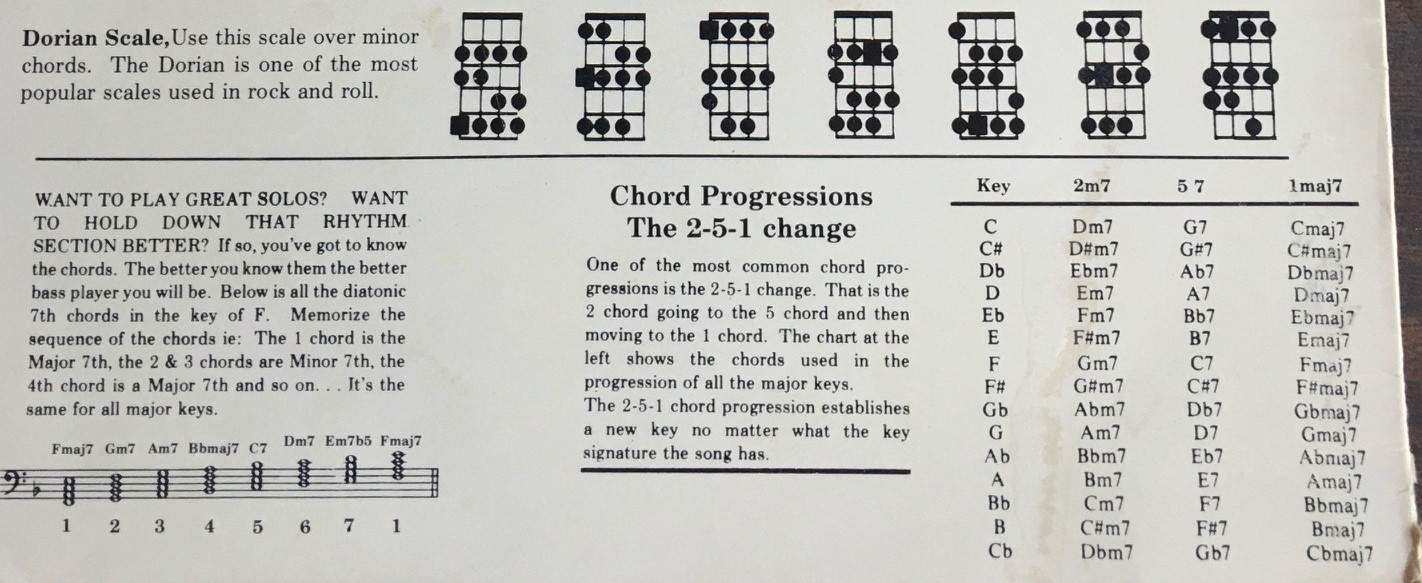
I started by memorizing all the Dorian scale patterns/linkages, and then applying them to the diatonic 7th chords in a particular key, often within a 2-5-1 structure. Takes some practice, but made a huge difference for me. I can end up with a solo that sounds like me within any key center, and it generally wows the audience.

I think the key to bass solos is not forgetting your the bass player, lol! Too many bassist think solo time is a license to abandon your bassist post and go on a noodle run. It's a sure fire way to get the audience to prey it's over soon. Learn to maintain a simple bass part while you solo. For example, the old school funk guys would hit a big root on the 1 every 2 measures. I actually find this works pretty good. Hit the root on the 1, noodle for 4-6 beats and work your way back to the 1. This hit on the 1 makes it funky - good for bassists - and gives you a structure you can elaborate on.
Last edited:


