

Enjoy the benefits of a premium membership!
Upgrade Account
-
TalkBass has been independent since 1998. Add your voice.
Create a free account to reply to discussions, view embedded media, and browse with fewer display ads.
Join free Log in
Want zero display ads or expanded classifieds tools? Compare plans.
You are using an out of date browser. It may not display this or other websites correctly.
You should upgrade or use an alternative browser.
You should upgrade or use an alternative browser.
Source Audio Sorcerers Society (S.A.S.S) Part 3
- Thread starter gregmon79
- Start date
More options
Who Replied?
Yes. Im mostly arco with the eub nowadays. It sounds great, but im still scratching the surface of the c4. Hope to get in some more scratching this weekend.

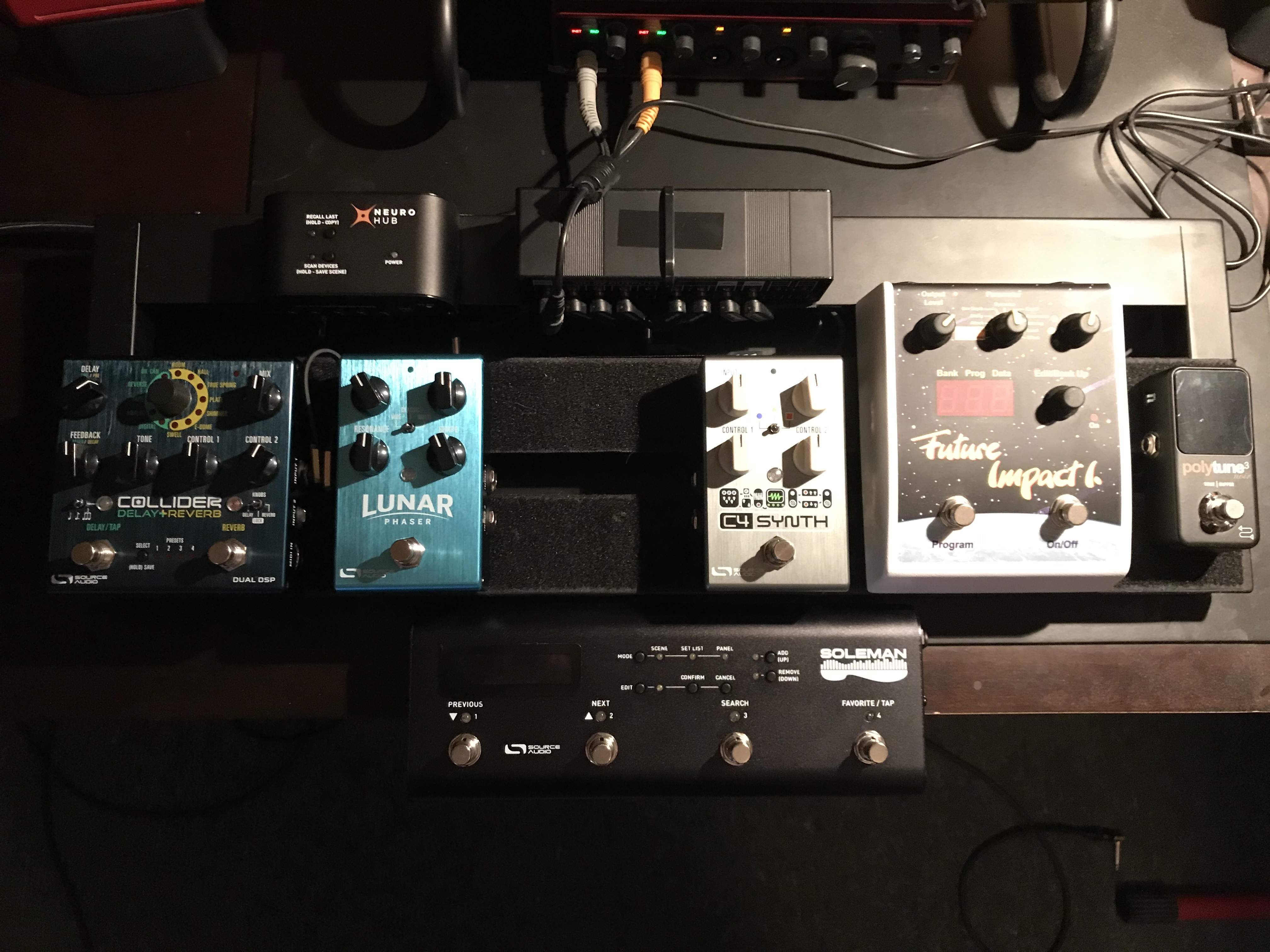
Dry fitting my revamped Metro 24 pedalboard this afternoon - anyone care to wager which pedal the open slot is meant (hoping!) for?


rsmith601
Commercial User
- Apr 14, 2009
- 4,461
- 8,356
- Disclosures
- CEO and Co-Founder, Source Audio
Does it begin with U?Dry fitting my revamped Metro 24 pedalboard this afternoon - anyone care to wager which pedal the open slot is meant (hoping!) for?
View attachment 4147961
Does it begin with U?
Ladies and gentlemen, we have a winner! (Two, if I can get my hands on one...)

Dry fitting my revamped Metro 24 pedalboard this afternoon - anyone care to wager which pedal the open slot is meant (hoping!) for?
I just ordered my fancy schmancy blue knobs for the Ultrawave, so I'm right there with you @WaveyDavey!
 Hopefully we get more info soon!
5sg.

Source Audio C4 Synth
Source Audio C4 Synth | The Official Source Audio Shop | Reverb
b-stock deals!!
Source Audio C4 Synth | The Official Source Audio Shop | Reverb
b-stock deals!!
rsmith601
Commercial User
- Apr 14, 2009
- 4,461
- 8,356
- Disclosures
- CEO and Co-Founder, Source Audio
I just approved this today. These units have some very-hard-to-notice defects in the panel graphics, or a small scratch somewhere. Not good enough to sell to a dealer as a new and perfect pedal.Source Audio C4 Synth
Source Audio C4 Synth | The Official Source Audio Shop | Reverb
b-stock deals!!
I would have taken advantage, but I asked my wife and daughter for one in honor of my birthday. I’ve been instructed not to open any packages that come to the house. So I thought sharing this good deal was the polite thing to do.I just approved this today. These units have some very-hard-to-notice defects in the panel graphics, or a small scratch somewhere. Not good enough to sell to a dealer as a new and perfect pedal.
Man... i really with you guys could bring back the reflex. It would be the answer to my current pedalboard limitations

I probably spent to much on a used one on reverb, but it is definitely worth it.Man... i really with you guys could bring back the reflex. It would be the answer to my current pedalboard limitations

My biggest complaint about the Reflex is that the User LFO was never developed. I understand that SA have their reasons for discontinuing the pedal and not developing it further. I would lose my mind if there was a Reflex 2 that had Neuro app support.
One of my favorite tricks is running the Sample-Hold LFO into the harmonizer of my HX Effects or H9. Generating random harmonies makes me feel like I'm playing with a modular synth.
One of my favorite tricks is running the Sample-Hold LFO into the harmonizer of my HX Effects or H9. Generating random harmonies makes me feel like I'm playing with a modular synth.

I also concur that a Reflex would be an amazing tool! Why was it discontinued? Too ahead of its time?!!
Too expensive to make and support, if I remember right.I also concur that a Reflex would be an amazing tool! Why was it discontinued? Too ahead of its time?!!
I’ve heard rumors that they lost a hundred dollars for each one they sold, but no idea if that’s true, seems crazy.
rsmith601
Commercial User
- Apr 14, 2009
- 4,461
- 8,356
- Disclosures
- CEO and Co-Founder, Source Audio
I have not complained about this in a while, so I cant help myself.I also concur that a Reflex would be an amazing tool! Why was it discontinued? Too ahead of its time?!!

Reflex was very expensive to develop. Custom housing. Had to work with lots of things.
It sold in low volumes. Yes, I think it was ahead of its time. But I also think people found it expensive. Expression pedals are cheap. The Expressionator is like $200. I think this set in people's mind that anything more than $200 was too much.
The responsibility of making Reflex work with everything fell on us. I think we tested it with perhaps a hundred different things and found ways to make it work prior to release. There are a group of us pedal makers who make nice with expression inputs, and then there are literally hundreds of others who don't know what they are doing (they are often called genius on forums for copying a common circuit and adding a cool paint job, but they don't know Ohm's law!). We would need to buy the pedal and figure out how to make it work. Sometimes for only one customer. I think we needed to provide significant support to at least half of the units sold. When Reflex could not work with some odd thing, customers went crazy on us and demanded a full refund FROM US.
When I looked at the big picture about 2 years in, I realized we were losing about $100 per unit on each shipment. People bitterly complained that we were not investing even more money into it with the software options. I made the decision to kill it. We lost hundreds of thousands of $$ on that project.
In retrospect, it should have been a $500 pedal and we should have drawn the line by saying we have made it work with 98% of the most important pedals out there, and that is enough. If you buy an 18 volt pedal and expect it will work with Reflex, then sell your Reflex ASAP.
I think we will do another version some day. We are wiser today than back then.
So, that is the whole story.

I have not complained about this in a while, so I cant help myself.
Reflex was very expensive to develop. Custom housing. Had to work with lots of things.
It sold in low volumes. Yes, I think it was ahead of its time. But I also think people found it expensive. Expression pedals are cheap. The Expressionator is like $200. I think this set in people's mind that anything more than $200 was too much.
The responsibility of making Reflex work with everything fell on us. I think we tested it with perhaps a hundred different things and found ways to make it work prior to release. There are a group of us pedal makers who make nice with expression inputs, and then there are literally hundreds of others who don't know what they are doing (they are often called genius on forums for copying a common circuit and adding a cool paint job, but they don't know Ohm's law!). We would need to buy the pedal and figure out how to make it work. Sometimes for only one customer. I think we needed to provide significant support to at least half of the units sold. When Reflex could not work with some odd thing, customers went crazy on us and demanded a full refund FROM US.
When I looked at the big picture about 2 years in, I realized we were losing about $100 per unit on each shipment. People bitterly complained that we were not investing even more money into it with the software options. I made the decision to kill it. We lost hundreds of thousands of $$ on that project.
In retrospect, it should have been a $500 pedal and we should have drawn the line by saying we have made it work with 98% of the most important pedals out there, and that is enough. If you buy an 18 volt pedal and expect it will work with Reflex, then sell your Reflex ASAP.
I think we will do another version some day. We are wiser today than back then.
So, that is the whole story.
Thanks for sharing!!! Paints an accurate pic of just some of the big issues y’all gotta deal with with new and innovative products. I also think it was ahead of it’s time. I can’t even imagine the nightmare you went through dealing with angry customers over something you barely had control over. Not saying those customers didn’t have a right to be frustrated. But maybe they were frustrated with the wrong side sometimes....just sounds like an icky situation for you as well as the consumer in some instances. Can’t say I blame you one bit for pulling the plug on that one.
Yeah unfortunately none of that surprises me much re: “consumer entitlement”. We are in a weird era that way, privileged people feel entitled to the miraculous at rock-bottom prices (or conversely are able to justify spending absurd amounts of money for things declared “boutique” or “hifi” as status symbols). Looking at what that thing was capable of I could totally understand the pricing too- there is literally nothing else that compares that I know of that doesn’t use the processing power of a computer. I hope you are able to make a profitable version some day, as it seems like tastes and technology are finally starting to catch up with that kind of control environment.I have not complained about this in a while, so I cant help myself.
Reflex was very expensive to develop. Custom housing. Had to work with lots of things.
It sold in low volumes. Yes, I think it was ahead of its time. But I also think people found it expensive. Expression pedals are cheap. The Expressionator is like $200. I think this set in people's mind that anything more than $200 was too much.
The responsibility of making Reflex work with everything fell on us. I think we tested it with perhaps a hundred different things and found ways to make it work prior to release. There are a group of us pedal makers who make nice with expression inputs, and then there are literally hundreds of others who don't know what they are doing (they are often called genius on forums for copying a common circuit and adding a cool paint job, but they don't know Ohm's law!). We would need to buy the pedal and figure out how to make it work. Sometimes for only one customer. I think we needed to provide significant support to at least half of the units sold. When Reflex could not work with some odd thing, customers went crazy on us and demanded a full refund FROM US.
When I looked at the big picture about 2 years in, I realized we were losing about $100 per unit on each shipment. People bitterly complained that we were not investing even more money into it with the software options. I made the decision to kill it. We lost hundreds of thousands of $$ on that project.
In retrospect, it should have been a $500 pedal and we should have drawn the line by saying we have made it work with 98% of the most important pedals out there, and that is enough. If you buy an 18 volt pedal and expect it will work with Reflex, then sell your Reflex ASAP.
I think we will do another version some day. We are wiser today than back then.
So, that is the whole story.
Last edited:

Quick question. I took a look at the Source Audio Neuro Hub manual, I might have passed by what I'm looking for.
Can you use the hub and connect a midi switcher to the usb port on it? I don't want to use a computer live. I'd want to use the midi in to connect to an MPC for clock, but use a midi switcher (DMC Micro) to usb to run through presets that I've set up.
This is all kind of new to me. I'm guessing the answer is yes. But I want to make sure my ducks are in a row before I start buying things. If not I'm assuming I'd need a midi switcher with midi in and out.
Thanks!
Can you use the hub and connect a midi switcher to the usb port on it? I don't want to use a computer live. I'd want to use the midi in to connect to an MPC for clock, but use a midi switcher (DMC Micro) to usb to run through presets that I've set up.
This is all kind of new to me. I'm guessing the answer is yes. But I want to make sure my ducks are in a row before I start buying things. If not I'm assuming I'd need a midi switcher with midi in and out.
Thanks!


