Yeah, I don’t see a huge difference in the difference between P and J pickup position. It gets down to how big is large?
I don't think he was talking about position, but more the construction of the pickup. The positions are indeed quite similar, for the E and A strings. The D and G strings are a different story. But for E and A, I don't think that's the deciding factor. But pickup construction/architecture (probably) is.
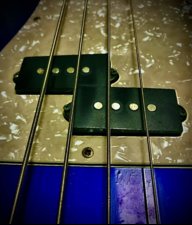
If you look under the hood (or just estimate by looking at the shape of the pickup housing), the P pickup is quite a bit wider than the J. The coil wire on a P is wound shallower and wider - indeed so much wider, that you could not place a P bass coil inside a J pickup housing. A split coil J is only split to achieve hum-cancelling, but is wound like a J pickup - tall and narrow. Even a Model J, which is indeed pretty fat sounding. But it's not just that P and J are physically not the same - as a result, they don't sound the same. Some say it's the aperture, some say it's because of the position of the coil/wires inside the magnetic field. I don't know, it's above my pay grade. But they sound different.
An interesting pickup is Nordstrand 51 J (or something like that, cant remember the name). It's a split coil 51P pickup in J housing. That might be another interesting beast, a take on the 51P SCPB pickup, but split. Some say that the Fralin 51P sounds a lot like the good ol' regular (57) split P. I doubt it, because like the J pickup it's tall and narrow, but maybe it does sound like it because of the single pole per string design? Someone should try them all in one bass and make good sound clips!
What I do find can get you closer is using loading capacitors and resistors to fine-tune the resonant peak. Again, not quite the same thing, but a smidge closer I think. A lot cheaper than new pickups too, and you can use that with any passive pickup design