
Enjoy the benefits of a premium membership!
Upgrade Account
-
TalkBass has been independent since 1998. Add your voice.
Create a free account to reply to discussions, view embedded media, and browse with fewer display ads.
Join free Log in
Want zero display ads or expanded classifieds tools? Compare plans.
You are using an out of date browser. It may not display this or other websites correctly.
You should upgrade or use an alternative browser.
You should upgrade or use an alternative browser.
Squier Vintage Modified Precision V: who's got one?
- Thread starter Chef
- Start date
More options
Who Replied?
Did you mean to tag me here? I hadn’t thought of doing anything to the neck, haha.@Monterey Bay-ss what grit are you going to use on the back of the neck? I think this may be a quick and needed mod.

I personally take off the gloss with 1500 grit@Monterey Bay-ss what grit are you going to use on the back of the neck? I think this may be a quick and needed mod.



All this talk about modifying the Squier P5!
I admit that I put USA Fender electronics and a switchcraft jack in mine and was rewarded by almost no improvement. The difference was so slight that I recommend leaving the electronics alone. The original stuff sounds just fine.
Then there is the hardware. It all works....it does what it is supposed to do and I am perfectly satisfied with the original hardware.
Oh, the gloss finish on the neck is my preferred finish so I would never change that either.
LOL Ain't life grand? Many of you will disagree with everything in this post and that is just fine. I'm happy with my Squier P 5 and I want you to be happy with yours too.
Aren't you glad there are blonds, redheads and brunettes? Sunburst, red and white Squier P 5's?
I admit that I put USA Fender electronics and a switchcraft jack in mine and was rewarded by almost no improvement. The difference was so slight that I recommend leaving the electronics alone. The original stuff sounds just fine.
Then there is the hardware. It all works....it does what it is supposed to do and I am perfectly satisfied with the original hardware.
Oh, the gloss finish on the neck is my preferred finish so I would never change that either.
LOL Ain't life grand? Many of you will disagree with everything in this post and that is just fine. I'm happy with my Squier P 5 and I want you to be happy with yours too.
Aren't you glad there are blonds, redheads and brunettes? Sunburst, red and white Squier P 5's?

The only improvement needed for my VMP5 was a set of TI flats. Everything else stock except for lighter knobs. Still have full P5 electronics and Pickguard in storage.


How is the neck dive on these basses?
I read some reports that there is some neck dive but nothing a good strap can't handle. True or not?
I read some reports that there is some neck dive but nothing a good strap can't handle. True or not?

Haven't noticed any at all. It's the same proportions as any other Precision Bass, so I find that an odd observation. Not by you, but others that have reported it.How is the neck dive on these basses?
I read some reports that there is some neck dive but nothing a good strap can't handle. True or not?

All Fender P-basses neck dive, at least a little.How is the neck dive on these basses?
I read some reports that there is some neck dive but nothing a good strap can't handle. True or not?
The ‘64 Precision I played from 1972-1984 did it.
If I was playing seated without the strap on, or standing with a thin, slippery strap and a satin dress shirt (don’t judge me, it was the early 70’s!), the headstock would head for the floor unless I stopped it.
Thanks to the upper horn extending almost to the 12th fret, it was way better than an Alembic or early Gibson basses. Simply trapping the body with my right elbow or keeping my left hand on the neck, was enough to save it.
This is one of the reasons I prefer shorter headstocks (4 plus 1 or 3 plus 2) to reduce neck dive on 5-string basses, and also one of the reasons I prefer wide, soft straps with a rough suede back with most fivers.
Last edited:
Mild neck dive is so prevalent with electric bass, that many players don’t even notice it.
Even my Dingwall ABZ-5, which is an ergonomic and ergonomic marvel, dives a little if you use the standard strap pin on the lower bout.
Thankfully, fixing the dive on the VMP5 is a game of ounces, and it’s easy to reduce or even cure if you’re motivated.
Replacing the stock tuners with import Ultralites, shaves 6 1/2 ounces off the pointy end, improving the balance noticeably. No other lightweight tuner is as effective. Installation only requires hand tools, and 5 shims cut from an aluminum pop can.
The back of the headstock won’t be pretty, because of the extra screw holes. The dents in the finish from the stock tuners don’t help either. If you’re bothered by this, the stage 1 fix involves a wax wood repair crayon, a Q-tip and clear nail polish to hide the holes. Stage 2 involves using a sanding block and ultra fine sandpaper to matte the finish and cut it back a few thou to eliminate the dents.
If you’re worried about resale value, be sure to mask off the serial # first...
Tuners won't give it perfect standing balance, but it’s enough to help if you have chronic pain from a neck injury or nerve damage in your shoulders.
Perfect balance on the Squier requires an additional investment of about $20 US.
One of Sheldon’s innovations on later Dingwalls, is a recessed Dunlop strap lock in the back of the body. He uses it on his long scale basses to reduce the reach required from that 37” B string, and on his D-Bird to solve the well-known balance problem with Thunderbird-style basses.
I posted a photo series about how to apply this to the VMP5 a while back. All you need is the recessed strap lock and a small drill bit. The bit size is right on the Dunlop packaging.
The end result is perfect standing balance, without hanging extra weights off the body, making an ugly strap pin extension, or tying helium balloons to the headstock.
It also pulls the strap in a little tighter against the right side of your back, which feels cozy and helps to hold the bass in position.
Another bonus, is that the whole bass moves about 2” to the right. This is helpful if your search for better balance is motivated by shoulder or wrist pain. The shorter reach to the first fret, along with the way it eases the tension on your right arm and wrist, are major benefits.
There are two potential downsides to the rear strap lock:
Perfect balance introduces some interesting new possibilities: You can wear your bass with the headstock tilted up about 30-45 degrees, and it never moves.
That keeps your right hand closer to your body, and lets you sling the bass lower without losing speed and control. This opens up your posture in a way that's easier on your left wrist, and also gets rid of that awkward, cramped right wrist position if you tend to rest your forearm on the top of the body.
Take a look at these photos of Bunny Brunel and Norm Stockton. Both of them are great bassists, but the photos should make it fairly obvious how and why a position change can mitigate or even prevent carpal tunnel and other wrist problems...


Even my Dingwall ABZ-5, which is an ergonomic and ergonomic marvel, dives a little if you use the standard strap pin on the lower bout.
Thankfully, fixing the dive on the VMP5 is a game of ounces, and it’s easy to reduce or even cure if you’re motivated.
Replacing the stock tuners with import Ultralites, shaves 6 1/2 ounces off the pointy end, improving the balance noticeably. No other lightweight tuner is as effective. Installation only requires hand tools, and 5 shims cut from an aluminum pop can.
The back of the headstock won’t be pretty, because of the extra screw holes. The dents in the finish from the stock tuners don’t help either. If you’re bothered by this, the stage 1 fix involves a wax wood repair crayon, a Q-tip and clear nail polish to hide the holes. Stage 2 involves using a sanding block and ultra fine sandpaper to matte the finish and cut it back a few thou to eliminate the dents.
If you’re worried about resale value, be sure to mask off the serial # first...
Tuners won't give it perfect standing balance, but it’s enough to help if you have chronic pain from a neck injury or nerve damage in your shoulders.
Perfect balance on the Squier requires an additional investment of about $20 US.
One of Sheldon’s innovations on later Dingwalls, is a recessed Dunlop strap lock in the back of the body. He uses it on his long scale basses to reduce the reach required from that 37” B string, and on his D-Bird to solve the well-known balance problem with Thunderbird-style basses.
I posted a photo series about how to apply this to the VMP5 a while back. All you need is the recessed strap lock and a small drill bit. The bit size is right on the Dunlop packaging.
The end result is perfect standing balance, without hanging extra weights off the body, making an ugly strap pin extension, or tying helium balloons to the headstock.
It also pulls the strap in a little tighter against the right side of your back, which feels cozy and helps to hold the bass in position.
Another bonus, is that the whole bass moves about 2” to the right. This is helpful if your search for better balance is motivated by shoulder or wrist pain. The shorter reach to the first fret, along with the way it eases the tension on your right arm and wrist, are major benefits.
There are two potential downsides to the rear strap lock:
- Depending on how big your gut is, and how high or low you wear your bass, it may tilt the top edge of the body away from you slightly, making it harder to see the fingerboard.
- If crazy solos are your thing, your left wrist may bump into your hip when you’re reaching for the 20th fret.
Perfect balance introduces some interesting new possibilities: You can wear your bass with the headstock tilted up about 30-45 degrees, and it never moves.
That keeps your right hand closer to your body, and lets you sling the bass lower without losing speed and control. This opens up your posture in a way that's easier on your left wrist, and also gets rid of that awkward, cramped right wrist position if you tend to rest your forearm on the top of the body.
Take a look at these photos of Bunny Brunel and Norm Stockton. Both of them are great bassists, but the photos should make it fairly obvious how and why a position change can mitigate or even prevent carpal tunnel and other wrist problems...
Last edited:


How is the neck dive on these basses?
I read some reports that there is some neck dive but nothing a good strap can't handle. True or not?
Haven't noticed any at all. It's the same proportions as any other Precision Bass, so I find that an odd observation. Not by you, but others that have reported it.
I used to use a leather guitar strap (about two inches wide) on my VMP5 and it was pretty steady and level. I then switched to a 3.5 to 4 inch wide nylon strap, and started getting neck dive. FWIW.
BnB
Doing just fine with a vegan 2" strap myself ¯\_(ツ)_/¯I used to use a leather guitar strap (about two inches wide) on my VMP5 and it was pretty steady and level. I then switched to a 3.5 to 4 inch wide nylon strap, and started getting neck dive. FWIW.
BnB
This one has already sold. If you see one for ~300 USD, BUY IT!Here's another one, already with MIA pickup and Hipshot bridge (no affiliation).
Sorry in advance for being "that guy": I have neither the patience nor skill required to fish out useful bits on replacement pickups from this lengthy thread. I hope that pickup options have changed enough within the past five years that others will find it worthwhile to revisit the topic now.
In my case, the stock pickup has plenty of output but lacks authoritative low end relative to every other bass I own, and while I like plenty of gank and swak, the gank and swak out of this one seems a bit much even for me. I can get a sound I like with some fairly extreme EQ adjustments on my amplifiers, but I can't get the lows, gank, and swak quite where I like them. Also, (*what most would call) the G and (especially) the D string really overpower the other strings (the B, E, and A all sound good relative to each other, and I would venture to guess the D and G have relative balance); I tried to adjust pickup height, but the inner screw on the D-and-G half of the pickup stripped instantly and completely
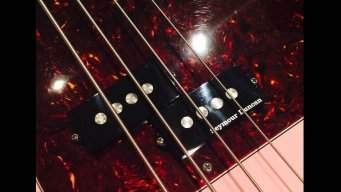
I gather that the MIA Fender pickup doesn't seem to change a whole lot, and the Nordstrand option sounds faithful to the Fender, i.e. it sounds like it might not make a big difference, either. The Seymour Duncan Quarter Pound seems like an easy option with plenty of low end, but I don't want to lose the mids, which sounds like a distinct possibility going that route. I would love to go with a Lace Aluma-P like I have in my favorite 4-string, but my contact at Lace suggested it wouldn't fit this instrument (I still think it might, but it would at least require a custom pickguard and some drilling, as far as I can tell). In light of all that, I've ordered and M&V Atlas to replace the stock pickup but they're moving shop and won't get to it for two months; they've offered to refund my money if I decide it's not worth the wait. Have I missed any good options, or gotten the wrong idea about any of these pickups (including the stock one, which I would happily not replace if I can get my sound out of it)? I like to drive an all-tube amp, so I would like to retain the high output.
Thank you for any help you can provide. I love this bass, even as-is.
*I tune either GCGCF or ADGCF, but referencing standard tunings for each string seems logical.
In my case, the stock pickup has plenty of output but lacks authoritative low end relative to every other bass I own, and while I like plenty of gank and swak, the gank and swak out of this one seems a bit much even for me. I can get a sound I like with some fairly extreme EQ adjustments on my amplifiers, but I can't get the lows, gank, and swak quite where I like them. Also, (*what most would call) the G and (especially) the D string really overpower the other strings (the B, E, and A all sound good relative to each other, and I would venture to guess the D and G have relative balance); I tried to adjust pickup height, but the inner screw on the D-and-G half of the pickup stripped instantly and completely
I gather that the MIA Fender pickup doesn't seem to change a whole lot, and the Nordstrand option sounds faithful to the Fender, i.e. it sounds like it might not make a big difference, either. The Seymour Duncan Quarter Pound seems like an easy option with plenty of low end, but I don't want to lose the mids, which sounds like a distinct possibility going that route. I would love to go with a Lace Aluma-P like I have in my favorite 4-string, but my contact at Lace suggested it wouldn't fit this instrument (I still think it might, but it would at least require a custom pickguard and some drilling, as far as I can tell). In light of all that, I've ordered and M&V Atlas to replace the stock pickup but they're moving shop and won't get to it for two months; they've offered to refund my money if I decide it's not worth the wait. Have I missed any good options, or gotten the wrong idea about any of these pickups (including the stock one, which I would happily not replace if I can get my sound out of it)? I like to drive an all-tube amp, so I would like to retain the high output.
Thank you for any help you can provide. I love this bass, even as-is.
*I tune either GCGCF or ADGCF, but referencing standard tunings for each string seems logical.
Zoobiedood
Commercial User
- Sep 1, 2015
- 869
- 744
- 56
- Disclosures
- Writer/Ambassador/Artist/Resident Bass Expert for Seymour Duncan
If you want a hot sound with mids, look at the SPB-2.
Sorry in advance for being "that guy": I have neither the patience nor skill required to fish out useful bits on replacement pickups from this lengthy thread. I hope that pickup options have changed enough within the past five years that others will find it worthwhile to revisit the topic now.
In my case, the stock pickup has plenty of output but lacks authoritative low end relative to every other bass I own, and while I like plenty of gank and swak, the gank and swak out of this one seems a bit much even for me. I can get a sound I like with some fairly extreme EQ adjustments on my amplifiers, but I can't get the lows, gank, and swak quite where I like them. Also, (*what most would call) the G and (especially) the D string really overpower the other strings (the B, E, and A all sound good relative to each other, and I would venture to guess the D and G have relative balance); I tried to adjust pickup height, but the inner screw on the D-and-G half of the pickup stripped instantly and completely
I gather that the MIA Fender pickup doesn't seem to change a whole lot, and the Nordstrand option sounds faithful to the Fender, i.e. it sounds like it might not make a big difference, either. The Seymour Duncan Quarter Pound seems like an easy option with plenty of low end, but I don't want to lose the mids, which sounds like a distinct possibility going that route. I would love to go with a Lace Aluma-P like I have in my favorite 4-string, but my contact at Lace suggested it wouldn't fit this instrument (I still think it might, but it would at least require a custom pickguard and some drilling, as far as I can tell). In light of all that, I've ordered and M&V Atlas to replace the stock pickup but they're moving shop and won't get to it for two months; they've offered to refund my money if I decide it's not worth the wait. Have I missed any good options, or gotten the wrong idea about any of these pickups (including the stock one, which I would happily not replace if I can get my sound out of it)? I like to drive an all-tube amp, so I would like to retain the high output.
Thank you for any help you can provide. I love this bass, even as-is.
*I tune either GCGCF or ADGCF, but referencing standard tunings for each string seems logical.
-
...In my case, the stock pickup has plenty of output but lacks authoritative low end relative to every other bass I own...
Based on the info you've provided, I suspect that you're dealing with two problems that are going to frustrate your tone search....Also... the G and the D string really overpower the other strings... I tried to adjust pickup height, but the inner screw on the D-and-G half of the pickup stripped instantly and completely
...Have I missed any good options, or gotten the wrong idea about any of these pickups?
*I tune either GCGCF or ADGCF...
#1: Before you start swapping pickups, you need to deal with a basic setup issue that is common to almost all of these basses:
- The stock pickup screws are made of something that resembles swiss cheese.
- Fender-style 5-string staggered P-bass pickups are already hard to set up as-is, because of the length of the long pickup half.
- The folks installing the pickups in the VMP5 were obviously hurried, as most of them are set far too flat relative to the fingerboard radius.
- In addition, they are almost never set to an appropriate height.
- Replace the stripped screw (or all of them) with a good Japanese or American made screw.
- If the hole was stripped, rather than the screw, grab the white glue and some toothpicks...
- When you're re-installing the screws, be sure to set the point inward of the original mounting hole as needed, in order to get enough angle on the screw to allow the pickup halves to sit correctly, without the shaft of the screw binding in the hole.
- This is a subtle adjustment in position and angle, typically less than an 1/8th of an inch; but it makes a big difference in how easy it is to get good string to string balance.
Invalid Link Removed
My final step in all bass setups is to plug into a DAW, without any plugins present, and fine tune the pickup heights to get equal volume on on the VU meters across all the strings. It should only take minor deviations from Fender spec to get them even.
With this taken care of, you now have a good baseline for evaluation:
- If it's impossible to get even levels with this setup, then you'll know that you've got a defective pickup half, and can proceed accordingly.
- If the levels match up, you'll at least know that the bass is performing as it should.
If that's the case, at least you can start searching for replacement electronics without falling into the trap of wasting money on parts that don't meet your needs.
Which brings me to #2:
The fact that you're tuning to a low G or A, makes me wonder if a.) your other basses are active, or b.) none of them have vintage-wound Precision pickups in them.
A lot of people have the idea that vintage P-basses had a deep, swampy tone. They are often confusing the sound of vintage recorded mixes, with the raw tone of the instrument. Vintage and vintage-style P basses actually work the way they do in part because they have a tight, controlled low end.
If you're still looking for a deeper, more extended low end after getting your VMP5 properly set up, then you'll either need to apply some corrective EQ, swap in an overwound pickup like a Duncan QP, or even switch to a soapbar pickup and/or an active preamp.
On that note, a couple of thoughts about aftermarket pickups:
- Replacement pickups are limited by the need to stay reasonably true to the original. While Duncan QP's have a fuller low end than stock Squier or Fender Am Std pickups, they still sound like a P. Cycling through the standard suspects from Dimarzio, Nordstrand et al, is unlikely to get you a big, fat soapbar sound on a low G or even a low A.
- Focus on the mids and highs. If you like the overall character of the stock pickups in those areas, you might get more benefit from installing an active preamp, instead of swapping pickups. Dialing up an extra 10 or 12 dB at the low end from an active preamp, is going to give you WAY more than any replacement P pickup ever could.
- Listen to the guys at Alumitone. They know their stuff, and if they say it won't work, it's probably because it won't cover all five strings properly. I've tried 4-string pickups in wide-spaced fivers in the past, and it's always a recipe for frustration.
- If you already have a non-vintage pickup that has served you well on other five string basses (the Nordy Big Single soapbar is one that comes to mind for me), then why not do the obvious? It's easy to drop a bigger pickup into a Precision, because the pickguard covers up any woodworking errors that you make during installation. A custom pickguard will set you back less than the price of a second pickup, so it's still cheaper than swapping the pickups on a Jazz bass...
Last edited:
Does this one come in a 5-string version? The only split coil I see from SD for 5s in this configuration is the QP (which might work after all, according to @steve_rolfeca's assessment).If you want a hot sound with mids, look at the SPB-2.


