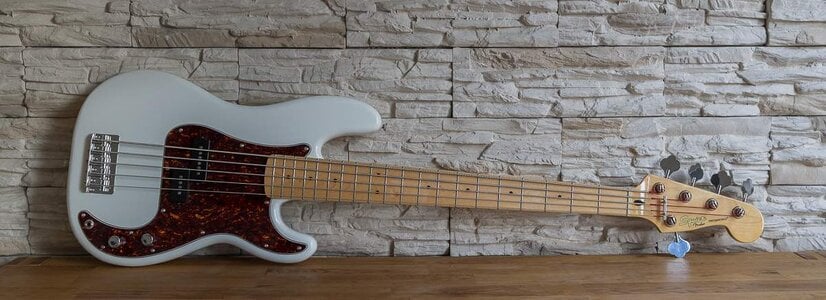
The original bridges on these are a bit wonky IMHO so that's why I replaced mine with a Hipshot A style. It improved the tone a bit as well (again, IMHO)

TalkBass has been independent since 1998. Add your voice.
Create a free account to reply to discussions, view embedded media, and browse with fewer display ads.
Join free Log in
Want zero display ads or expanded classifieds tools? Compare plans.

The original bridges on these are a bit wonky IMHO so that's why I replaced mine with a Hipshot A style. It improved the tone a bit as well (again, IMHO)
The original bridges on these are a bit wonky IMHO so that's why I replaced mine with a Hipshot A style. It improved the tone a bit as well (again, IMHO)

This is a common problem when experimenting with strings.They are not all as far back as they can go. I guess I need to turn the screwdriver some more!
This is a common problem when experimenting with strings.
People expect intonation changes when going from round wounds to flats, for example, but even minor changes within brands or gauges can require a quick readjustment.
Hex VS round core, changes in the ratio of core to wrap sizes, the number of wraps, etc., all affect intonation, as do minor action adjustments and seasonal changes in the neck relief...

I just traded a 655 away and I have a VM P 5. I just did not dig the tone of the Ibanez although the Nordy pups sounded better than the Bartolini ones they have been using. My VM P 5 has Nordy pups and a Hipshot bridge and is quite delightful.I'm considering the VMP five stringer or an Ibanez SR655 or just getting a decent 4 stringer pbass and going BEAD. I want the mix cutting pbass sound with a decent B string. Part of the draw of the Squier is the simplicity of a passive pbass.
Which do you recommend?


As you know, the way Fender or any big company keeps prices down is by saving on workers wages and materials. The stock hardware might look the same or similar to MIA Fenders but they are not. They are made of cheaper materials and don't work as well. Maybe those materials work just fine for some people but they don't compare to quality parts like Hipshot. I wanted to get the most out of the Bass that I already had so that's why I upgraded everything. This is all just IMO.
YMMV and so on.....
I agree. I also hear an audible difference between a good high-tech bridge and a bent-plate. Especially if the the fancy bridge locks the saddles down, using a nice large contact area (like the Babicz).
But when it comes to regular "vintage style" bent-plate bridges, the only useful benefit I've ever been able to find, came from swapping saddles.
Bridge plates are generally made from roughly the same gauge steel, bent to similar proportions, and then chromed or nickel plated. I defy anyone to demonstrate a clear difference in tone between domestic or offshore bridge plates, or between current Squier production and pre-CBS Fender.
Saddles, on the other hand, do vary in meaningful ways. Squier basses are made in at least a couple of different factories, and the saddles are either cast from lightweight pot metal, or machined from solid stock, Fender-style.
Squier has used both kinds over the years. Because they use steel for their billet ones, a magnet is the easiest way to tell what you've got.
- Cast saddles are usually recognizable by their slightly rounded, bulging ends, and the horizontal mold line that runs across the end of the saddle.
- The machined ones are generally steel, with a perfectly flat end. If there are any machining marks under the chrome, they will be visible as concentric circles on the end, from the cutoff tool.
My VM Fretless P-bass came with pot metal saddles, and it sounded noticeably different after I upgraded to vintage-style Allparts "threaded" steel. "Better" is a subjective term, but I personally prefer the steel.
On all the VMP5's I've seen, the stock saddles were steel. Because of the narrower spacing on the 5-string, you can't swap all five saddles for the Allparts ones. However, I have mixed and matched them in order to adjust string spacing problems. Interestingly, the Allparts saddles must be made from a different alloy, as they don't attract a magnet quite as strongly.
Despite the sharper edge on the string grooves, neither I nor my friends can detect any difference in tone between the Allparts saddles and the stock ones.
I currently have 3 stock saddles and 2 of the Allparts ones on my VMP5.
There's no audible difference between the D & G vs the other strings, even with fresh roundwounds. I tried one under the B string, but that didn't make any difference either. I prefer the way the stock saddles look, so I have been meaning to re-fit them, along with a couple of shims to fix the spacing issue.
Awesome! You got one at the lower end of the weight range.
Am I correct in assuming that the colour balance in your photo is off, and the bass is Oly White?


Sadly, I'm not aware of a rosewood option that's a straight drop-in for these basses.that sure would look nice with a rosewood board also
Sadly, I'm not aware of a rosewood option that's a straight drop-in for these basses.
The VM Jazz V has the same comfortable neck carve, but it's maple, too.
The Jaguar V's neck has a Rosewood board. Unfortunately, the one I sampled appeared to have come from one of their other factories. It had a thin matte finish, lots of fret sprout, and was generally a step down.
I would proceed with caution if I was considering a neck swap w/one of those: the heel profile may be different. Also, the fret sprout may be an indication that those necks aren't as stable...