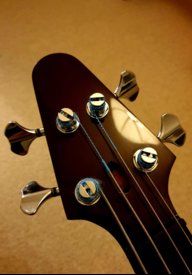
Yeah those are the tuners I'm using. If I can get it under 7lb I'll be a happy bunny!I’ve made a lot of light basses without neck dive. If you use the clunky steel tuners (Fender style), it can be an issue, but with Hipshot USA ultralights, I’ve made P’s as light as 6.6 pounds, and 5 string basses as light as 7.0, without a hint of neck dive.

Enjoy the benefits of a premium membership!
Upgrade Account
-
TalkBass has been independent since 1998. Add your voice.
Create a free account to reply to discussions, view embedded media, and browse with fewer display ads.
Join free Log in
Want zero display ads or expanded classifieds tools? Compare plans.
You are using an out of date browser. It may not display this or other websites correctly.
You should upgrade or use an alternative browser.
You should upgrade or use an alternative browser.
Super-lightweight P bass build
- Thread starter Flying B
- Start date
More options
Who Replied?Try a T-Bird! Never picked one up that didn't dive like a submarine. That headstock is HUGE.
Maybe I got lucky, but the epi T bird I used to own didn't neck dive at all. It was a great sounding bass, but the neck was just too skinny for me so ended up selling it.

I've been doing some uniquely constructed electrics with ultra-light bodies made from big box construction pine. Before giggling do take a look at the topic HERE. You could certainly do the same thing to produce a lightweight P bass.
That's a great thread Rudy! I'll read it all when I get time.

I’ve made a bunch of consistently light basses, and although it seems obvious, the secret to making a light bass is to make sure every part is light. My basses have roasted maple necks with graphite reinforcing rods, roasted ash (selected for light weight) bodied, ultralite tuners, aluminum bridges, aluminum neck plates, even the knobs are aluminum. Hardware made out of brass is literally 3x the weight of aluminum hardware - every gram matters.Yeah those are the tuners I'm using. If I can get it under 7lb I'll be a happy bunny!
Race car mentality!I’ve made a bunch of consistently light basses, and although it seems obvious, the secret to making a light bass is to make sure every part is light. My basses have roasted maple necks with graphite reinforcing rods, roasted ash (selected for light weight) bodied, ultralite tuners, aluminum bridges, aluminum neck plates, even the knobs are aluminum. Hardware made out of brass is literally 3x the weight of aluminum hardware - every gram matters.
This will be a slow burner, as usual, as I'll only be working on it in 30 minute bursts in my lunch break at work. I do work in a cabinet making workshop which helps with access to machinery etc.

I started work on a template for the chambering today, I already had a body template from a previous build. I'll need to make a neck one too.
I started work on a template for the chambering today, I already had a body template from a previous build. I'll need to make a neck one too.

A penetrating epoxy product, like Rot Fix, (designed to repair rotting wood trim) might work well to seal and toughen the wood, making it less susceptible to damage. I'd apply it after you're done shaping.
On the right track, but I wouldn't use that type of epoxy. ( I did experiment on scrap) The last two basses I built, I used paulownia which is very light and quite soft. I used a couple coats of West Systems epoxy. It sands nicely and accepts paint very well. After finishing, it as hard/stable as any ash/alder bass I've ever owned.

I finished routing the cavities today and also got the top glued up. The two halves had cupped a bit since I cut them so had to run them over the planer to flatten them a bit so they are only about 7.5mm thick now. I have some black veneer so I'll probably put a layer of that under the top to get a bit more thickness (and it looks cool!).
I may be able to get the sandwich glued up tomorrow.

I may be able to get the sandwich glued up tomorrow.
I managed to get the body sandwich glued up yesterday, I'm afraid I forgot to take a picture in all the excitement.
But it got me thinking about using west systems epoxy as a finish, as when I slathered the underside of the walnut top with epoxy it looked fantastic. Has anyone tried it, and if so how did you manage to not get any runs?
But it got me thinking about using west systems epoxy as a finish, as when I slathered the underside of the walnut top with epoxy it looked fantastic. Has anyone tried it, and if so how did you manage to not get any runs?
Glue is dry. I got the body rough cut on the bandsaw and made a start routing with the template. Pinstripe looks good!

Walnut wetted down a bit to show the grain.

Walnut wetted down a bit to show the grain.

A number of people have documented using West or other epoxies as a grain filler, which it's better at than some common grain fillers because it doesn't shrink.
It's not generally a good choice as a finish, since it is prone to degrade from UV exposure. Any clear finish should give very similar "wet look grain popping" effects as the layer of wet epoxy did. Most clear finishes will do a better job of being a finish than epoxy would, long term. Stock approach with things surfaced with epoxy (such as those with a layer of fiberglass over the surface, wetted out with epoxy so it goes clear but adds strength - not needed in guitars, normally) is to use a clear finish over the epoxy.
It's not generally a good choice as a finish, since it is prone to degrade from UV exposure. Any clear finish should give very similar "wet look grain popping" effects as the layer of wet epoxy did. Most clear finishes will do a better job of being a finish than epoxy would, long term. Stock approach with things surfaced with epoxy (such as those with a layer of fiberglass over the surface, wetted out with epoxy so it goes clear but adds strength - not needed in guitars, normally) is to use a clear finish over the epoxy.

It's not generally a good choice as a finish, since it is prone to degrade from UV exposure. Any clear finish should give very similar "wet look grain popping" effects as the layer of wet epoxy did. Most clear finishes will do a better job of being a finish than epoxy would, long term. Stock approach with things surfaced with epoxy (such as those with a layer of fiberglass over the surface, wetted out with epoxy so it goes clear but adds strength - not needed in guitars, normally) is to use a clear finish over the epoxy.
Huh? West Systems epoxy is designed and sold specifically to be used as a finish on woodwork on boats. In addition to being a structural adhesive. It's a very tough finish, made to withstand extremes in sunlight, temperature and saltwater.
When painting basses, we generally like polyurethanes and polyesters and lacquers for most of the finish for the beauty. Brilliant colors and high gloss. Most epoxies have some built-in amber shade, which looks great on bare wood, but it's tough to work with other colors. And epoxy, like West Systems, always stays a little soft, so it's harder to polish up to a high gloss. And, of course, epoxy is particularly nasty to spray, so it's usually applied by brush or roller. More work getting it smooth and level.
West Systems works great as an all-in-one super tough finish on some handsome looking wood. As long as you are okay with the amber tint, and you use some technique in level sanding it and polishing it up to a mild gloss.
I haven't used West Systems for the complete finish on one of my basses yet, but I'm tempted to try it on one of my all-walnut models. Right now, I use West Systems to fill the grain and make a smooth base, and then use water-base polyurethane for the color coats and top clear coats.
It's intended to be protected by varnish, gelcoat or paint:
Finish coatings like paint or varnish are applied over an epoxy barrier coat to decorate the surface and protect the epoxy from sunlight. The finish coating extends the life of the epoxy moisture barrier, which in turn provides a stable base that extends the life of the finish coating. Together the two form a protective system far more durable than either coating by itself.
Protection from sunlight is a primary consideration in the selection of a finish coating. Long-term UV (ultraviolet) protection of the barrier coat depends on how well the finish coating itself resists UV and keeps its pigments or its shield of UV filters on the surface of the epoxy barrier coat. A high gloss finish reflects a higher proportion of the light hitting the surface than a dull surface. All other things being equal, a white (especially a glossy white) coating will last the longest.
WEST SYSTEM ® 207 Special Clear Hardener has
been specifically developed for coating applications
where an exceptionally clear, moisture resistant, natural
wood finish is desired. An ultraviolet inhibiting
additive improves resistance of a WEST SYSTEM ®
105/207 mixture to sunlight, however, the cured
epoxy surface will still require further UV protection
with a quality UV filtered varnish or two pack
polyurethane paint. It has been designed to work well
in humid conditions.
Multiple coats of
105/205 Epoxy create a superior moisture barrier and a tough, stable base for paints and
varnishes.
In West Systems, a clear finish would be 105/207 (not 105/205 nor 105/206 which are not intended for that per the data sheet) followed by a Marine Spar Varnish or other clear UV filtering finish.
Last edited:
I managed to get the body sandwich glued up yesterday, I'm afraid I forgot to take a picture in all the excitement.
But it got me thinking about using west systems epoxy as a finish, as when I slathered the underside of the walnut top with epoxy it looked fantastic. Has anyone tried it, and if so how did you manage to not get any runs?
West Systems makes a great all-in-one finish for a wood like walnut. But yes, you have to brush or wipe it on. You have to be real careful how thick you put it on, to minimize runs, lumps and brush streaks. And you'll have to sand them down when leveling. Not real hard to do, as long as you understand the technique of sanding epoxy.
It's intended to be protected by varnish, gelcoat or paint:WEST SYSTEM ® 207 Special Clear Hardener hasbeen specifically developed for coating applicationswhere an exceptionally clear, moisture resistant, naturalwood finish is desired. An ultraviolet inhibitingadditive improves resistance of a WEST SYSTEM ®105/207 mixture to sunlight, however, the curedepoxy surface will still require further UV protectionwith a quality UV filtered varnish or two packpolyurethane paint. It has been designed to work wellin humid conditions.Multiple coats of105/205 Epoxy create a superior moisture barrier and a tough, stable base for paints andvarnishes.In West Systems, a clear finish would be 105/207 (not 205/206 which are not intended for that per the data sheet) followed by a Marine Spar Varnish or other clear UV filtering finish.
Okay, but I can tell you from personal experience that I've put wooden parts coated with 105/206 out in the CA sun for 2 years as a test, and didn't see any significant degradation of any kind. Color, bond, shrinkage, anything.
I don't think there's any reason to worry about UV degradation of a West Systems finish on a bass.
My Brother was a boat repairer/builder for a few years, all he ever uses is West System, it's more or less impervious to the most brutal salt water conditions. I found out recently that it does indeed have a shelf life when my can of resin turned a bright cherry red. I think I had that can for at least 10-15 years, so I'm not complaining much. Other than making a few repair projects a bit "pink", it didn't seem to affect the bonding strength, but I "retired" it and got some new cans. I'm researching various options for poured epoxy resin fingerboard inlays, and West is near top of the list. My only hesitation with a lot of the commonly available resins is that they are only available in quart or gallon quantities, which would take me forever to use. I tried Zpoxy as a grain filler on Cocobolo and still got a couple patches where the finish failed to stick, mist have sanded through the epoxy filler when leveling it, which is easy to do with epoxy. I have yet to try it as a full finish coat on anything.
As I've mentioned several times, West 207 "special clear" hardener has much longer shelf life than 205/206. My research before buying epoxy found folks that used 10 year old, had been opened cans for boat repairs with no issues nor off colors (being stuck at some remote location and that what they had available.) This seems to be a difference between the "amine blush" hardeners and the "non-blushing" hardeners. What I actually bought is Progressive Epoxy Polymers basic no blush, and it's going on 16 years in my personal stash, still cures nicely; that hardener has yellowed a tiny bit from when it was new. If it will take you forever to go though a quart, 207 would be the hardener to buy.
Last edited:
When I went to use my epoxy last week (which is several years old) the resin itself had gone very thick and gloopy in the can, the hardener itself was fine. I ended up using a different can we had at work, I'm reading now that if I stand the thickened stuff in warm water it may become usable again.
I made a start on the neck blank today. I've been hoarding this nice piece of sycamore for a while. It's nicely quarter sawn and was very reasonably priced.


I believe it was air dried, and it's incredibly stable, it stayed arrow straight when I ripped it into strips. Hard to photograph but there's some nice subtle figure in it too.

Managed to get it glued up with some walnut strips and black veneers.
It's wine o'clock now here, happy weekend everyone

I believe it was air dried, and it's incredibly stable, it stayed arrow straight when I ripped it into strips. Hard to photograph but there's some nice subtle figure in it too.
Managed to get it glued up with some walnut strips and black veneers.
It's wine o'clock now here, happy weekend everyone


