• TalkBass has been independent since 1998. Add your voice.
    Create a free account to reply to discussions, view embedded media, and browse with fewer display ads.
    Join freeLog in
    Want zero display ads or expanded classifieds tools? Compare plans.

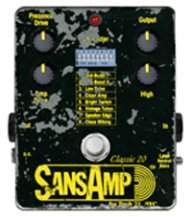
Tech 21 Club

Do you have a theory or mental model for why it’s so nonlinear?
Just pots being pots. This is typical IME, with the effect being determined by the pot, taper, and circuit. I think if you were to test this with many various pots on many circuits you'd find similar nonlinearities, especially at the extremes.

seems to require understanding of the underlying implementation.
I don't think it's unintuitive. Just to follow up on my question in my initial response, how do you have the output level set for the out you're using? Do you have it set to inst?
 
Pots are imprecise components and can vary 15-20%. This is why we test on a scope. In general if you are using any of our DI's with an amp you want to shoot for unity gain level wise. When used with a mixer you will normally need to engage the -20dB PAD unless you are going into a line channel or using a power amp.
 
Count me in!

I'm rockin' two Tech21 NYC GED-2112 SansAmp rack units for a stereo rig. 😎😎

Here's a lazy photo I just took.
ResizedImage_2026-04-05_21-01-29_4400.jpg
 
Yes it does, but it does less and less the higher you get. If you need more room to make adjustment, perhaps alter your gain staging after the BDDI so you can start with a lower level setting and work from there. What output signal level option do you have selected? Line or instrument level?

Just to show you what mine does at various levels, the chart below shows my BDDI v1 here using these settings:

View attachment 7464811

And here are the results with the level starting at 9:00, then brought to 12:00, 1:00, 2:00, 3:00, and max:

View attachment 7464812

As noted, if you're already operating at the top of that range, the best option may be to set up your gain so that it runs with a lower level to start, then you have more flexibility to move it up or down as needed.


Oh, wait a minute! With Blend at zero, your Level does something? Mine has no effect (via the 1/4" output).
 
It looks like the inputs on the VT Deluxe are an either/or situation. If you're looking to have simultaneous clean and dirty channels, I don't think it will do that. You can switch between clean and dirty, but not have both come out of the VT at the same time.

A possible solution for this would be to get a small 2-channel mixer and add that to your board directly before the preamp, so you're blending the two signals together then running that into the VT Deluxe.

Are you considering the Deluxe just for the purpose of running parallel effects like this? Or are there other features of the deluxe that appeal to you as well? I am wondering if you'd get the result you want by getting the smaller/cheaper standard VT Bass preamp, then using the space and money you save to have a summer/mixer pedal on the board. Here's a diagram of the signal chain (please forgive my handwriting)
View attachment 7454764

I've done this before myself and it's pretty great, especially if you're using one channel to put a lot of effects on - you can blend in the second channel to get some cleans along with your dirty signal. Happy to answer any other questions you might have about how to make this work!
Sounds like a Boss LS-2 job maybe
 
  • Like
Reactions: bigtone23
Does the EQ do anything with blend at 0 still? It should also.

I can't fully tell what's happening there in your chain, but I assume it does this all when the BDDI is the only thing in your chain as well?

Yep the EQ does work.

There’s nothing else in the chain besides the BDDI here. You can see - I’m turning the Level knob all around and it has no effect. It does have an effect when I’ve increased the Blend.

Assuming I’m right about the signal chain, is this normal?
 
Nope! Unless I'm sorely mistaken, if the EQ on the BDDI works but the Level does not, that means something isn't working correctly.
According to the manual and my experience:

LEVEL adjusts the output level of both the 1/4” and XLR outputs.

BLEND allows you to blend the direct instrument signal with SansAmp Tube Amplifier Emulation circuitry. In most cases, you will probably have this set at maximum (100% SansAmp). For certain applications, however, such as an ultra-transparent sound or for use with piezo pickup-equipped instruments, you may want to blend-in the direct signal to achieve your desired sound. While the SansAmp Tube Amplifier Emulation circuitry is bypassed when Blend is at minimum, the Bass, Treble and Level controls remain active.

This output should not be affected by controls...

PARALLEL OUTPUT: 1/4” unbalanced direct output is “hard-wired” parallel with input jack. Instrument signal passes through, UNEFFECTED, to the input of your stage amplification system, if desired.

I think there may be something wrong with the unit. The Tech 21 folks are great about helping you troubleshoot when you call...they have always been very accommodating when I needed help. IME Tech 21 customer support and product quality are top tier. Everyone has an occasional product issue and on those rare days it's always nice own a piece of gear where the company cares about their customers and their reputation among players.

I recommend you give them a call.


I proudly share my big comparision project with you here in hope that it may help some players to decide which pedal to get, ore to help owner understand their unit better. I made a lot of effort to provide the frequency graphs and finally have something like this on youtube. there is a fantastic talk bass post about the VTBass and its character knob that i need to find and credit both here and in the infobox of the video. thanks so much to that person, it really helped me to understand my measurements...

if you have tips what could have been done better or what parts i should keep for future videos, let me know!
Darius
 
if you have tips what could have been done better or what parts i should keep for future videos, let me know!
I enjoyed the video. One comment: your default Presence setting on the BDDI is at noon, but that control is boost only*, so flat is actually fully counterclockwise.

*Presence was boost only on the original BDDI and RBI, anyway.
 
I need to double check but I believe my experience differs from that, and it is a bit of a point of contention for me.

IIRC BDDI Presence at noon is approximately similar to RBI boost off. Something like that. I do recall that with presence at noon the RBI has an incredible amount of presence dialed in. Almost a stupid, unusable amount IMO (at least on the 7 or 8 RBIs I've tested :D ).
 
  • Like
Reactions: thegrimmbass
This was a point where i went back and forth on several times...
i remember reading somewhere that the presence was boost only. then later i stated that in the earliest version of the video (that i trashed...) and then wondered where i got that info from and i could not find it again. the manual of the v2 states: "brings out the upper harmonic content and attack. For a smoother high end and for clean settings, decrease to taste." this could still mean both. i emailed tech21 about this and other questions and unfortunately never got any reply :/
 
OK, I am a man of data, and it looks like I've been proven wrong here. Mostly. My recollection that the RBI has a drastic difference in presence boost at noon from the BDDI v1 at noon was correct, However the starting and ending points are similar. See sweeps below. The curve with higher presence is the RBI in each instance.

RBI vs BDDI v1 with Presence at 0:
1775662028410.png


RBI vs BDDI v1 with Presence at 12:00 o_O:
1775662066353.png


RBI vs BDDI v1 with Presence Max:
1775662103664.png