• TalkBass has been independent since 1998. Add your voice.
    Create a free account to reply to discussions, view embedded media, and browse with fewer display ads.
    Join freeLog in
    Want zero display ads or expanded classifieds tools? Compare plans.

The difference between an average player and monster chops...

Status
Not open for further replies.
First, different strokes for different folks, to each his/ her own, and all that stuff.

Second, I personally believe that if medium scale basses were an all-around *that* much better, each manufacturer would produce more than they do, which is obviously few in number and currently meeting demands (also obviously few in number). These manufacturers are not stupid, they understand how supply & demand works: simply put, if people wanted them, they would be made.

Lastly, BassHappy, you are apparently very passionate about this and your basses, which is good. But this is *your* thing, so keep on keepin' on, let the chips fall where they may, and let everyone discover what basses they will in their time whether it be fretless, 5-string, 6-string, or a shorter scale instrument.

Have a great weekend all!
 
BassHappy,

Personally, I was more mystified than offended by your original post. If your point was / is Guys, there are some really nice medium scale instruments out there. Check them out and you might be surprised at how good they are. For some of you, they might even resolve some comfort issues you have with long scale basses, I doubt you would have caught so much flak. You certainly wouldn't have woke me up.

But when you state definitively and universally that medium scale is better than long scale and is the difference between being average or having "monster chops"...point / set / match! Well, that's pushing things a tad bit. I don't doubt that medium scale has provided you with a refreshing improvement to your bass playing life. That's great! I've played medium scale basses and enjoyed them. Would do again if the right bass came along at the right price. Thing is, going from medium to long or vice versa for me is simply not a big deal. And judging by the responses in this thread, I don't think I'm in the minority in thinking that way.


Hey again.....

First of all I would like to apologize to anyone out there who felt that my post was "condescending". It certainly was not my intent, but I can see in re-reading the original post how someone may think that. For that, I apologize and I accept responsibility for the fact that I have apparently driven some of you away from the post. I guess many of you can just stop here because I have offended you. It's too bad really, because I feel it has been fascinating reading all the responses, good and bad. However for those still interested - feel free to read on. In my eyes, bands like Happy the Man who cut their teeth on bands like Genesis, Gentle Giant, Yes, Van Der Graff Generator and American fusion bands like the Dregs, Mahavishnu and Weather Report are just in a different world from country and blues. My mistake and I apologize.

I started at 12 on a Kay Old Kraftsman, worked by way up to a short scale "mustang" body style Kalamazoo - then got a Gibson EB-0. I then went into the army and bought a new 1972 Fender Jazz through the PX. I used it for a couple of years, and always managed but struggled down low playing the fast passages the music in my band required. Then, we were perfecting a song from "Death's Crown" which was later released on Crafty Hands called "Open Book". The song calls for a three count sustain on each note during the verses and due to the dead spots in the neck on the Fender it completely interrupted the flow of the song - as certain notes just refused to sustain. It made the bass unusable for that tune. So, I switched to a Rickenbacker, which at the time I didn't know was a 3/4" shorter scale, but I knew it felt better and lo and behold no dead spots - but I wasn't in love with the width at the nut. I ended up using the Rick on the entire first eponymous "Happy the Man" record, except when I got the bass from Paul - Ken Scott allowed me to go back and re-record "Knee Bitten Nymphs in Limbo".

When I actually received the first bass he built for me which was 32.5" scale, it was like coming home. I could relax and play all of those really low fast passages I had struggled a bit with in a much more comfortable way. It took me 12 years, but it was over the top inspiring in a way I can't really properly describe with words - to find a bass that actually FIT me.

Ever since this life changing event, I felt a responsibility to make sure there is an awareness among players young and old, that basses can be just like anything else. There are SIZES and as expressed before, I am not a SHORT SCALE guy - I love my Rob Allen - it is great as a compositional tool and I can play it for hours and hours without fatigue, but for the most part short scale basses are too small. and just not comfortable. I played them years ago and simply outgrew them.

It was almost by mistake that I found out about medium scale in 1976, and I am hoping to put a glow in someone else's life when they finally get ahold of a world class or at least a decently constructed medium scale bass and have endured similar issues as me. I know what it can mean. It's not just short scale and long scale - there is something in between and it's rockin!

Thanks for listening....

BassHappy
 
I am perfectly happy to stick with the discussion a bit.

It's definitely not something you can be definitive about, but one should always explore for themselves what's available, and what really suits them.

I really like my Fenders/Squiers, and Fender style instruments in general.But it's really not any kind of fanboyism or "it was good enough for whoever, so it's good enough for me" attitude.

I spent time in my early years playing different things. I never knocked anything else. Everything I tried had a fair chance. There was just nothing I liked as much as the classic Fender sound and style. I have what suits me, and I am content.

Same with scale. Different things suit different people, naturally.
And if medium scale were more popular, they would likely be more common. But that's a possible catch 22. Maybe they remain less common because enough people that they suit are NOT checking them out, hence a potential demand that goes unrealized, limiting the production of them. Or maybe they really are not that popular. Just speculating a bit here.
 
Slightly off topic, but it comes around.

I checked out 'Happy the Man' cus of all the mentions and I do like some prog rock.

In this video, you can see the drummer dressed in a white spandex one-piece bikini blowing up a balloon while he crashes cymbals together. About 1:25 in you can see him in his spandex bikini, hips cocked, making some twinkling noises. Unfortunately you only get quick glimpse of the bass...it was too short.


In short, it does not surprise me that the bassist of this band likes a daintier instrument. What does surprise me is that the Daisy Rock line doesn't show up in the site dedicated to the basses. I think they're 30" scaled basses, so the OP should be able to pull off some Paganini with a minibass like that.

I've only ever tried a few shorter scaled basses, I didn't like them, they lacked bottom. It was as if they hadn't hit puberty yet.

:D
 
And if medium scale were more popular, they would likely be more common. But that's a possible catch 22. Maybe they remain less common because enough people that they suit are NOT checking them out, hence a potential demand that goes unrealized, limiting the production of them. Or maybe they really are not that popular. Just speculating a bit here.

Given that there are quite a few 30" basses available, thousands of 34" and plenty of 35", but not much at 31, 32, 33... it seems fair to suggest that the curve of what's available doesn't really match the curve of what would be suitable for the bass-playing population as a whole.

I've never noticed a 32" bass in any shop I've been into, but would love to try one.
 
Let me tell you a little story. Once upon a time in a faraway land there lived a young man who wanted to play the bass guitar after seeing Gary Thane blast his way through a 2-hour long Uriah Heep show in 1972 via a late 60's Fender P-bass and several Ampeg SVT stacks. About a year later, this young man bought a Fender P-bass for $200. Then he bought other basses like a Plexiglass Dan Armstrong, an old beat-up Telecaster bass, a Vox "Banana Splits" bass, etc. Then he stumbled upon a Gibson EBO3 short scale bass. For the young man, it was like sticking your finger in a light socket. He was enlightened. He played the EBO3 for about a year and then sold it for beer money. Now, some 40 years later, this young man (now almost 60) decided to buy another short scale bass (a cheap Epiphone EBO made in Korea, 30.5 in. scale which he has heavily modified). Enlightened once again. I will NEVER play a long scale bass again. The magic of the short scale bass has returned! Polythemus
 
The idea that short scale makes anyone better is one of the stupidest things I've heard here. Does that mean all bassists should be masters of the electric guitar? I've seen MMW's bassist go from Hofner to Precision to upright and his "chops" (hate that word) were best on the P. no scale correlation there.
 
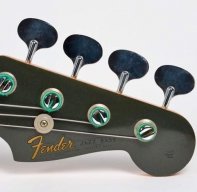
I have one of these...
fernandes-nomad-bass-pewter-59141.jpg

And it's just plane fun to sit in a lawn chair on the patio and play with other people. I don't notice the short scale, like I said, it's just fun to play.
 
I get what the OP is saying. The term "chops" has different meanings to different people though. Like I said earlier, the chops that matter most to me are timing, note choice, rhythm, and dynamics. But if your definition of chops means technical ability, fluidity, speed, dexterity, etc.. then I can agree a shorter scale CAN improve some people's chops.

For a more extreme example, I know when I pick up my little 26" scale Samick mini bass, I can stretch my hand and hit at least 1 or 2 more extra frets (compared to a 34") without changing position.. and about 3-4 more frets in the upper reg. Not having to change positions can make it easier and faster to play some lines, especially lines that make you stretch a little on a 34".

But on the flip side, I have to look at the fretboard a lot more when I play melodic stuff on the mini bass, because I learned all my positions on a 34" and my muscle memory naturally makes me overshoot the notes sometimes. So overall, I don't think the "reach" advantage improves those kind of chops for me if I have to stare at my hand half the time.

I have a Hofner too (32" scale), but when it comes down to it, I personally play the best on my 34"ers.
 
Its an interesting argument in theory yes a shorter scale should be faster but if youre some one whose played a long scale bass for years it maybe difficult to untrain your muscles to not miss the frets.

To be honest a bigger concern for bassist should be actually hearing basslines that work with the song. We arent supposed to be front men were supposed to glue everything together. Its also why I get annoyed when people make statements like if you cant do x technique you aren't a good bassist or if you can't play x speed you aren't good . Its really a ridiculous argument when you think about it.
 
The idea that short scale makes anyone better is one of the stupidest things I've heard here. Does that mean all bassists should be masters of the electric guitar? I've seen MMW's bassist go from Hofner to Precision to upright and his "chops" (hate that word) were best on the P. no scale correlation there.

Why is it stupid to believe that for some people a short or medium scale bass fits them better? Some people utilize a 3 finger technique when playing the first 4 frets. If they bought a great 31" that is the equal of any bass, like a Birdsong, and were able to use 1 finger per fret on the whole neck, how could this not increase their efficiency?
 
Given that there are quite a few 30" basses available, thousands of 34" and plenty of 35", but not much at 31, 32, 33... it seems fair to suggest that the curve of what's available doesn't really match the curve of what would be suitable for the bass-playing population as a whole.

That's why I say it's just speculation. Nor am I talking about the bass playing population as whole. But, what if enough bass players would like them, and would find them more suitable than long or short, but have for one reason or another(other peoples' negative opinions or simple tradition being two possibilities) never given them a chance. They simply get overlooked.There is the potential demand that never fully materializes, so companies only cater to the demand they see, which is why there is less in the middle ground.

Speculative, and maybe pure BS in the end, so feel free to take it with the appropriate grains of salt.
 
But, what if enough bass players would like them, and would find them more suitable than long or short, but have for one reason or another(other peoples' negative opinions or simple tradition being two possibilities) never given them a chance. They simply get overlooked.There is the potential demand that never fully materializes, so companies only cater to the demand they see, which is why there is less in the middle ground.

Hence why I fully support the OP's message. Let's all demand 32" basses! we can always burn them if we don't like them!
 
Status
Not open for further replies.