Half space loading happens when the speaker is less than 1/4 wavelength from the floor, so lifting it even two feet won't change the low end. It only seems less bassy because you can hear the mids and highs better. If you want to hear the mids and highs when the cabs on the floor use a pair of vertical 2x10s or 2x12s. If you don't want to carry that much gear lift the cab or tilt it back, or use a cab with built in tilt back. Heck, even Leo Fender had that figured out when he put tilt legs on his speakers sixty years ago.While I understand your design goals with some of your models, you have to acknowledge that it's much, much more common for a player to expect a balanced response with the typical half-space loading that usually comes with placing the cab on the floor.

Enjoy the benefits of a premium membership!
Upgrade Account
-
TalkBass has been independent since 1998. Add your voice.
Create a free account to reply to discussions, view embedded media, and browse with fewer display ads.
Join free Log in
Want zero display ads or expanded classifieds tools? Compare plans.
You are using an out of date browser. It may not display this or other websites correctly.
You should upgrade or use an alternative browser.
You should upgrade or use an alternative browser.
The Dispersion Issue
- Thread starter BassOnTheSide
- Start date
More options
Who Replied?
I think this is one of the best sites for learning about the value of dispersion: Linkwitz Lab - Loudspeaker Design
Pros of good dispersion:
1. Easier to hear yourself
2. Easier for your bandmates to hear you
3. Easier for your audience to hear you
4. More consistent tone with changing listener position
5. More consistent tone in different venues with different acoustics
6. Stage-monitoring becomes less important
7. PA support becomes less important
8. Any bleed into mics sounds more like your preferred tone
9. You get a better performance from the band because they're all hearing the music better
10. The audience enjoy the gig more because the band are playing better
Cons of good dispersion:
1. More bleed into mics
2. Your mistakes are more likely to get heard
3. If you talk about it you risk being accused of being some techy nerd who's more interested in gear than music...
I like good dispersion because I hate fiddling with gear when I'm in 'musician mode' and a cab with good dispersion makes setting up, sound checking and gigging a whole lot easier - especially when you're playing small venues with less than ideal sound engineering and PA systems.
Excellent post.
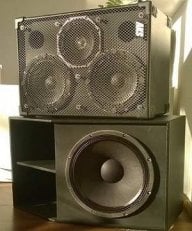
We've addressed these issues with our cabs. And while that can be seen as a bold claim... it can also be taken as just a statement of what we've accomplished. With our slightly angled baffles ( and lower oriented tweeters) the front drivers can be heard while standing very close to the cab or even sitting with your head beyond the front edge. We didn't know for a fact that it would work well, we prototyped it until it did. The three slots on the bottom of the cabs direct the lows and mids of the bottom speaker in more than a 180 degree pattern. Yes, there are more than lows coming out of those slots. And we're not getting complaints about bleeding into mics. Or hotspots. Many drummers and bandmates have commented favorably to bassists about what they're getting.
So is this the perfect cab for everyone? Of course not. But we tried to address the issues we ran into as professional bassists in a variety of venues. And it's great when we get positive feedback from folks telling us we undersold the benefits.

And I've successfully, but not always, refrained from embarrassingly fawning over each and every "it depends" of yours even though I did feel a strong urge to. I really applaud that.You are not the only one who is interested in this topic. I have received some really good and interesting questions about this topic via PM, which is why I feel that it is important for the community as a whole that this discussion remain accurate rather than simplistic (black-white) rule of thumb only. I hope this information helps understand why I have a problem with somebody stating exclusionary "black and white" answers for a decidedly "gray" situation. It just can't be black and white because to make it so would be to eliminate ALL of the most important real world variables.
That makes sense. One time, when I had to explain to a poster what it means when two given drivers beam differently (yeah, I know - I can only say I tried my best) I found myself mentioning frequency, angle and roll-off bandwidth as separate points of view of the phenomenon.An interesting general note about line arrays. It's often said that the vertical pattern of an array is, say, 40 degrees, therefore nothing is heard beyond the 40 degrees.. This is a very simplistic and inaccurate answer because the 40 degrees is still based somewhat on frequency, and it's not a brick wall cutoff but a 3 dimensional function of level versus position and frequency. At 50 degrees, the output may be 8dB down at some frequency (say 1000Hz) but now if you are only 5 feet away at 50 degrees, the level will be the same as on axis at ~20 feet, so position (distance) is just as important as position (angularity from the axis). So, the level match may in fact be pretty darn ideal close but off axis. This is one of the principal aspects of acoustic energy density shading for level balancing and can be seen every day in the large format system "J array" topology, where fewer boxes and greater splay (less on axis summed energy) at the bottom of the J reduce energy density to match up with the rest of the system at a farther distance.
(here, here and especially here.)
Since we've moved away from discussing a specific product, are radiating planes not created equal then? Does a 4x8" behave differently than a single 18" after all, just as (or maybe only "similarly to") different single drivers of same (nominal or actual) diameter cannot so easily be predicted to beam exactly at the same point in their response? OTOH I've learnt here not to assume 4x driver configurations disperse like a single one of them off-axis. For the sake of discussion lets assume both the 408 and the 118 are on the floor and the player stands in front of each one or slightly to the side, to rule out, uh, what I'll informally/uninformedly call "proximity effects". (I suspect something of the latter sort does come into play with full stacks, if people here, all the time, suggest bringing speakers "next to ear level" as something actually beneficial, which I assume to be the case even if that is not really the same thing as "at least one driver directly pointing at your ear": only really tiny players are as tall as a fridge, no?)Correct, there are other factors that I mentioned, including the size and spacing of the individual elements, the number of the elements and the total length of the array.
So yeah, that's it basically: is a tweeterless 4x8, 4x10 or square 4x12 just a big bad radiating plane a couple feet+ wide, or does good stuff manage to escape to the side? People gig them all the time, even outdoors with little or no reflecting surfaces to speak of, and still can make out what notes they're playing if not simply enjoy the tone, even off-axis (which is anything but rare, as relative placing goes).
While there's plenty of discussion about "better" designs, and especially about their superior dispersion, on this board, a couple words about why "worse" stuff kinda works anyway wouldn't hurt. And I mean it: I doubt a significant slice of bass amplification buying market would be swayed into the same old, same old just because of a couple technical comments which on the surface may seem to validate it, and thus thwart the efforts of a decade-long good fight for "correct" bass gear.
Bang & Olufsen for bass. Sweet.



- Mar 8, 2011
- 12,232
- 51,187
- Disclosures
- Authorized greenboy designs builder/Owner of BNA Audio
Half space loading happens when the speaker is less than 1/4 wavelength from the floor, so lifting it even two feet won't change the low end. It only seems less bassy because you can hear the mids and highs better. If you want to hear the mids and highs when the cabs on the floor use a pair of vertical 2x10s or 2x12s. If you don't want to carry that much gear lift the cab or tilt it back, or use a cab with built in tilt back. Heck, even Leo Fender had that figured out when he put tilt legs on his speakers sixty years ago.
Some folks will never want to raise a cab. They just like to feel the stage vibrate their feet a bit. Been guilty of that myself many times. There's the visceral aspect to playing live too. When I first used IEMS on a big tour I was miserable for awhile. One of the crew guys put those shaker things they use under drum thrones underneath a plywood platform and told me to stand on that when I could. Totally psychological, but I would've sworn the bass got huge when I stood on that platform. All that to say, the 'feel' can be very important to some, myself included


Half space loading happens when the speaker is less than 1/4 wavelength from the floor, so lifting it even two feet won't change the low end.
I have to disagree with you a bit here. Half space loading, in every context I have ever seen it referenced, indicates one boundary (the floor). Pro audio subs that are test in half space are tested on the ground. Never have I seen half space discussed as anywhere "less than 1/4 wavelength". I understand the gain will be at some frequencies due to proximity to the floor despite elevation, but there will also be some boundary cancellation at another frequency(-ies). The coupling of the cab with the floor to where it excites the stage cannot be discounted as a positive benefit of the standard floor placement to many, myself included. I'll acknowledge that can be a problem as well, depending on the stage and room.
If this were true then just standing far enough away from a floor-placed cabinet so that one is within dispersion of the mid/hi device should sound the same as being closer the the cab when elevated. And it does not, to my ears, with my cabinets.It only seems less bassy because you can hear the mids and highs better. If you want to hear the mids and highs when the cabs on the floor use a pair of vertical 2x10s or 2x12s. If you don't want to carry that much gear lift the cab or tilt it back, or use a cab with built in tilt back. Heck, even Leo Fender had that figured out when he put tilt legs on his speakers sixty years ago.
A tilt-back which retains coupling with the floor is a good solution, seemingly even better is the placement options of wedge shaped cabs like the Fearless F115.
Those bins are Karlson's, a favorite amongst tube hi-fi enthusiasts. That bottom power amp looks like a Marantz 510M, another vintage stalwart.Stanley didn't have dispersion issues back then (only blown speakers from what I've heard)
View attachment 788310

There was one question posed that made the poster lose some credibility IMO. Asking if the 4" drivers are running in full range. On a live bass guitar cab they would not last long enough to ask the question if run in full range.
They're tested on the ground, with the mic an inch or so above the ground, to eliminate any floor bounce. They don't have to be tested that way if the measured bandwidth is only 100 hz, but since they can be tested on the ground why would you lift it up?I have to disagree with you a bit here. Half space loading, in every context I have ever seen it referenced, indicates one boundary (the floor). Pro audio subs that are test in half space are tested on the ground. Never have I seen half space discussed as anywhere "less than 1/4 wavelength".
So long as the direct and reflected waves are less than 180 degrees apart when they meet they're fully constructive. When the distance to the floor is less than 1/4 wavelength they can't meet 180 degrees apart. Also, our cabs are usually in quarter space below the baffle step frequency, because we usually have our cab baffles less than 1/4 wavelength in the lows from a wall behind us.
I understand all this, at least as much as a layman can. In practice I've never seen or heard of elevating bass cabs and calling it half space loading. Also it's impractical (unless the pro audio subs must be place on an elevated stage at a particular venue, for some reason) and will cause cancellation the frequency whose 1/4 wavelength is equal to the distance from the boundary. A trade-off acceptable in some cases. The lose of floor coupling is more of an issue in practice for me.They're tested on the ground, with the mic an inch or so above the ground, to eliminate any floor bounce. They don't have to be tested that way if the measured bandwidth is only 100 hz, but since they can be tested on the ground why would you lift it up?
So long as the direct and reflected waves are less than 180 degrees apart when they meet they're fully constructive. When the distance to the floor is less than 1/4 wavelength they can't meet 180 degrees apart.
What do you mean when you say "our cabs"? Are you a manufacturer of bass cabs?Also, our cabs are usually in quarter space below the baffle step frequency, because we usually have our cab baffles less than 1/4 wavelength in the lows from a wall behind us.
There was one question posed that made the poster lose some credibility IMO. Asking if the 4" drivers are running in full range. On a live bass guitar cab they would not last long enough to ask the question if run in full range.
My bad, changed that in post #165
(in this case I meant fullrange from 800hz and up, they indeed wouldn't last long if they don't have a highpass in front of 'm
)
- Feb 12, 2006
- 61,053
- 5
- 221,031
- Disclosures
- Development Engineer-Mesa Boogie, Development Engineer-Genzler (pedals), Product Support-Genz Benz
Regarding 1/4 wavelength cancellation (each source at 1/4 wavelength from the summed measurement point), this is not at all a black and white, all or nothing endeavor.
It's a smooth phase shift function between 0 wavelength difference and 1/4 wavelength difference, so the amplitude will change with separation at the frequency being measured. It does not suddenly go from no cancellation to full cancellation.
It's a smooth phase shift function between 0 wavelength difference and 1/4 wavelength difference, so the amplitude will change with separation at the frequency being measured. It does not suddenly go from no cancellation to full cancellation.
Our cabs is any electric bass cabs, or any speakers placed close to a wall. Also, I overlooked this before:What do you mean when you say "our cabs"?
You hear the sum total of the speaker and all of the boundary reflections and their effects on the net result, which changes throughout the room. Ever noticed how the lows can seem louder at the back of a room than the front or on stage? That's why.If this were true then just standing far enough away from a floor-placed cabinet so that one is within dispersion of the mid/hi device should sound the same as being closer the the cab when elevated. And it does not, to my ears, with my cabinets.
No, nothing at all.Not sure what you mean to say but it seems like you would deny line arrayed PA was a good idea and that is patently not true.
Beaming in the vertical plane doesn't matter if you are in the beam. That's how tilting back a cab works for a monitor at close range.
I only claim that stacked generic MI cabs can't generate a even wavefront at higher frequencies at vertical plane just like PA line arrays.
With line arrays the distance of elemens is restricted to 1/2 of highest wavelength. With subs the demand is very easy to achieve because (for instance) 80Hz demands for a minimaum of around 2 meters of distance to the next sub.
With arrayed 10" drivers the highest frequency is restricted to around 700Hz at best, with 15" drivers stacked vertically the highest frequency would be around 500Hz at best.
MI cab woofers run fullrange most of the time so any frequency content beyond 700Hz doesn't follow the demands of an "even" wave front thus can't be considered with principles of "line array" respectively even wavefront theory.
The vertical stacking of generic MI cabs rather suffers from all well knwon comb filtering issues as it's known in the horizontal plane for the 810.
The vertical comb filter effects are well audible "on axis" even with the fridge. Dependent on players distance to the cab the sound is different even "on axis", similar like going "off axis" in the horizontal plane but staying in a nearly steady distance to the cab.
Most of the time on stage I'm rather on axis to the cab than "off axis" but, different distance to the cab generates all of those "natural" comb filtering effects that are really audible, even with my 212+8 cab. All of my MI cabs can't act like "line arrays" in the vertical plane cause they are not designed to act like these at high mids and treble.
Last edited:

Regarding 1/4 wavelength cancellation (each source at 1/4 wavelength from the summed measurement point), this is not at all a black and white, all or nothing endeavor.
It's a smooth phase shift function between 0 wavelength difference and 1/4 wavelength difference, so the amplitude will change with separation at the frequency being measured. It does not suddenly go from no cancellation to full cancellation.
As a general rule of thumb, do you think that 24” and lower is a good starting point for cabinet elevation above the stage floor assuming the cabinet is not angled?
- Feb 12, 2006
- 61,053
- 5
- 221,031
- Disclosures
- Development Engineer-Mesa Boogie, Development Engineer-Genzler (pedals), Product Support-Genz Benz
Possibly, I think personal taste may play as much of a part as anything else, but I would think that <24" would be a reasonable starting place. Also, I would investigate the combination of raising it a little AND tilting it back a little.As a general rule of thumb, do you think that 24” and lower is a good starting point for cabinet elevation above the stage floor assuming the cabinet is not angled?

So how many of you consider dispersion or off-axis response when buying a bass cab/speaker?
...does the crowd really care? Do you really care?
Well, there is the OP. FWIW.
Just because the discussion has wandered a bit in 10 pages; and because there is very little data for a pedestrian bass player, like myself, to get a grip on; I decided to set up a VERY simplified Excel model of two point radiators at varying distances, d, to look at where signal cancellation occurs. Here is the result:
This chart shows the frequencies and wavelengths that are pertinent to the bass and then the angles at which destructive interference will occur for the primary and secondary minima.
Couple of observations. First, we talk about "combing;" but, in reality, the primary minimum can show up; but, the secondary minimum only becomes important at quite high upper harmonics for significant radiator separation. Not so much a comb as maybe a "trough."
Second, I listed A(440), which I believe is the harmonic on your D string at the 7th fret, for reference. The "beaming" becomes a concern in that range with the drivers 20" apart. Drivers in a 410 are, what, about 12" apart? So, yes, the 410 or 810 may have some upper frequency dispersion variations; but, that only kicks in around 1 kHz.
I'm sure that one of the experts is going to respond that this model is overly simplified, yadda, yadda, yadda. Well, I can say that it pretty well matches up with the empirical listening I described back in Post #78. It also suggests that most decently designed bass cabs stand a fair chance of not having significant "beaming" issues. Multiple cabs are a different situation; and certainly there are big questions if you are responsible for FOH designs.
Feel free to criticize. I have no skin in this game. But, please show some data that can be understood by the uninitiated here.
- Feb 12, 2006
- 61,053
- 5
- 221,031
- Disclosures
- Development Engineer-Mesa Boogie, Development Engineer-Genzler (pedals), Product Support-Genz Benz
Your observations and data do show that the sky doesn't fall in practice, and now if you get away from a point source to the area source model, you will find that the beaming and comb filtering is even less defined.
Since the drivers are not point sources but area sources, there is a whole set of distances contributing, and smearing the "Q" of definition of the artifacts beaming and combing) becomes much less. Exactly the same thing occurs within the optics of projection lighting for instance.
Since the drivers are not point sources but area sources, there is a whole set of distances contributing, and smearing the "Q" of definition of the artifacts beaming and combing) becomes much less. Exactly the same thing occurs within the optics of projection lighting for instance.
Last edited:
That makes sense.Your observations and data do show that the sky doesn't fall in practice, and now if you get away from a point source to the area source model, you will find that the beaming and comb filtering is even less defined.
Since the drivers are not point sources but area sources, there is a whole set of distanced contributing, and smearing the "Q" of definition of the artifacts beaming and combing) becomes much less. Exactly the same thing occurs within the optics of projection lighting for instance.


