• TalkBass has been independent since 1998. Add your voice.
    Create a free account to reply to discussions, view embedded media, and browse with fewer display ads.
    Join freeLog in
    Want zero display ads or expanded classifieds tools? Compare plans.

The Dispersion Issue

I have a question about the dispersion of the quad stacked 3" driver array. With the cabinet on the floor behind me, if I turn off three of the four stacked drivers and just go with one then I will have a certain level of highs at ear level with no beaming. It may be adequate I don't know. If I then turn on the other three will there be a reduction in the level of highs at my ear relative to the one driver case?

I guess the point is, if it beams but the SPL at ear level is the same in both cases (and is adequate) then I don't care and am pleased that it increases it in the horizontal plane for listeners located horizontally off-axis.

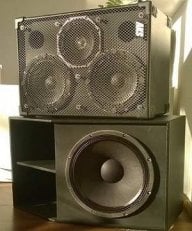
I don't think you can think of the line array element of the BA12-3 in the context of your question. These drivers are matched perfectly to the output of the 12" woofer at their crossover point, approx. 800 Hz. One 3" driver would not keep up with the woofer within this design....if I understand your question correctly. The line array is creating efficiencies in the totality of the design that are not achievable with the individual components.

I would like to reinforce that this design is not beamy in the vertical plane as some have suggested. We spent well over a year developing this design, including consulting with several pro audio professionals, beta testing with several players in live settings, on axis to 45 degree off axis data measurements and even first hand play-testing with a couple of the top bass builders in the business. At no time did we experience anything we'd consider beaming.

Frankly the most common comment about the response (other than its unique dispersion characteristics) was how smooth and musical it sounded. Unfortunately those to descriptors are a little difficult to measure with technical data.

I defer to those who have played and purchased the design, of which there are plenty of mentions in a few other threads on TB.
 
I just face my bass guitar toward the part of the audience that I want to benefit from a smooth and properly dispersed frequency response. Being the concerned musician that I am, I do my best to spread it around in a spirit of fairness. :thumbsup:

Edit: Kidding aside, what I've learned here on TB regarding beaming, dispersion, and phase issues has greatly impacted my choice and use of speaker cabinets. For the better, I think.

M. M. :)
 
Last edited:
"beaming" may not be the right term, but each driver in the line array is a point source, and it turns into a line array through destructive interference (combing). Dispersion is wide horizontal, but destructive vertical.

If you put the cab on the floor and there's 4 upper mid/tweeter drivers then of course there's vertical cancellation at ear level height.
Lift the cab up, put it on a chair.
I don't think we'll ever hope to get dispersion measurements from a bass cabinet manufacturer.
EASE data is nice, it's measured and software predicts this dispersion so the pro audio engineer knows how many cab in a line array to stack.
 
The interference is both constructive AND destructive, not just destructive. Otherwise you would not get the sensitivity gain within the array's total coverage pattern. The point of the line array is that the interference is configured (or oriented) to bring this useful benefit.
 
The point I tried nicely to make is that the claim that it "beams like crazy" is inaccurate and in fact is just false. The array is to short and the number/geometry of the elements just won't make this happen even if that was a design goal.

"Beam like crazy" was a bad word choice but the point I was making is in there. I understand that an array of four 3"drivers will "beam" differently then one single 12" driver and it's more a matter of acoustic interference but it gets worse the closer you are to an array and when you are not having the cab on ear height. To my ear a smoother dispersion in all directions works best for a basscabinet since you can not always have it placed on ear height and/or let's say 10 -15 ft away.
Of course it all doesn't matter much if you don't have that high-end zing in your bass sound. Sometimes I like to play with a Miller-esque sound and then I really want to hear all the small details in the sound myself, this is especially helpful when playing "difficult" stuff and you have to pay attention to your playing technique.

I have heard the cabinet and it does not beam like crazy, others here have mentioned the clarity and ease of hearing themselves, and Arjank's quote about lack of clarity/muddy was in error (the opposite of what the original poster's comment said, probably a language-translation error).

Did the others hear it with a stack of three or with one cabinet placed on the ground and standing in front of it? When I test my cabs that's one of the first things I do, stand in front of it (like 2-3 ft away) and listen to how it sounds compared to a larger distance, the difference should be minimal.

I am very careful to provide clear, factually and mathematically accurate information when I comment, I have been designing pro audio gear for 35 years and many of you have used gear from projects I have been involved with. I have no problem with anybody discussing technology oriented subjects with me, but it gets old when incorrect or inaccurate statements are made as fact by somebody who doesn't understand the complete picture, and then my words are incorrectly quoted and used against my position. I do not do this with anybody here, and IMO, it's just as disrespectful when it's done to me.

I know what such an arrangement does (experimented with arrays with small fullrange drivers myself). Like I already said, such an array is not something that I want or find useful in a basscab that stands on the floor the majority of it's time.
In my initial post in this thread I asked if all four 3" drivers run fullrange (edit: 800hz and up) or that two of 'm have a lowpass to improve vertical dispersion. There are other designs that use this for good reason e.g. this line array for hifi use Invalid Link Removed


Is Arjank a manufacturer/designer as he claims or is he just a regular forum member? If he is a manufacturer/designer then it would be most helpful to others in the discussion for his user profile to reflect his true status.

This has been asked before, no I'm NOT a manufacturer or commercial user just a very passionate hobbyist. I did build one 210 cab with coaxial mid/high driver for some other bassplayer though. Today I asked him what comments he gets on his sound, listeners tell him his sound is very clear and spreads very uniformly throughout the room/venue, other bassplayers are amazed at how it performs, especially compared to it's size.

Maybe it's just me and I'm to picky regarding anomalies in my sound....
 
Last edited:
Going back to the OP.

"Does the crowd really care?"

It's not their responsibility to 'care' about off axis dispersion or any other tech stuff. It's our responsibility to give the best presentation of our music as we possibly can. I like to think the listeners get greater pleasure from good sounding, well performed music, even if they don't know why.
amen
Even if I am playing to a crowd of drunks, which I used to do but don't anymore; even then I would attempt to make the best setup and sound possible. Your "best presentation of our music as we possibly can" is, IMO, what we should all strive for.

I think this is one of the best sites for learning about the value of dispersion: Linkwitz Lab - Loudspeaker Design

Pros of good dispersion:

1. Easier to hear yourself
2. Easier for your bandmates to hear you
3. Easier for your audience to hear you
4. More consistent tone with changing listener position
5. More consistent tone in different venues with different acoustics
6. Stage-monitoring becomes less important
7. PA support becomes less important
8. Any bleed into mics sounds more like your preferred tone
9. You get a better performance from the band because they're all hearing the music better
10. The audience enjoy the gig more because the band are playing better

Cons of good dispersion:

1. More bleed into mics
2. Your mistakes are more likely to get heard
3. If you talk about it you risk being accused of being some techy nerd who's more interested in gear than music...

I like good dispersion because I hate fiddling with gear when I'm in 'musician mode' and a cab with good dispersion makes setting up, sound checking and gigging a whole lot easier - especially when you're playing small venues with less than ideal sound engineering and PA systems.
Your "2. Easier for your bandmates to hear you" is a very important consideration which seems to be not as highly spoken about in this thread. It is, IMO, one of the most important considerations. With cabs that do not display good side dispersion it is quite likely that the drummer or guitar player will not get the full benefit of our bass awesomeness. And turning the volume up to accomplish this doesn't help the band have a smooth and coherent/mixed sound on stage and usually will result in acoustic mud.

Correct, there are other factors that I mentioned, including the size and spacing of the individual elements, the number of the elements and the total length of the array. There appears to be an additional aspect as well, because in my work with larger format pro audio line array designs the placement of the array in the center of the driver creates what looks like a co-linear (rather than coaxial) alignment, and the array in the center of the driver can advantageously alter the pattern of the LF element. This principle is "commonly" used in large format line arrays to meld summed energy patterns in the horizontal plane, like a "first approximation" solution. Because of the placement and dimensions of the column, I would expect this effect to be present.

An interesting general note about line arrays. It's often said that the vertical pattern of an array is, say, 40 degrees, therefore nothing is heard beyond the 40 degrees.. This is a very simplistic and inaccurate answer because the 40 degrees is still based somewhat on frequency, and it's not a brick wall cutoff but a 3 dimensional function of level versus position and frequency. At 50 degrees, the output may be 8dB down at some frequency (say 1000Hz) but now if you are only 5 feet away at 50 degrees, the level will be the same as on axis at ~20 feet, so position (distance) is just as important as position (angularity from the axis). So, the level match may in fact be pretty darn ideal close but off axis. This is one of the principal aspects of acoustic energy density shading for level balancing and can be seen every day in the large format system "J array" topology, where fewer boxes and greater splay (less on axis summed energy) at the bottom of the J reduce energy density to match up with the rest of the system at a farther distance.


You are not the only one who is interested in this topic. I have received some really good and interesting questions about this topic via PM, which is why I feel that it is important for the community as a whole that this discussion remain accurate rather than simplistic (black-white) rule of thumb only. I hope this information helps understand why I have a problem with somebody stating exclusionary "black and white" answers for a decidedly "gray" situation. It just can't be black and white because to make it so would be to eliminate ALL of the most important real world variables.
Very nice explanation. And your "why I have a problem with somebody stating exclusionary "black and white" answers for a decidedly "gray" situation" really can be applied to the whole field of acoustics. Some of these interactions and "best solutions" in the industry have been arrived at by trial and error starting with a scientific acoustic principle base. I remember when I worked on the acoustics staff with Boeing on the 747. I made a change which resulted in a significant noise reduction at a certain altitude which allowed a 747 to be within a specific country's legal requirements. Another engineer looked over my work and asked why I did a specific thing and that the numbers didn't add up (un-scientific, didn't follow acoustic theory) My answer was "look at the results". Sometimes designs have a certain amount of "intuitive art" which does follow scientific principles, but combines elements in a particular fashion in order to optimize. And I am not referring to any specific product but to the whole field of acoustics, as I give in my example.
 
  • Like
Reactions: dukeorock
I think this is one of the best sites for learning about the value of dispersion: Linkwitz Lab - Loudspeaker Design

Pros of good dispersion:

1. Easier to hear yourself
2. Easier for your bandmates to hear you
3. Easier for your audience to hear you
4. More consistent tone with changing listener position
5. More consistent tone in different venues with different acoustics
6. Stage-monitoring becomes less important
7. PA support becomes less important
8. Any bleed into mics sounds more like your preferred tone
9. You get a better performance from the band because they're all hearing the music better
10. The audience enjoy the gig more because the band are playing better

Cons of good dispersion:

1. More bleed into mics
2. Your mistakes are more likely to get heard
3. If you talk about it you risk being accused of being some techy nerd who's more interested in gear than music...

I like good dispersion because I hate fiddling with gear when I'm in 'musician mode' and a cab with good dispersion makes setting up, sound checking and gigging a whole lot easier - especially when you're playing small venues with less than ideal sound engineering and PA systems.

My take on Con point nr.2 "Your mistakes are more likely to get heard"
This is IMO a Pro, if you hear yourself better in a live situation you can fix your mistakes. If you have your signal (DI) send to the FOH and you can't hear and fix your mistakes the audience will keep hearing them through the PA. This point has always been a high priority on my list.
 
Last edited:
To answer the OP's question, I didn't "...consider dispersion or off-axis response when buying a bass cab/speaker?" but I certainly did consider this when selling one. I used to play through an Acoustic (450, I think) mated to a Cerwin-Vega rear-firing folded horn 18/forward firing 10" fiberglass covered cab. Although the setup was very loud, the dispersion was so bad (particularly on stage) that it caused all sorts of problems. At one point I resorted to resting the cab horizontally on top of a 2 x15 that I also sometimes ran with. After about a year I gave up and just sold it as it was almost impossible to manage the sound out front properly, much less on the stage.
 
Beaming isn't a bad thing on the vertical plane. There's nothing to be gained by directing sound where no one's going to hear it. The vertical pattern of four threes might be too tight to hear if the cabs on the floor and you're not standing 20 feet away, but it's not that big a deal to tilt it back or lift it. You have to do the same thing with almost any cab to hear the mids. You could make the vertical pattern relative to frequency more uniform with power shading, but it's probably not worthwhile with that short an array.

That's what I'm saying the whole time.
And I don't want to tilt back my cab or put it on a stool or chair.
 
That's what I'm saying the whole time.
And I don't want to tilt back my cab or put it on a stool or chair.

Here's where we differ, Arjan

At least with my cabs, I prefer them off the floor, with the exceptions of the 109 and 112 which were designed to be vertical and on the floor. My cabs don't lose much bass when you elevate them. I just happen to prefer the cabs closer to my ears (if it's not a compromise in the low end). My 46 and 66 are similar to Jeff's 12" cab with the 3's oriented in a center vertical stack.. I don't find them particularly beamy in the vertical, but they are a bit in comparison with the 112 or 109. If on the floor I prefer them wedged up a bit but find that they really come alive when elevated. The 46 and 66 can get too much low end support on the floor. It's not that the mid/highs are beamy, it's just that low end support from the floor is more of a detriment in this case. The balance can be skewed toward the lows. This is just part of my design process, but I wanted a cab that's at its best when elevated.
 
Here's where we differ, Arjan

At least with my cabs, I prefer them off the floor, with the exceptions of the 109 and 112 which were designed to be vertical and on the floor. My cabs don't lose much bass when you elevate them. I just happen to prefer the cabs closer to my ears (if it's not a compromise in the low end). My 46 and 66 are similar to Jeff's 12" cab with the 3's oriented in a center vertical stack.. I don't find them particularly beamy in the vertical, but they are a bit in comparison with the 112 or 109. If on the floor I prefer them wedged up a bit but find that they really come alive when elevated. The 46 and 66 can get too much low end support on the floor. It's not that the mid/highs are beamy, it's just that low end support from the floor is more of a detriment in this case. The balance can be skewed toward the lows. This is just part of my design process, but I wanted a cab that's at its best when elevated.

That's a totally valid design aspect Mike, just like I want mine to sound good when placed on the floor :)
I'm also used that people put cabs on the floor instead of elevated, IME all the people that elevated their cabs was because they couldn't hear the mids and highs well.
 
  • Like
Reactions: b-b-b-bass
I had an experience with a very tech-knowledgeable bassist. He had a Flex Top cab. One 10 with two 6.5" mids and two tweets. I happened to be in Asheville where he lived. He played a gig and called me---all upset---and said that the mids were not working. Since I was in the neighborhood I invited him over. We set it up like he had it the night before. On the floor and he had the usual amount of bass boost he used with all cabs. I raised the cab 12" off of the floor and turned the bass flat. All of a sudden---the mids were back. These mids are not in a vertical array. Side-by-side and crossfired. So the vertical combing was not an issue. It was just that the balance skewed toward the low end. Said bassist now has an amp stand and the balance is perfect.
 
For me, dispersion matters on a bunch of different accounts.

-In recent years, I've been faced with a large share of gigs without a 'full' or sufficient front end to support the bass. Part of that was being in a band that needed to supply PA in many varied situations, but also in some cases playing venues that were under-supplied with PA to start with.

-I play in a band and genre that needs proper bass representation. We can say that about most forms of modern music, but some are more bass heavy than others. Being able to show up and know that no matter what the situation there's going to be sufficient low end presence in the 'house' in as many parts of the room as possible is stuff that you base reputations upon. Often times we haven't had the benefit of a PA system designed for a space. In 'brute force' situation, it's easier to play with gear that isn't creating an uphill battle against the forces of nature. Often in difficult rooms we've heard from people that our band sounds better than others in the same room, that it doesn't sound like we're just using a vocal PA and repeat offenders often comment that our mix is consistent and good.

-"But but but...we know beaming tends to occur in the mids and above." If you push lows without anything above that, you create an unintelligible mess. Providing mid content gives pitch to the lows and helps keep definition. It helps the players as well as the audience hear what's going on in the bass range.

Now as time goes by...

...We're playing much fewer shows where we provide our own sound or are faced with anemic FOH. That's good. That's less me hauling and setting up gear and more time concentrating on playing.

-Good dispersion is allowing my whole band on a wide stage hear me. It's also helping ME hear me when I'm not right up on my amp since we're not shoehorned onto a 15x10' space. Although if a stage is tight, or we're supporting a touring act that isn't going to move their gear for us to get on stage, I can still stand wherever and hear myself.

-Having an amp that puts out a good coherent sound gets me fewer complaints of bass volume on stage from soundmen. My sound is 'working' with the room and the house system better.
 
If I can join in, as a player, designer and manufacturer I've always felt offering the widest dispersion and smoothest response it a cabinet system as an ultimate goal. Not just for the audience or various venues (with or w/o FOH support) but for my fellow band mates. If we can hear "ourselves" better as musicians on a stage, then we stop trying to listen "for" each other and start listening "to" each other more...and hopefully as a result we can fall into the groove easier than trying too hard to establish that collective groove as a band.

+1 This is my main view on the benefits of good dispersion on stage (and presuming that there is a good FOH system taking care of the audience. As a secondary matter, I tend to move around a lot, on stage, so being able to hear myself when I'm rocking out with the guitar player, sharing the singer's mic, invading the drum riser, or actually jamming in "my" spot, it's nice to be able to hear myself.
 
That's a totally valid design aspect Mike, just like I want mine to sound good when placed on the floor :)
I'm also used that people put cabs on the floor instead of elevated, IME all the people that elevated their cabs was because they couldn't hear the mids and highs well.

Our because the low end gets too much reinforcement on the floor. I just tell bassist " it it's ok if you turn the bass down"
 
  • Like
Reactions: Arjank
At least with my cabs, I prefer them off the floor...it's just that low end support from the floor is more of a detriment in this case. The balance can be skewed toward the lows. This is just part of my design process, but I wanted a cab that's at its best when elevated.

Our because the low end gets too much reinforcement on the floor. I just tell bassist " it it's ok if you turn the bass down"
While I understand your design goals with some of your models, you have to acknowledge that it's much, much more common for a player to expect a balanced response with the typical half-space loading that usually comes with placing the cab on the floor.

-------------------

I am interested in a cabinet that disperses well, and I'd guess that my custom 12"+6" cabs do a pretty good job of spreading the mids/highs around, but aside from my anecdotal experience I have no way of knowing if that's so. And I have no way of comparing their performance against another cab because no such measurements exist for any of these products. The only way to even get a subjective take on that is to get a bunch of these cabs in the same room (actually, in the same spot in the same room) and do some critical listening and various positions on and off axis, as well as various distances.

Until that happens all us consumers are somewhat at the mercy of the manufacturers who we must trust are taking these critical dispersion characteristics into account and that the final product has the performance we hope it will in all aspects.
 
Last edited:
The core of your comment here is what this all boils down to. There are a lot of interesting and innovative designs available from many companies on this forum and there can be all sorts of technical data, plots and charts to substantiate those designs but so much of that can be unclear or miss understood when it comes to how will this product perform "LIVE" for me.
It really comes down to what do these products offer in the real world and with your specific requirements. Certainly player comments on the forum help substantiate those real world observations and expectations.
Even with tons of technical data or a powerful, slick marketing campaign --- if a product does not deliver, you really can't hide that fact.


All too true. I can understand the financial need to not want to have to pay for shipping or make a trip to a store or gig to check something out. But knowing what most of us seem to know about specs is key... they simply cannot convey the entire story. It is not difficult to find cabs with very similar specs which sound markedly different. Knowing that, when I wanted to know how Jeff's new cabs performed, I went to a Genzler dealer. And now I know. Very nice cabs. What I read had no effect on what I ultimately heard. Call me old school.

On the dispersion tip we did a couple of things with our cabs to address that. Not exactly following the norm for cabs but not something so bizarre that it should scare the horses. They actually struck us as common sense moves. Those dispersion aspects have largely met with approval, while some still dismiss the cabs in general. So far the folks who've heard them IRL corroborate what we claim. While some who haven't continue to disapprove. Nothing new there.