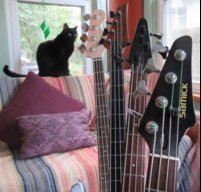
this is for those of you who (mistakenly) think you will never get good at building.
I have gone from making absolute garbage to some fairly nice basses in the past year and a half. But i have always been plagued by not getting the setup where i wanted it, and not understanding why.
I have followed the internet guides to the letter and yet my setups always come out very high. Even Jason Wittig who taught me how to do a low setup is baffled by it. For a few months now I had a theory. And I finally was able to prove it.
First of all, you have to understand that most of the guides and aimed at people replacing a Fender neck. I really hate how things are so focused on Fender because of how they mislead the rest of us.
- with the Fender offset neck, the angle of string deflection at the nut is less than 5degrees. This of requires string retainers to keep the strings tight to the nut.
- With the way Jason build his one-piece necks the deflection is only 7degrees. he sometimes finds he also needs retainers.
- I have chosen to use scarfed-joint necks for several reasons.
- I don't want to be seen as a Fender copier.
- the scarfed joint is the sturdiest style neck because the grain is always in the strongest direction.
- no need for retainers ever.
Here is the problem:
- It is nearly impossible to make a quality scarfed joint neck at less than 15degrees deflection.
- at 15 degrees defection the string needs to seat deeper into the nut to hit the first fret at an angle that will play in perfect tune.
- the same goes for getting the action right throughout the neck length.
I finally found the proper way to grind the nut to achieve this. place a straight edge across the second and third frets and measure the gap at the first fret it will be a couple thousandths of an inch. a straight edge from the nut to the second fret should have the same gap at the first fret, no more than that. When it is correct a straight edge slide along the frets should almost slide over the nut. It should meet just the slightest resistance at the nut.



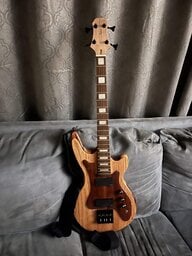

 however... in your case it would probably mean you're even happier than a kid in a candy store


 happened. The old world is dying, and the new world struggles to be born. I'll get to it. One day.