
Enjoy the benefits of a premium membership!
Upgrade Account
-
TalkBass has been independent since 1998. Add your voice.
Create a free account to reply to discussions, view embedded media, and browse with fewer display ads.
Join free Log in
Want zero display ads or expanded classifieds tools? Compare plans.
You are using an out of date browser. It may not display this or other websites correctly.
You should upgrade or use an alternative browser.
You should upgrade or use an alternative browser.
The Mike Lull Club
- Thread starter Ron Plichta
- Start date
-
- Tags
- club
- Status
- Not open for further replies.
More options
Who Replied?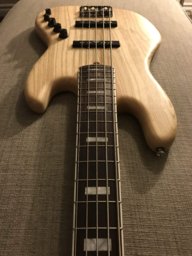
Hmmm... yeah, I thought initially that the push/pull was active/passive, but it really didn't make any difference in the gain when switched in or out. So, perhaps there's a gain pot internal somewhere that is set low (haven't looked yet). It almost sounds like it's a mid select when switched, but turning the knob sounds more like a tone than a mid. And, it does work both passive and active, so I'm guessing it must be tone. I guess having both a tone and the bass/treble seemed slightly odd to me.
---
c
Hey Chris - congrats on the bass, man!
If you have your EQ at the center detent, you probably won't hear a difference between active and passive. Boost the bass and treble some, then work the push/pull. If it's an active passive you should hear a difference there.
If nothing else, email Mike Lull and see what the man says!

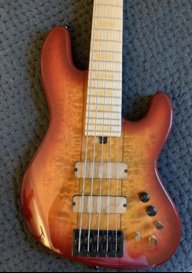
#1249 showed up at my door today
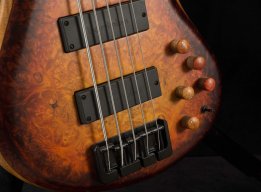
Been fondling her for the past hour or so, and so far me likey very, very much. Still trying to figure out the controls... seems like Volume, Blend, a push/pull that I'm unsure of (mid maybe with mid freq select?) and stacked bass/treble? Any insight would be appreciated.
Can't wait to bring it to practice Friday night, plug it in and turn it up.
Sooo, can I join the club?
---
c
Now that you've had a little more time with it, how's the bass working out Chris???
And as an update to my fretless dilemma, I ended up picking up a mid-grade 5'er that'll last me till I can custom order a new Lull.
Now that you've had a little more time with it, how's the bass working out Chris???
And as an update to my fretless dilemma, I ended up picking up a mid-grade 5'er that'll last me till I can custom order a new Lull.
Well, I was able to go through and tweak the setup somewhat on Friday before practice with my band. In short, this thing kills now. Still a bit of minor tweaking to do, but I'm liking it very much after spending a bit more time with it.
Great P tones, great J tones... great all round. Amazing through my MB amp... sits in the mix wonderfully. This may quickly make the jump to being my #1. I'm actually almost considering getting rid of my Lakland DJ5 since it's somewhat redundant, but I love that bass too. We'll see. I definitely need to get rid of a couple beyond the Stammie.
---
c
Hmmm... yeah, I thought initially that the push/pull was active/passive, but it really didn't make any difference in the gain when switched in or out. So, perhaps there's a gain pot internal somewhere that is set low (haven't looked yet). It almost sounds like it's a mid select when switched, but turning the knob sounds more like a tone than a mid. And, it does work both passive and active, so I'm guessing it must be tone. I guess having both a tone and the bass/treble seemed slightly odd to me.
---
c
Well IME there is not much gain difference between active and passive modes(Vic help me with this if I get it wrong) but if you set the bass/treble to flat you should not encounter any gain difference.
I like having that tone knob with the Treble bass actually,maybe because I am weird(it is most likly the case
 ) It allows me to dial in a different tone but to keep my lows boosted if that makes any sense. Regardless, and e-mail to Mike would probably answer the question.

Yes, if the gain is set correctly in the preamp of an active bass that supports passive mode, then with the EQ set flat, going back and forth between active and passive mode should only potentially alter tone, not volume levels. This makes passive mode most useful... even if it's not just for dead battery bailout scenarios.Well IME there is not much gain difference between active and passive modes(Vic help me with this if I get it wrong) but if you set the bass/treble to flat you should not encounter any gain difference.
I actually went in a while back and set the trim pot to equal the input pad on my DB750... So that if anything goes wrong in active mode during a show (battery), I can switch to passive on the bass and amp to retain my volume without to mess with the amp's gain knob. If that makes any sense...
The volume is only equal if the preamp is set flat, but once you start boosting things then active is louder than passive. Because the Lull is my main bass I don't mind tailoring everything to it and my amp... Other basses will just have to deal.
The volume is only equal if the preamp is set flat, but once you start boosting things then active is louder than passive. Because the Lull is my main bass I don't mind tailoring everything to it and my amp... Other basses will just have to deal.
Yes, if the gain is set correctly in the preamp of an active bass that supports passive mode, then with the EQ set flat, going back and forth between active and passive mode should only potentially alter tone, not volume levels. This makes passive mode most useful... even if it's not just for dead battery bailout scenarios.
I too try to match the output levels so that the volume does not really change between active and passive. IIRC on the Bart preamp, if the battery goes dead passive mode still does not work? I could be totally wrong but I thought that was the deal. That is why people really like the Mike Pope preamps, Sadowsky etc where this is not the case. Please correct me if I am wrong.
Good to know. It would make sense that the output would be the same gain level in active/passive for said reasons. I've only had 2 other basses that are active with passive bypass, a lakland 55-02 and 55-94 (both with Bart's)... and both of those are somewhat more quiet when switched to passive, soi I guess I just assumed that's how it is typically.
---
c
---
c
It's true that the battery goes dead I believe in all cases unless they do some sort of special wiring.I too try to match the output levels so that the volume does not really change between active and passive. IIRC on the Bart preamp, if the battery goes dead passive mode still does not work? I could be totally wrong but I thought that was the deal. That is why people really like the Mike Pope preamps, Sadowsky etc where this is not the case. Please correct me if I am wrong.
You're not interrupting the power supply to the preamp, you're just bypassing it. The power is still applied to the preamp in most cases I'm aware of. That said, the current flow should be very little since it's not driving the output anymore, so the battery drain should be negligible.
I can't really say more without a wiring diagram, but it is possible to take the battery out of the circuit if that's desired. Just adds a little more complexity to the implementation is all.
Regarding working when the battery is dead, I know Sadowsky does, and there's no reason why the a bass with a bart system couldn't be wired the same way.
- Apr 24, 2004
- 1,359
- 53
- Disclosures
- Designer Fodera Guitars/Michael Pope Design, Inc., Trickfish Amplification
The problem with switching power on and off is that since audio and power ground are the same on most internal preamps, you need to bias the signal to half of the battery voltage so that the circuit can amplify both sides of the waveform. When you turn power off in a 9V system, there is a 4.5 volt discharge that gets sent to your amp. Then when you turn it back on there is a very sudden 4.5 volt "WALL" of voltage that sends your speaker lurching forward until all the caps in the preamp get charged up. The new Fodera preamp has none of that. Final prototypes are in hand now...finally! Although we don't shut off power during bypass (for a few other reasons) we could and the result would be a gentle transient similar to that of the natural bypass switch. Keeping audio ground and battery negative separate is an important part of getting more performance out of a battery powered preamp.
But at the end of the day, the preamp pulls just over 1mA from the batteries. So at 500 to 700 mAh of capacity in a typical 9V you can expect just under 500 to 700 hours of life. Even if you're ultra-conservative in your estimates, that's at the very least 100 four hour long gigs. That's plenty in our opinion, given that the down sides of switching power off during bypass included losing much more important functionality in the switching circuit.
But at the end of the day, the preamp pulls just over 1mA from the batteries. So at 500 to 700 mAh of capacity in a typical 9V you can expect just under 500 to 700 hours of life. Even if you're ultra-conservative in your estimates, that's at the very least 100 four hour long gigs. That's plenty in our opinion, given that the down sides of switching power off during bypass included losing much more important functionality in the switching circuit.
- Apr 24, 2004
- 1,359
- 53
- Disclosures
- Designer Fodera Guitars/Michael Pope Design, Inc., Trickfish Amplification
That said, the current flow should be very little since it's not driving the output anymore, so the battery drain should be negligible.
Absolutely accurate in theory, but in practice not so. Because the loads that most preamps drive are 10k up to around 1M (in MOST cases) most of the power consumption comes from the quiescent current needs of the semiconductors. In a 9V preamp, you'll only see peaks that are significantly above a volt. Even at a constant 2V rms (would never happen) into a 10k load (the lowest it would likely see) you're asking for an additional 0.2mA to drive that load. Most amps have a 50k impedance at the input (active input), so now it's 0.04mA. Add that to the quiescent current requirements of an LF442 which are about 0.35mA and you see that the load doesn't mean much, even in a probable worst case scenario. Bypassing an internal preamp PROBABLY has at best a measurable effect on battery life...and it would be a hard measure. For kicks, 2Vrms into 1M requires 0.002mA...or 0.000002 amps. or 2 micro-amps.
In order to see an increase in effective current pull with my preamps, I have to saturate it to the point of unimaginable distortion. I think that's likely the case with most internal preamps.
- Apr 24, 2004
- 1,359
- 53
- Disclosures
- Designer Fodera Guitars/Michael Pope Design, Inc., Trickfish Amplification
On another note...this means that the amp that you plug in to has a direct effect on your battery life to a very small degree.
...but that's only true of 9V systems, right? With 18V systems, you just create your reference between the cells, right? Or, are you just sitting at 9V instead of 4.5 in that case, and still have the same "issues"?The problem with switching power on and off is that since audio and power ground are the same on most internal preamps, you need to bias the signal to half of the battery voltage so that the circuit can amplify both sides of the waveform. When you turn power off in a 9V system, there is a 4.5 volt discharge that gets sent to your amp. Then when you turn it back on there is a very sudden 4.5 volt "WALL" of voltage that sends your speaker lurching forward until all the caps in the preamp get charged up...
This is REALLY interesting... I didn't even think of that. Thanks Mike. Larn sumthin' new ever-day...Absolutely accurate in theory, but in practice not so. Because the loads that most preamps drive are 10k up to around 1M (in MOST cases) most of the power consumption comes from the quiescent current needs of the semiconductors...
- Apr 24, 2004
- 1,359
- 53
- Disclosures
- Designer Fodera Guitars/Michael Pope Design, Inc., Trickfish Amplification
...but that's only true of 9V systems, right? With 18V systems, you just create your reference between the cells, right? Or, are you just sitting at 9V instead of 4.5 in that case, and still have the same "issues"?
Depends. If your batteries don't die at the same rate you can get into an imbalanced rail situation and have no headroom on one rail and lots on the other. Also, in an internal preamp you have to turn the thing on and off. The easiest and most common way to do that is to put the battery negative to the ring terminal of the output jack. This way, the battery positive is always connected, and the battery negative is brought to ground when the plug is plugged in, which completes the circuit. If you tie the battery positive to the plus rail, the junction of the two cells to ground, and the battery negative to the ring terminal, you've shorted your "bottom" battery. If you tie the battery positive to the plus rail, battery negative to the minus rail and the junction to the ring terminal, you have a load on your batteries at all times whether plugged in or not.
In any preamp I've done...9V, 18V, or 27V, I simply wire the batteries in series to be like one big battery and I use a resistor divider to produce a bias voltage at half of whatever the total of the 1, 2, or 3 batteries is.
For the record, there is no metal bodied jack with a bushing long enough to fit through a 1/4" bass top that has any kind of switching for turning a circuit on and off.
And also for the record, we found a way around this problem with the new Fodera preamp that doesn't involve any intervention from the player. Just plug in and the preamp turns on...but in a totally different way. And in a way that doesn't rely on a good connection from the not-very-reliable connection between the ring and sleeve of the jack.
Mike, you are leaving my head spinning with all of this. Thus, the reason I am not designing preamps in my spare time.  Thanks for the info...It is very enlightening. Now, I will have to read your posts about 10 more times and I might begin to understand it.
Thanks for the info...It is very enlightening. Now, I will have to read your posts about 10 more times and I might begin to understand it.
Another great point...Depends. If your batteries don't die at the same rate you can get into an imbalanced rail situation...
...
In any preamp I've done...9V, 18V, or 27V, I simply wire the batteries in series to be like one big battery and I use a resistor divider to produce a bias voltage at half of whatever the total of the 1, 2, or 3 batteries is...
Based on that, I'm sure the most typical way is the "one big battery". Thanks again... good stuff.
Oh, BTW, that I/O cable I got from you at NAMM '07 is still going strong.
Mike, thank you! I am a double E(in training) and I love hearing and learning where ever I am.
I agree, but I mean the current draw would not vary to to much between amps, right? Anywho, this is a very interesting point.
On another note...this means that the amp that you plug in to has a direct effect on your battery life to a very small degree.
I agree, but I mean the current draw would not vary to to much between amps, right? Anywho, this is a very interesting point.
So my Lull PJ5 is the only bass I've owned that has a truss adjustment that doesn't use a hex wrench to adjust. It looks like a flathead screw driver would do the trick, but fitting a standard screwdriver in there would seem quite awkward. What do/have you guys used? Is there flat head screw driver available that fits in there well... bent at a 90 angle or something?
Thanks.
---
Chris
P.S. Did I get a # yet
Thanks.
---
Chris
P.S. Did I get a # yet
- Status
- Not open for further replies.


