
This thread is one of the most gas inducing threads i've ever seen. I love my MTD KZ6 but this thread just caused me to start a savings for a USA MTD 635
Thanks alot guys!!!
Thanks alot guys!!!

TalkBass has been independent since 1998. Add your voice.
Create a free account to reply to discussions, view embedded media, and browse with fewer display ads.
Join free Log in
Want zero display ads or expanded classifieds tools? Compare plans.
What those guys are talking about is the debate between quarter-sawn and flat-sawn (slab cut is not correct terminology as far as I've ever heard or known, that's most typically used for fingerboard types as far as I've seen).
The expected stability of each cut type is is probably one of the most highly debated topics among luthiers. Here's the thing... that's not limited to ash necks. The same exact debate is also valid for maple, and other woods. The reason the debate persists is because nothing has been proven either way. There's been no definitive proof that a quarter-sawn neck is inherently more stable than a flat-sawn neck. In fact, most of my basses have flat-sawn necks, and I have NO stability issues whatsoever. None.
That said, sometimes a piece of wood will fool a luthier and be much less stable than predicted. This is where you have to give them the opportunity to build a replacement. It doesn't happen very often at the high end, but obviously, it does happen.
I'm guessing he may not have done this because he lives in Australia, which would complicate the logistics of a "repair" greatly.

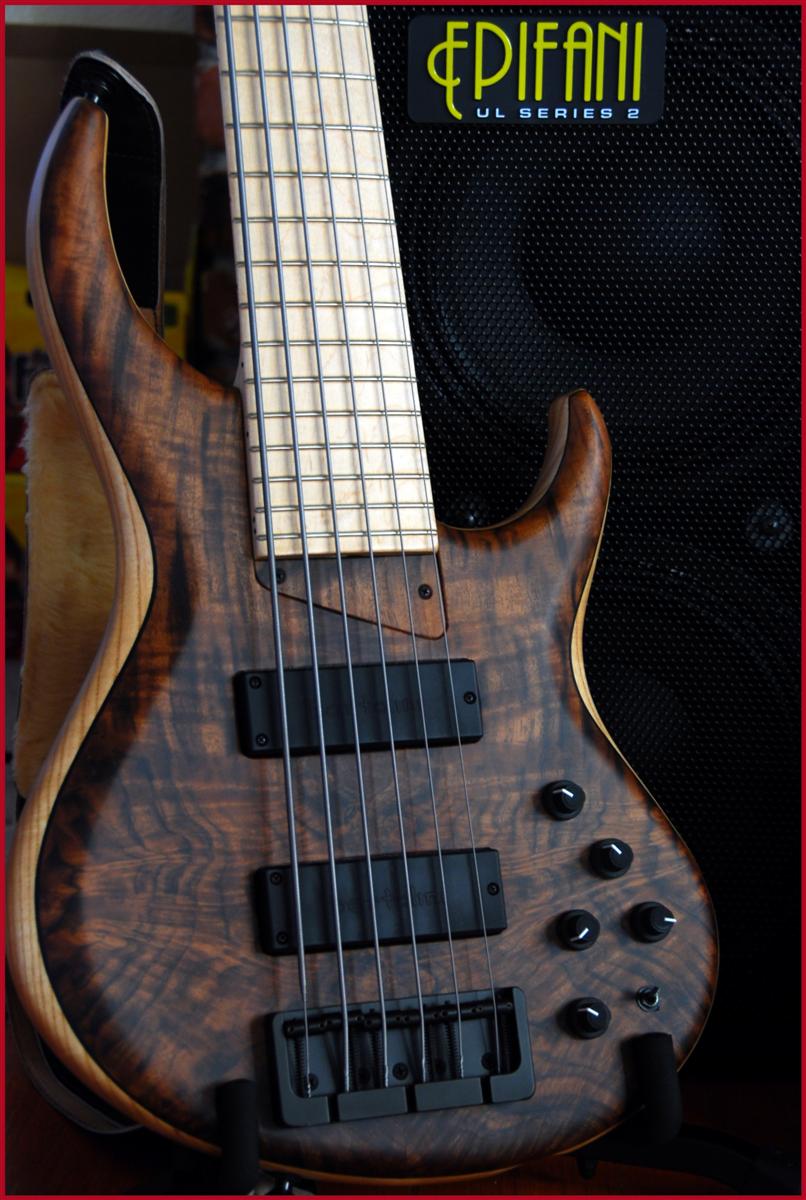
Edit...forgot sound clips.
Link Removed
Link Removed
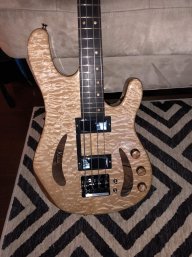
My MTD's go out all the time, but are the most easily adjustable basses I have ever owned, very sensitive to neck adjustments. A close second is my Taylor AB1. I've owned basses in the past with multiple laminates (Pedulla Hexabuzz) and multiple laminates AND graphite reinforcing strips (Kinals) that were either difficult (Pedulla) or impossible (Kinal) to adjust because of the so-called 'stability' of the neck. The were a total PITA, but none more frustrating that the Kinals, IMHO. The truss rod did nothing, really.
All wood is going to move, eventually, especially if you live in dry climates or, as in my case, extremely wet climates. It's better, IMHO, to have something that takes adjustments readily and immediately than something that's going to fight you.
And if Michael Tobias thought for a minute that quarter sawn had any effect at all, aside from wasting a lot of wood, I'm sure he'd be using it. Same with multiple laminates and reinforcing strips. He goes for an organic, natural-wood sound, and tries to have little or nothing stand in it's way. So he uses flat sawn. I'm sure he has tried everything in his vast experience as a builder of the highest standing, and as a player, I respect his experience, knowledge and judgement from a structural standpoint.
Cheers,
Cameron
Here's a few of the Marilyn (#8, and being a "Marilyn" means it has a chambered body... it's not solid)...
A current one with the custom knobs installed... woods/layers in the knobs match the woods/layers in the body... alder, ebony, purpleheart, and water cured redwood.
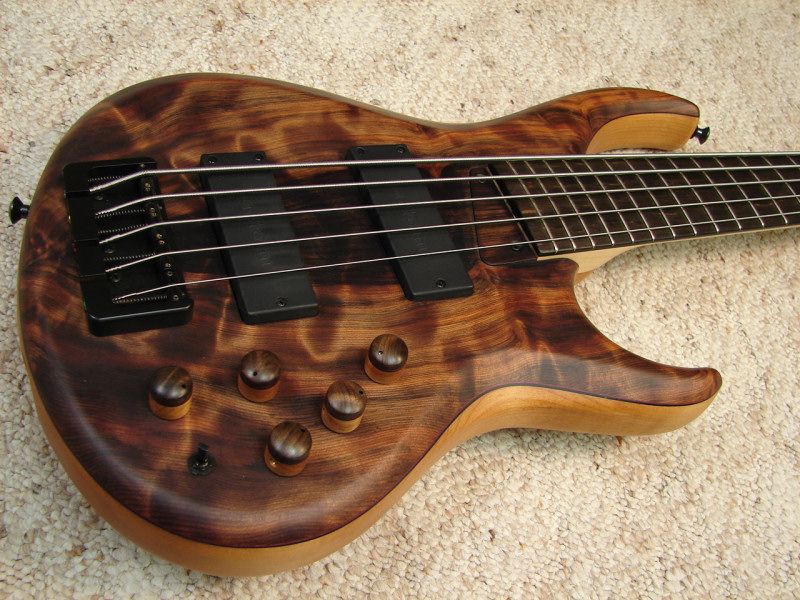
Here's a cool one with Mike just before it left the shop. Not a high quality picture, but still pretty cool IMHO.
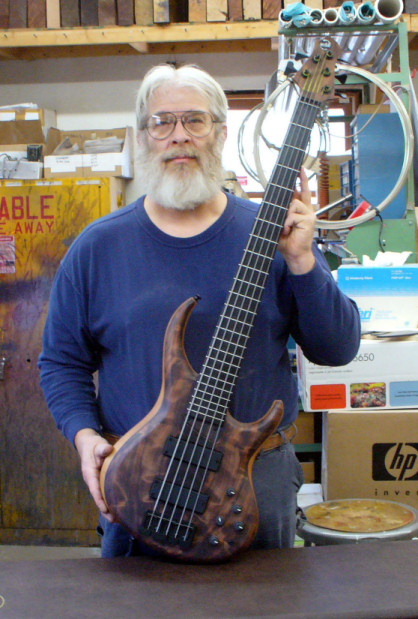
Here's a few product shots from when it was brand new, which show off the color variations a bit better, and you can kinda' see the flaming in the blistered ebony in the first pic... it shows up as faint diagonal lines, but in certain light conditions, you can really see them. Very rare.
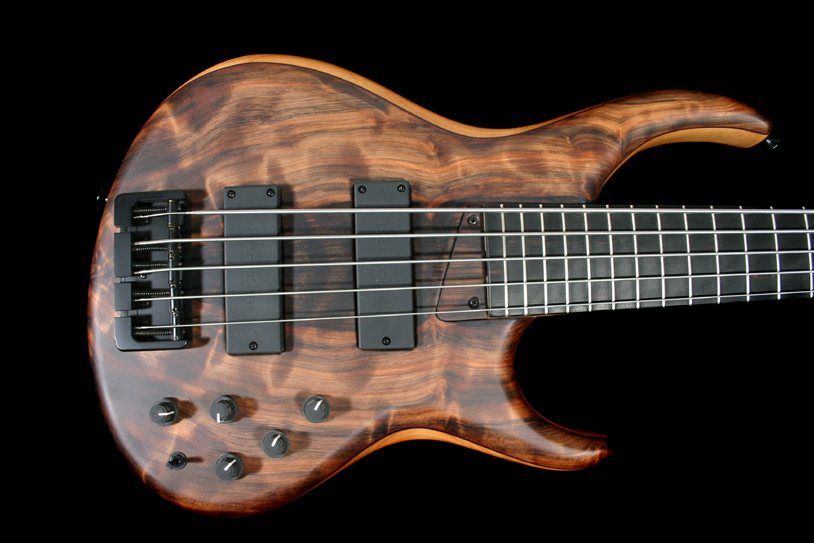
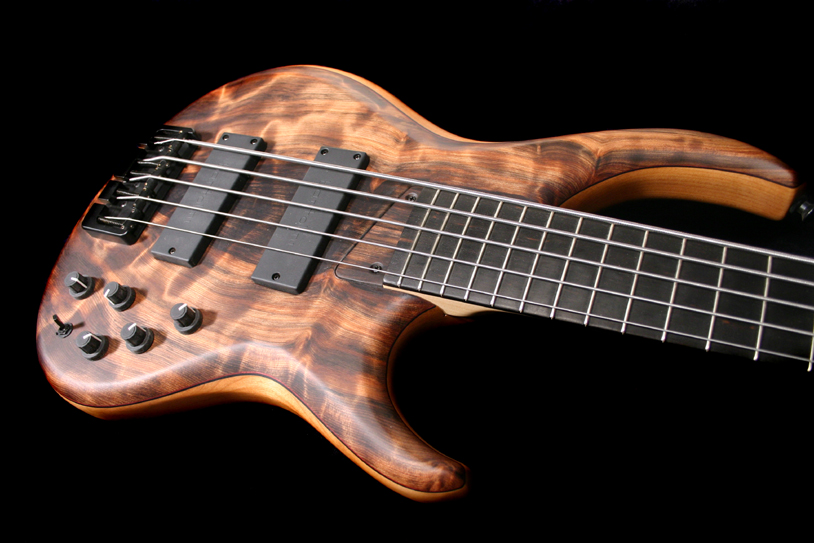
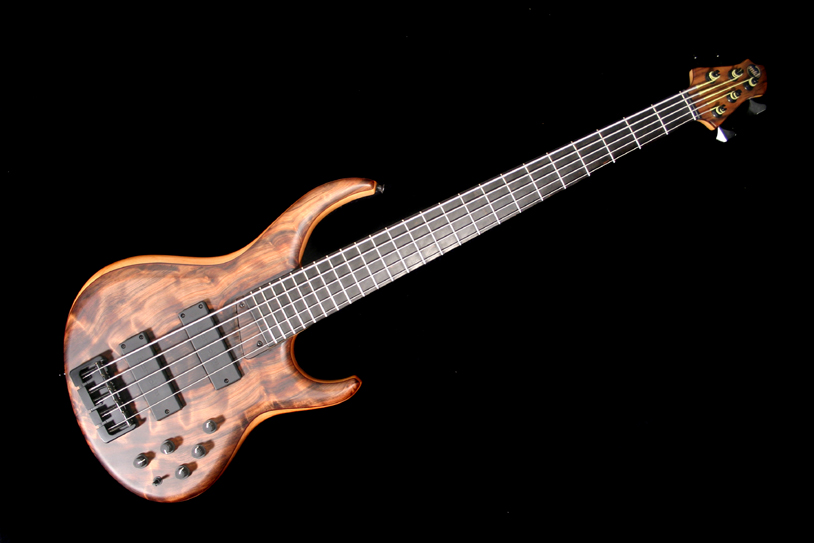
Here's a couple close-ups of the custom knobs...
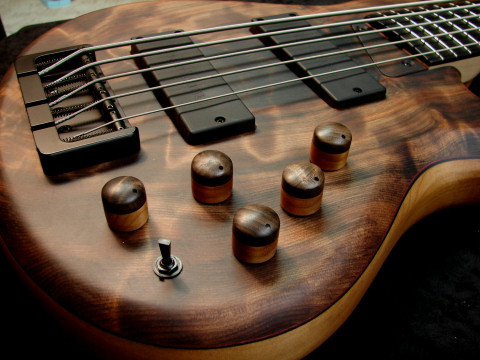
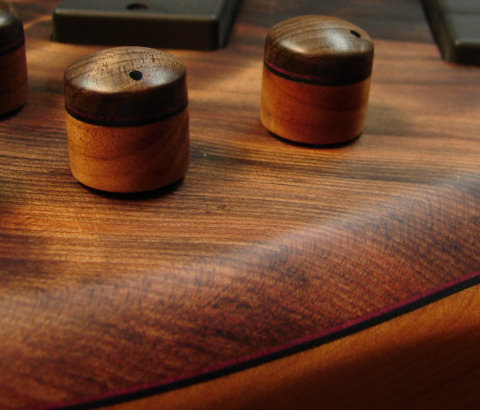
Hope you dig'em.


I think the body is 2" thick, it weighs 8.6 pounds, and Mike's chamber pattern is shown in one of the vids Bob put together:What is the thickness of the body? Do you have any pics of the chambers--before the top was on? What is the weight like on these? Noticeable tone difference?

For those of you who have ash necks on your MTDs, how do you find them stability-wise? I'm thinking about getting an ash neck on my next MTD and am trying to decide between ash and maple. I've heard lots of good things about the sound of ash, but very few comments about its stability. I live in Montreal, where an unstable neck would be a serious pain. Any thoughts would be appreciated!
FWIW, I've had no stability issues with my ash-necked bass. I've played three additional instruments since then, and all of them seem to really speak in the upper mids. Even by typical MTD standards, these basses have a lot of bark. I'm not trying to make a blanket statement about ash necks...just sharing my experience.By comparison, my maple-necked 535 is just a beast down low...it's actually an interesting experience playing them back-to-back.
What is the thickness of the body? Do you have any pics of the chambers--before the top was on? What is the weight like on these? Noticeable tone difference?
I would agree with the non-primary gigging instrument and extended range comments, but not the "not enough punch and clarity in the mids" comment. Mine has tons of great definition and clarity through the mids, but it's also got a lot more going on especially in the low end, which does make it more of a specific tool. For example, it'd be fantastic for small combo work, sparse mixes and such, but for a thicker mix like most cover bands, etc, I would agree, it's not the best choice.I would never consider one of Mike's chambered basses as a primary gigging instrument.... too much of a good thing. Every MTD I've owned or played has been big and a bit 'loose' down low (i.e., very wide, deep low end). The chambered models I've played seem to have even more of that, which IMO moves the tone in the wrong direction for, I would guess, most players. Too much boom, not enough punch and clarity in the mids IMO.
That, of course, doesn't mean they wouldn't kill in some contexts, I just can't quite think of an appropriate context myself for that voicing and design.... maybe a very sparse, 'modern' jazz trio type context where that huge low end with a bit of modern top end would be a positive... kind of an Anthony Jackson type tone.... kind of a combination of his more active early Fodera tone up top, and that very big, organic low end of his current passive chambered model.
IMO and IME of course.
I would agree with the non-primary gigging instrument and extended range comments, but not the "not enough punch and clarity in the mids" comment. Mine has tons of great definition and clarity through the mids, but it's also got a lot more going on especially in the low end, which does make it more of a specific tool. For example, it'd be fantastic for small combo work, sparse mixes and such, but for a thicker mix like most cover bands, etc, I would agree, it's not the best choice.
Somewhat, but again, I'm not willing to go along with your mid comments. I think they're still too strongly worded.+1 It's more a 'balance issue'. I agree, it isn't that the mid clarity 'isn't there', but rather that it is pretty much buried by all that huge, deep, open low end. I think we are saying the same thing.
What those guys are talking about is the debate between quarter-sawn and flat-sawn

No problem!! Not complaining, just trying to inform.Thanks Vic, sorry for the incorrect terminology.
A couple things... you can't always tell by visible grain pattern if a piece of wood will be as stable as it needs to be. I've had basses (and still currently do) where the visible grain is nowhere even close to "linear" and those necks are SUPER stable. Similarly, I've had a quarter-sawn neck in the past that, while not problematic, was not as stable as some of the flat-sawn necks I've had (and still have) and the grain looked great. The point being, wood selection is not strictly about visible grain patterns, which is why I kinda' challenge the comments you got where they based their entire opinion on visible grain patterns.I think in my case, it was a combination of a piece of wood with inconsistent internal grain (hard to predict), a slightly thinner neck profile and the fact it was ordered with a an ebony board, which Mike doesn't recommend on ash.
Yep, it can happen. Even to the best luthiers, but especially at the high end, this is rare, and it's definitely not a general characteristic of an ash neck. That's the main thing I'm most interested in addressing if anyone is concerned about it. Don't be.Yes, I did email Mike about the bass, when I couldn't get the action lowish without buzzing, but because it was second hand and on the other side of the world, all he could easily do was offer advice. It was less than a year old at the time, so I was still pretty disappointed. We had to completely level and refret the neck, but even after that, the curve on the bass & treble sides varies a bit, making it difficult to get a consistently low action.

I'm talking about a 635 - 24
+1I have one of each (MTD 535-21 #746 as well as a Ken Smith Neck-Through 5 MS) -- my perspective is that they are completely different instruments, both in terms of sound and feel.
#1: Size matters. The 35" scale on the MTD really improves the clarity of the notes, especially the lower fundamentals. It also means that it takes a tad more "oomph" in your fingerstyle technique to pluck the strings, especially close to the bridge. So, it takes more effort to play, but it's worth it!
#2: Flexibility. The Smith has a great "signature sound" to it that you can't get from the MTD (due to Ken's electronics). Although you can get some good differences b/n neck vs. bridge blends, the Smith will always have Ken's special sound to it. The MTD, on the other hand, has way more flexibility -- you can produce an array of very convincing signature sounds, assisted in large part by the 3-way mid selector switch.
Otherwise, I find the MTDs to be a lot more flexible with a wider tonal spectrum.Dude, I remember that bass! That was killer. If I had the money at the time, it very likely would have been mine. I little more on the Fendery side of the MTD sound, a really nice neck profile, and just friggin' awesome in a mix. If you ever decide to flip it, you know who to PM first (but please wait a LONG time before you even consider it, or even better yet, just keep it forever, 'cause I'm broke again).Since this is the MTD forum, I'll post a recent pic of my beloved #746 (Ash/Spalt plus Maple/Rosewood neck) -- acquired from fellow TB-er Saluki about a year ago.
Cheers,
Bruno S.



