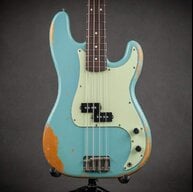
Holy mackerel that's an expensive pickguard!Thanks, Here ya goThey were cheaper last year but now everyone is forced to raise their prices...
Invalid Link Removed

Enjoy the benefits of a premium membership!
Upgrade Account
-
TalkBass has been independent since 1998. Add your voice.
Create a free account to reply to discussions, view embedded media, and browse with fewer display ads.
Join free Log in
Want zero display ads or expanded classifieds tools? Compare plans.
You are using an out of date browser. It may not display this or other websites correctly.
You should upgrade or use an alternative browser.
You should upgrade or use an alternative browser.
The Squier Mini Precision Bass Club
- Thread starter sabre79
- Start date
More options
Who Replied?
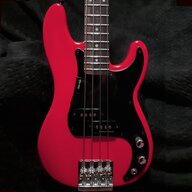
But remember, that includes FREE shipping! My black plastic guard was originally $35. With shipping to the USA and tax, it was in the $55 dollar range (I don't have that receipt within reach). So, an extra $30'ish bucks for a hand crafted wood guard seems a little more reasonable (although still pretty darn expensive!). If I were to part my MINI out now, I easily have $400+ in upgrades (with no labor). But, to me, it's worth every penny for a bass I can count on, feels wonderful to play, and sounds better than I need it too! I'd be $750+ for practically anything I could buy new that would be a dependable, good sounding, professionally built, short enough scale instrument. So, it's not like I've wasted money on my MINI (in my eyes). I simply crafted a 28 1/2" scale bass, built specifically to suit my particular work needs. To me, spending $55-$90 on the pick-guard for a tool I'm going to record with, is acceptable.Holy mackerel that's an expensive pickguard!
 But that's just me... I recently spent $100+ for a hand crafted Aluminum 'guard for my Nashville Telly, and I didn't blink.
Last edited:

Absolutely agree! I put a $300 Fender neck on a $78 bass!But remember, that includes FREE shipping! My black plastic guard was originally $35. With shipping to the USA and tax, it was in the $55 dollar range (I don't have that receipt within reach). So, an extra $30'ish bucks for a hand crafted wood guard seems a little more reasonable (although still pretty darn expensive!). If I were to part my MINI out now, I easily have $400+ in upgrades (with no labor). But, to me, it's worth every penny for a bass I can count on, feels wonderful to play, and sounds better than I need it too! I'd be $750+ for practically anything I could buy new that would be a dependable, good sounding, professionally built, short enough scale instrument. So, it's not like I've wasted money on my MINI (in my eyes). I simply crafted a 28 1/2" scale bass, built specifically to suit my particular work needs. To me, spending $55-$90 on the pick-guard for a tool I'm going to record with, is acceptable.
Yes indeed! If Fender had a 28 1/2" scale bass neck with a MAPLE fingerboard,View attachment 4686616
Absolutely agree! I put a $300 Fender neck on a $78 bass!
I'd be VERY interested.

me 2 id by 2Yes indeed! If Fender had a 28 1/2" scale bass neck with a MAPLE fingerboard,
I'd be VERY interested.
I was showing my new mini bass to my son and he felt like the volume on the pickup was uneven. Everything sounded great except for the A string and he was just going MEH, but we adjusted the pick up height and oh my God it came alive! So don’t forget to adjust those pick ups! Height means a lot whether it sounds good or not. I was going to change out the pick up until I did that.

What was the gap when it "came alive"? That adjustment is the step in the setup I don't yet do.I was showing my new mini bass to my son and he felt like the volume on the pickup was uneven. Everything sounded great except for the A string and he was just going MEH, but we adjusted the pick up height and oh my God it came alive! So don’t forget to adjust those pick ups! Height means a lot whether it sounds good or not. I was going to change out the pick up until I did that.

About a quarter of my nuts and screws weren't snugged when I got mine, and I did the string-to-pickup gap adjustment at the same time as the general tightening and setup.... we adjusted the pick up height and oh my God it came alive! So don’t forget to adjust those pick ups! ...
But...
Doesn't one check/do this adjustment on ANY and EVERY new bass? I always did it as part of the initial setup: saddle height, intonation, string to PU gap, etc.
I did it on the Mini, as well, but didn't mention it (other than the loose screws) because it's a given that I do a setup on a new bass.
I Just eyeballed it. Lol! I raise it/lower it till it sounds full and robust. When it starts to sound a little distorted I raise them. We used that old adjustment technique slanting each pickup (split p) towards the outside strings or you can lower only the side that is weakest on the outside adjustment screw. Basically it brings the two inner strings closer to the pole, (fingerboard profile). We also lowered the string at the saddle. Raising and lowering a string height can change your intonation. So to sum it up first lower your string height then length and finally maybe you can slant ^^vv the pickup. (Split P) re- check intonation.What was the gap when it "came alive"? That adjustment is the step in the setup I don't yet do.
Last edited:
Yes! It certainly is but as of late my string to string volume has been good!About a quarter of my nuts and screws weren't snugged when I got mine, and I did the string-to-pickup gap adjustment at the same time as the general tightening and setup.
But...
Doesn't one check/do this adjustment on ANY and EVERY new bass? I always did it as part of the initial setup: saddle height, intonation, string to PU gap, etc.
I did it on the Mini, as well, but didn't mention it (other than the loose screws) because it's a given that I do a setup on a new bass.

Plug the bass in, take your screwdriver and make 1/4 adjustments to one screw at a time until each string sounds good to you. Generally, I raise the middle screws (A and D) on a P bass pickup compared to stock, but sometimes they come set at an absurd E to A up-slope and D to G down-slope. Keep track of how many 1/4 turns you make of each screw so if you don't like the adjustments you've made you can easily go back.What was the gap when it "came alive"? That adjustment is the step in the setup I don't yet do.
Some measurements for your successful adjustment would give me a starting point, if you can manage it.Plug the bass in, take your screwdriver and make 1/4 adjustments to one screw at a time until each string sounds good to you. Generally, I raise the middle screws (A and D) on a P bass pickup compared to stock, but sometimes they come set at an absurd E to A up-slope and D to G down-slope. Keep track of how many 1/4 turns you make of each screw so if you don't like the adjustments you've made you can easily go back.
Just ordered a new pickguard from the seller in The UK. IN VINTAGE DARK TORT! SHOULD LOOK GREAT ON MY BLACK MINI!
In my not-very-humble opinion tort is a Marmite thing. (Or is Marmite a tort thing?Just ordered a new pickguard from the seller in The UK. IN VINTAGE DARK TORT! SHOULD LOOK GREAT ON MY BLACK MINI!
 )
)
The closest I get to Marmite (here in the USA) is when my girlfriend gets a yeast infection.In my not-very-humble opinion tort is a Marmite thing. (Or is Marmite a tort thing?
(If it's anything like that, I'll have to pass...  )
)A friend has exactly the right phrase for this: "Too much information."The closest I get to Marmite (here in the USA) is when my girlfriend gets a yeast infection.
Lol!In my not-very-humble opinion tort is a Marmite thing. (Or is Marmite a tort thing?

The closest I get to Marmite (here in the USA) is when my girlfriend gets a yeast infection.


