• TalkBass has been independent since 1998. Add your voice.
    Create a free account to reply to discussions, view embedded media, and browse with fewer display ads.
    Join freeLog in
    Want zero display ads or expanded classifieds tools? Compare plans.

The time has come! Markbass MegaThread!

Status
Not open for further replies.
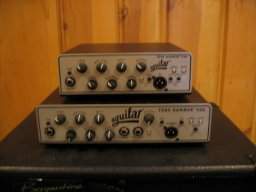
+1...If I understand correctly, the F1 would be the lowered powered version of the SD800, and the SA450 is an LMII with additional features as you mentioned above.


That's the way I understand it.

The use of the class D power amp in the SD800 and the F1 allows for either higher power in the same box size (e.g., the SD800 versus the SA450) or the same power in a smaller box size (e.g., the F1 versus the LMII).
 
+1...If I understand correctly, the F1 would be the lowered powered version of the SD800, and the SA450 is an LMII with additional features as you mentioned above.
Yeah, I was confused by the fact that the SA450 and SD800 shared the same manual. Shoulda' noted the product naming indicated the diff (analog vs digital).
 
Hey Vic... glad you are enjoying the LMII.

The SA450 is actually virtually identical to the LMII in basic power and components. They add the two semi-parametric mids, the DI volume and pre post switch and put it in a bigger box. So, while it looks almost identical to the SD800, and the control layout and features are identical to the SD800, it's really an LMII inside (with the 'analog' power amp and 500 watts power).

So, better to think of it as a 'more fully featured' LMII than a 'little brother of the SD800', since the power amps are quite different between the SD800 and SA450.

Thats what i was going to say.
I gigged a LMII while i was waiting for my SA450 to arrive and i cant say i noticed any difference it tone unless i use the mid controls.
And it does seem there is a difference in tone between the LMII/SA450 and the SD800 although im sure its still the MB sound. As long as its got the two filters i think i would be happy.

I would like to point out ive done almost 100 gigs now with my SA450 and this venue is the only place i have had trouble with 9and that includes lots of wooded stages) so im not worried about the head not being right for me. I guess i was just trying to say that although im looking to get a SD800 to replace my GK as they are almost the same output i was surprised how close the SA450 was in volume but that the SD800 might be a better match for the thick tone of my UL212
 
Both speakon and 1/4".

and... the Speakon is a 'dual' jack... so you have either one Speakon or two 1/4's. All the other models have two 'dual' jacks... speakon or 1/4". Pretty cool. I'm not sure why they didn't just put two dual jacks on the LMII (the F1 will have two dual jacks), but no big deal.

K
 
Shoulda' noted the product naming indicated the diff (analog vs digital).

I never even noticed that! Now I'm also wondering - does the "S" stand for "solid state" while the "T" stands for tube (preamp type)? So the formula for the first two letters would be (preamp type)(poweramp type). You have:

TA503 (tube pre, analog power)
TA501 (tube pre, analog power)
SA450 (solid state pre, analog power)
SD800 (solid state pre, digital power)

Then it gets hard to keep straight when you add in the LMII, LMK, F1, LM250, and the R500!
 
I never even noticed that! Now I'm also wondering - does the "S" stand for "solid state" while the "T" stands for tube (preamp type)? So the formula for the first two letters would be (preamp type)(poweramp type). You have:

TA503 (tube pre, analog power)
TA501 (tube pre, analog power)
SA450 (solid state pre, analog power)
SD800 (solid state pre, digital power)

Then it gets hard to keep straight when you add in the LMII, LMK, F1, LM250, and the R500!

+1.. there's actually a description of what all the letters mean on the home page of the website. That being said... not sure what the 'F' of the F1 means:confused:
 
I never even noticed that! Now I'm also wondering - does the "S" stand for "solid state" while the "T" stands for tube (preamp type)? So the formula for the first two letters would be (preamp type)(poweramp type). You have:

TA503 (tube pre, analog power)
TA501 (tube pre, analog power)
SA450 (solid state pre, analog power)
SD800 (solid state pre, digital power)

Then it gets hard to keep straight when you add in the LMII, LMK, F1, LM250, and the R500!

Correct.

The only thing here that merits clarification is that the TA501 technically has a solid state preamp--but the signal is always passing through the compressor tube even when the compressor is off, and this tube is within the "preamp section," so it has some of the sonic properties of a tube preamp.

P
 
Yeah, I was confused by the fact that the SA450 and SD800 shared the same manual. Shoulda' noted the product naming indicated the diff (analog vs digital).

This difference is stated in paragraph one of the "Product Overview" section of the manual.

These two heads share a manual because they have the same preamp, front panel, rear panel, features, etc. The only difference is the power amp and the power rating.

Cheers,
Peter
 
The only thing here that merits clarification is that the TA501 technically has a solid state preamp--but the signal is always passing through the compressor tube even when the compressor is off, and this tube is within the "preamp section," so it has some of the sonic properties of a tube preamp.
Cool! I was actually wondering about exactly this. Thanks!
 
This difference is stated in paragraph one of the "Product Overview" section of the manual.
Yeah, this is actually where I first found my problem, then I found out the product naming thing, and the bad part about that is, I remember reading that on the web site before and just forgot about it... DOH! :)
 
Well I guess I fell for the "hype" too. Oh,wait a minute, that's the other markbass thread. Mine should be here in the next couple of days. Vic, I gotta stop coming over to your house, this gear envy is getting expensive, but when I played through your LMII, I knew I had to have one. I think it will sound killer through my two GS112s.
 
Well I guess I fell for the "hype" too. Oh,wait a minute, that's the other markbass thread. Mine should be here in the next couple of days. Vic, I gotta stop coming over to your house, this gear envy is getting expensive, but when I played through your LMII, I knew I had to have one. I think it will sound killer through my two GS112s.
Man, I'm SOOO tempted to come all the way out to that gig and hear it... it's a fer piece to drive, but at least I wouldn't have to stay all night... maybe I'd bring a bass with me too, for you to check out... something kind of aggressive... something with a spalted top...
:hiding:
 
Hi guys!
I have a wierd experince with the XLR out of my markbass. With some mixers the line signal loses the lows, and just a crappy mid and high sound remains. After lots of eqing, you can make a bass like sound, but it's not the great natural sound you have with the amp.
But! If you get an xlr jack adaptor and go into the jack line input, you receive THE sound. So? Have you experinced it as well? And why is it like this? With other amps, or preamps I haven't had such experience.
:help:
 
Hi guys!
I have a wierd experince with the XLR out of my markbass. With some mixers the line signal loses the lows, and just a crappy mid and high sound remains. After lots of eqing, you can make a bass like sound, but it's not the great natural sound you have with the amp.
But! If you get an xlr jack adaptor and go into the jack line input, you receive THE sound. So? Have you experinced it as well? And why is it like this? With other amps, or preamps I haven't had such experience.
:help:

I've been using the DI our (XLR) from my LMII and I don't hear any frequency loss in the low EQ. I also compared to the DI in my Mesa Walkabout and they sound similar enough that I don't think there is any loss. In fact, when I use the DI / XLR out from the Markbass LMII into my bergie IP112, I have to turn the "Low" eq knob down on the LMII a bit so it isn't too deep. Gary
 
Status
Not open for further replies.