• TalkBass has been independent since 1998. Add your voice.
    Create a free account to reply to discussions, view embedded media, and browse with fewer display ads.
    Join freeLog in
    Want zero display ads or expanded classifieds tools? Compare plans.

This is what a "Dead Spot" sounds like

My turn to link to this article:

Invalid Link Removed

Good article, thanks for the link. I had an I'll-be-damned moment when I read this:

"The excitation point (string support) must not be located in a node, but closely enough to an antinode of a resonance."

It explains why dead spots get less dead when I wrap my hand around the neck rather than just use my thumb on the back of the neck like I normally do. The dead spot is right where the neck is moving the most, so damping the vibration with your fretting hand makes it take less energy away from the string. How I see it anyway.

edit: And it also explains why I don't see much of a dead spot on the same note but different string -- doesn't line up with an antinode.

-Tom
 
The other thing that sucks about dead spots is that they can "leak" to the octave below.
Like if the dead spot is the "D" on the G-string...is can also show up on the "D" on the A-string, or even the open "D"!

This is a bummer because they're harder to steer around.
 
The cause is a rather long boring story. The short version is that deadspots are an unfortunate part of basses with a bolt-on neck. The vast majority of Fenders have them, you just gotta know what to listen for.

The best method to determine if your bass has a deadspot is to play every note on the G string. Listen closely. See if any of them respond like the audio clip I posted above. They are typically between frets 5 and 9.
Thanks for posting that example - I'm sure it will be useful to many. Just a couple of points: dead spots are certainly not restricted to basses with bolt-on necks, nor are they restricted to the G string.
 
bass12 said:
Thanks for posting that example - I'm sure it will be useful to many. Just a couple of points: dead spots are certainly not restricted to basses with bolt-on necks, nor are they restricted to the G string.

Right. But that's where you will most often find them.

I've had many neck-thru basses that were deadspot free. But in the hundreds of Fender basses I've dealt with over the years, I've always been able to find one.
 
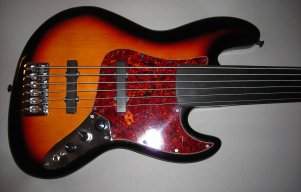
This thread caught my eye because I had discovered a dead spot just last night on my Squier fretless Jazz on what would be the 7th fret of the G string.
I had just put everything back together after shielding the p'ups and control cavity with copper foil tape to combat the 60 cycle hum., it made a huge improvement.:D
I haven't had the bass very long and I'm sure I would have noticed that bad a dead spot before I bought it.
I began to wonder how I could have screwed something up when I did the shielding, but it's getting more like Spring and the last couple of days have been much warmer with higher humidity, so the weather could have effected the neck. :hmm:
No small C clamps in the garage so I grabbed the chip clip from a bag of Lay's and put it on the headstock. Bamm! the dead spot was dead no more, but had moved down to the 5th and 6th!
Moving the clip around made for some interesting results, then I remembered some stick on wheel weights I had in the garage. Thin weights applied to the back of the headstock would look way better than a chip clip, so I gave them a try. They did the job, but there was still room for improvement.
My problem with the weights is, I'm old and I never did like heavy guitars. Besides, the wheel weights look a bit out of place, even if they were on the back of the headstock.
I decided to go back over the setup since the weather had changed and sure enough the neck relief needed a slight adjustment. After setting that to .012" I looked at the string height. I set the E string to 2.5 mm and G to 2mm at the 17th fret, then using a template, I adjusted the D and A strings to fit the arc. I adjusted the intonation a bit and plugged it in.
The dead spot is still there but not nearly as bad. Tweaking the setup really helped. I'll still keep the stick on weights handy.
 
Right. But that's where you will most often find them.

I've had many neck-thru basses that were deadspot free. But in the hundreds of Fender basses I've dealt with over the years, I've always been able to find one.

My Fender V doesn't seem to have any dead spots (I always check basses for dead spots BEFORE I buy them!) But living with it for a while I have noticed a couple of notes where character of the tone changes ever so slightly. I presume what that means is that the ratios between the various harmonics from the string have shifted ever so slightly for those notes. The sustain doesn't seem to change.

Well, that is up to recently. I had the basses stored in a room with little heat with temp near freezing. (It's winter) So one day I pull the old Fender out for a little wood shed and I about have a cow because there are these two or three HUGE dead spots on it. I mean REAL sustain-sucking serious DEAD spots! What in the world has happened to my bass? Visions of major disaster were dancing in my head. But happily after it warmed up to room temperature it went back to its old self again! I think there is some kind of lesson in here.
 
If the neck is longer, the likelihood of bad dead spots gets worse, I have found. A longer neck is more able to flex I guess. Hence why short scales sustain so well. Also I have found laminate necks have far fewer dead spots, as the lamination stiffens the neck. I occasionally run into dead spots on some one-piece neck Rics but never on two-piece or three-piece neck Rics, and I have played a pretty large sampling of Rics over the few years I've taken an interest in them.
 
I never thought of dead spots on my basses, but this thread made me take my bass (Godin Freeway 5) and check it out. And I've found one note that fades out much faster than others - it's D on 7th fret of G string, classic one :) (all the other D's anywhere else on the neck sound just fine.)

Well, it's kinda sad to know this, but it doesn't bother me much, as i never play "bass" notes on the G string, they sound thin there anyway, so i use this string for fills/short octave notes/chords/etc only, and play all the roots on D string and lower.

Gotta check my guitar for deadspots this evening, I'm curious now.

Another thing I'd like to say: I've noticed there are two kinds of deadspots:
First one is being discussed here — it's note fading out much faster than it should.

Second one is when fundamental frequency fades away faster than other harmonics and in several seconds 2nd harmonic becomes the most pronounced one. I have a couple of such deadspots on my bass (C# on 6th fret of G string and, curiously enough, open E) and at least one on my guitar (D on 5th fret of A string).
 
am i the only one who couldn't give a rat's ass about a dead spot?

99% of the time I'm with you on this but saying they have zero impact in the real world seems kind of naive to me. If you're playing a ballad, a dead spot is usually a good thing to avoid, for example.

Still, I am amazed how many people freak out because their bass has a dead spot that sounds much better than Dan's example.
 
am i the only one who couldn't give a rat's ass about a dead spot?

Nope. I bet Rocco Prestia's bass could be one big dead spot, and he'd never notice. If you play lots of 16ths, stick mostly to the "money notes", and do lots of palm muting, why would you care?

OTOH, if you work a lot with lineups where there's plenty of room to add melodic fills, play a lot of slow balads, and play a lot in the key of (place dead spot here), then they can be a roaring pain in the butt.

I don't notice the dead spot on my ATK when I'm using it for it's intended purpose (uptempo stuff with lots of straight 8ths), but it bugs me on ballad dates. Since I do a lot of that sort of work, I'm still trying to fix it.
 
99% of the time I'm with you on this but saying they have zero impact in the real world seems kind of naive to me. If you're playing a ballad, a dead spot is usually a good thing to avoid, for example.

Still, I am amazed how many people freak out because their bass has a dead spot that sounds much better than Dan's example.

Exactly. We're talking about a D note, most of the time. It would be slightly less impactful if it was an accidental. But that D sure comes in handy.

It would only be a non-issue if all you played was metal.
 
I posted on another thread about how it seems the more strings a bass has the less likely it is to have dead spots. My 10 string bass did not have dead spots ... and it was a bolt on.

Picture%20314.jpg
 
There is a classic recording where the infamous Fender G string 6th fret deadspot is easily heard - Verdine White, on "That's The Way Of The World", on the album of the same name, by Earth, Wind, and Fire. The fundamental dies out quickly while the overtones keep ringing on the sustained high Db during the intro.
 
Exactly. We're talking about a D note, most of the time. It would be slightly less impactful if it was an accidental. But that D sure comes in handy.

It would only be a non-issue if all you played was metal.
lol! i guess i play mostly 50's and 60's metal then ;)

btw, i didn't say they had zero impact in the real world, just to clarify. i just said i couldn't give a rat's ass about a dead spot. still don't, either.