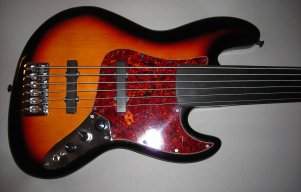
Here's a question...since dead spots are the bane of bolt on necks, do the number and/or size of the bolts make any difference? My bass is a 6 bolt neck. Just curious, like a cat...

TalkBass has been independent since 1998. Add your voice.
Create a free account to reply to discussions, view embedded media, and browse with fewer display ads.
Join free Log in
Want zero display ads or expanded classifieds tools? Compare plans.

Here's a question...since dead spots are the bane of bolt on necks, do the number and/or size of the bolts make any difference? My bass is a 6 bolt neck. Just curious, like a cat...
not in my experience. it has to do with the resonant frequency of the neck, not how many or large the bolts are.
Some folks have wondered what a "dead spot" sounds like. Well here you go. This is about as bad as they come. A customer of mine brought me this 2006 MIM P bass with a nasty deadspot. As usual, it's on the 7th fret of the G string.
In this audio clip you'll hear 2 normal notes on the G string, and then the dead D note: http://www.atkinsonbasses.com/storage/deadspot.mp3
Here's a picture of the waveform:

Here's a question...since dead spots are the bane of bolt on necks, .
And that resonant frequency is a byproduct of the fact that you have 2 separate pieces of wood (the neck and the body) mated to each other by bolts, correct or am I misunderstanding this.
And that resonant frequency is a byproduct of the fact that you have 2 separate pieces of wood (the neck and the body) mated to each other by bolts, correct or am I misunderstanding this.

Quickie said:Not true...I have had Rics and Spectors...neck thru models that have had dead spots. John Hall on the Rickenbacker forum pointed this out with adjustments to the truss rods that could help.
This is a great example to those who deny their basses don't have a dead spot. All wood basses/necks have dead spots...although..some may be much less noticeable.
The neck and body thing is correct, the "joined by bolts" part is not. It doesn't matter how the wood is joined be it by the tree (neck through) or bolts. The key feature is you have this long thin relatively flexible "twanger" (the neck) attached to a large relatively heavy solid object. At some frequency even though the neck is stiff, it is still flexible enough to vibrate. When you find it's resonant frequency, it does and it sucks energy from that note. Hence a "dead spot".
The universe being the way it is, somehow these dead spots are always on notes you want to use a lot! So people are always trying to somehow move them somewhere else. They standard way to do this is to add weight to the head stock. That way you can move a dead spot at G down to A# or at D down to C# where they won't matter so much. The weight doesn't get rid of the dead spot just lowers it's frequency!
I have experimented with variations in bolts in a bolt-on neck and they can make a SLIGHT difference in dead spots it's not enough to "fix" any such problems. Also changing the stiffness of neck will alter it's resonant frequency (hence truss rod adjustments will move dead spots) or even keep it from "twanging" altogether (heavy non-adjustable graphite necks)
Even if graphite necks do have resonances because of the stiffness they will be such high notes they won't be a concern.
One SURE way to get rid of a dead spot is to simply press your headstock against a wall when you play the note! Simply damps out all neck "twang" and the bass comes alive! It's just not practical to play it that way! Which is why people have built these basses either with the body extending way up the top side of the neck (stiffens a large part of the neck) or with one of those weird "flying buttress" constructions that go between the bass body and the headstock. It's just a permanent version of pressing your headstock to the wall! I've never tried one of those so I can't say how it works, but I've done the wall thing and it works for sure!
I wonder if this problem would still occur if you were to construct a bass out of a material other than wood (I think Ampeg had some Plexiglass type basses back in the day)
Huh? That just shows the phenomenon. It doesn't prove that all basses have audible dead spots, even if technically they may exist, they most certainly don't have to manifest themselves in a way we can hear them.
I have four Rics, and one has an audible dead spot. The other three don't. That's just how it is, on a functional/practical level.
I wonder if this problem would still occur if you were to construct a bass out of a material other than wood (I think Ampeg had some Plexiglass type basses back in the day)

Here you go. Any wood instrument will have this.
Invalid Link Removed
Yeah--I don't deny that. But what about the PRACTICAL element of this. If you don't hear it, why worry?
I had one of the Dan Armstrong Ampeg Lucite (Plexiglas/Perspex) basses...it had a maple neck with rosewood fingerboard, mine had the usual dead spot inspite of it's short scale. It was very heavy but it balanced fairly well.

Yeah--I don't deny that. But what about the PRACTICAL element of this. If you don't hear it, why worry?

One of the worst deadspots ever recorded has to be on Marvin Gaye's "Whats Going On" when James Jamerson goes for the C# on the G string at the 6th fret and it is a sick THUD.
Rocky