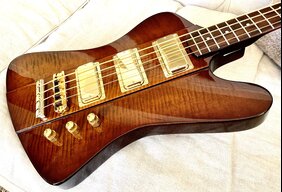
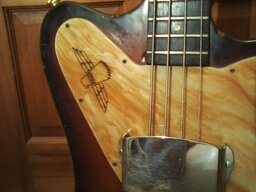
I have about a dozen three point equipped basses. I’ve changed the strings on them many many times. Never once have I removed the strings and had the bridge jump off the bass. The reason is probably because like any sane person, I typically unstring and restring the bass while it’s laying flat on a table. Im sure that if I picked it up vertically or flipped it over on its belly I’d experience the dreaded bridge ejection, but why would I do that. It’s really a non issue if you know what you’re doing, the issue never comes into play. I consider the easy removal of the three point a feature, it allows me to lift it out of position, easily clean under the bridge and then simply slide it back in place with out having to reset intonation or action.
Now the occasional string break on a three point is a different story and could be an unmitigated disaster on stage, and a PITA at home. In 25 years of playing bass I’ve only broken one or two strings and they were both while tuning up to pitch, not during a performance. So the saddle didn’t fall out, but easily could have. Just lucky I guess.
On the other hand, I have had at least two occasions where one of the grub screws on my Fender bent plate saddle fell out, during a performance. Screws up tuning, intonation and action and it’s impossible to find one of those little buggers once they are gone. I’ve had a few also strip out at the hex head while adjusting and I’ve had a number that decided to self adjust while playing (probably from some previous owner replacing a lost one with the wrong size new one).
Bottom line - neither bridge is perfect. Both are adequate. One has just as many faults as the other. Both are Butt Ugly.
Give me a Warwick two part bridge on a Warwick, an Alembic two part bridge on an Alembic, an Epiphone two part bridge on a Gibson, and a High Mass bridge on a Fender, and I’ll be completely satisfied.

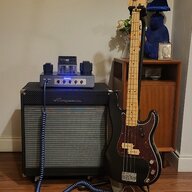

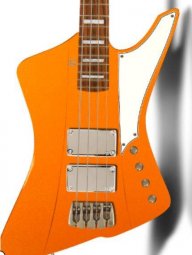


 <forgot to include this