If it was flat black it was a goth.
The price is too low to be a VP or a CP so it’s not one of those.
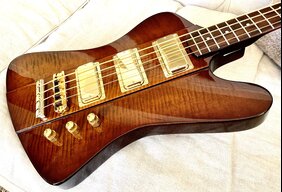
If it was a brown burst it was most likely a IV.
If it had a prominent multi laminate neck through design it was a Pro.
No expert here, but as I understand it, some cap designs have values and tolerances that can drift over time. How much time and how much drift, I don’t know. Certainly not an original design feature but one that can have an impact on tone.
The other signal chain component that can play a huge impact in tone and is very difficult to exactly duplicate is pickup construction. Wire type (metallurgy, size and coating material) has changed over the years making it more difficult to exactly match a vintage spec. Wire winding methods (tension, scatter, random vs linear) have changed over the years with much of it previously done by hand and therefore much more random and inconsistent vs todays machine winding. Magnet types and compounds (ceramic, iron, Alnico, hybrids) all greatly effect the pickup output, and the construction of these materials has changed over time making it very difficult to obtain the exact same spec as a vintage pup. Then to further compound all these issues, just like certain cap values magnet strength can change over time. Not an original design feature but a factor that can have a noticeable impact on tone.
Then there’s the whole tone wood discussion with aging wood and coatings, changing the tone of a bass over time. I won’t go down that path, too many land mines.
Bottom line, an inanimate object like a bass does change over time. The sum of its parts define its inherent sound, and as time goes on and the components drift from their original state it can create a very special sounding instrument from what was once just a typical off the shelf bass. Which begs the question, I wonder what our VP and NR basses which sound quite nice today will sound like 75 years from now.
ok, now you hit in on the head….I try to refrain from these responses as they always seem to start completely unrelated dialog but in this case (and from what you posted) it makes sense to add as it may answer some questions some may have….
there are MANY different types of caps out there…the types are dictated by the tech at the time they were built….although the transistor was invented in 48, they were not used in pro audio till at least a decade later, they were just a PITA to implement…… for that reason, the caps found in early 50’s gear would be of the high voltage tube-tech type….since charge (Q) equals the capacity by the Voltage it follows that at a lower Voltage (such as those used by transistor-tech) the capacity (physical size) of a cap would have to increase for the same charge (Q) which is directly related to the uFd rating of the cap…..
when a designer is shopping around for a cap, three things are of importance, first, electrical characteristics (what’s the cap going to do? decouple noise? couple sensitive signals? bulk decoupling of a power supply?)
second, price.
third, physical size (more recent requirement with shrinking assemblies) ….
finally, tolerances, meaning how much will the capacitor uFd value drift from its spec as a function of temp….commercially there are three main ones,
5ZU 10% drift, cheapest
X7R 5% drift, more expensive
NPO (C0G) 1% drift, most expensive….
without going into particulars of construction technology such as ceramic, tantalum, aluminum, polypropylene etc. the crux basically is;
if I’m designing a very fast Phase Locked Loop circuit to capture a satellite downlink where proper operation of the circuit ensures the safety of human life for example, you better believe I’m gonna select the more expensive NPO type for the loop filter….if on the other hand I want to decouple HF noise from the input of a gain stage, I’ll choose the cheaper 5ZF type
banking on its inferior quality to guarantee better broadband rejection as I’m using its quality shortcomings to my advantage……make sense? now picture Leo’s shop in the early 50’s where he probably had a broad selection of different types of caps due to whatever was available in his initial low procurement quantities…. cheap ones, expensive ones, etc and he gets an urgent order for 40 P basses but doesn’t have enough of the same type of caps to fill the build, undoubtedly other (possibly better quality) caps will end up in some of those P basses…..alternative, since the application is not mission critical (meaning there is no major human life or monetary risk) cheaper higher drift caps may end up on some the instruments hence “these are both 52s but this one sounds so much better”… make sense? lotsa moving parts in these manufacturing related topics….



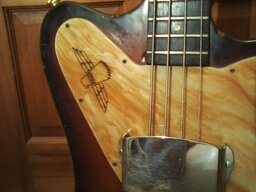
 Are the 'newer Gibson cases' the brown ones w/fuchsia interior? If so I have one I bought in the '90s from GC here in SF. Amazingly it was $50! (new!) Best 'deal' I ever got - I think the guy on the floor didn't know what it was.



 ).
).