thats how I do it. NOW I have passed my initiation into the holy T-Bird brigarde. Hail T-Brird

Enjoy the benefits of a premium membership!
Upgrade Account
-
TalkBass has been independent since 1998. Add your voice.
Create a free account to reply to discussions, view embedded media, and browse with fewer display ads.
Join free Log in
Want zero display ads or expanded classifieds tools? Compare plans.
You are using an out of date browser. It may not display this or other websites correctly.
You should upgrade or use an alternative browser.
You should upgrade or use an alternative browser.
Thunderbird Club
- Thread starter TBird1958
- Start date
-
- Tags
- club thunderbird
More options
Who Replied?
now I know the difference between a below 500 EUR bass and a 2000 EUR bass.
That's not a bug, that's a feature! I always do one string at a time with the bass lying flat on its back. My cheapo Epiphone has a high mass bridge with captive saddles. My custom built NR41 has saddles held in by string tension - they both work fine.
As others have mentioned, the 3-point bridge has saddles numbered 1-4. Not sure whether 1 = G or E. You can always get a Hipshot or Babicz to replace the stock 3-point if it bothers you.

thats how I do it. NOW I have passed my initiation into the holy T-Bird brigarde. Hail T-Brird
When I got my first bird it was the night before a practice and 2 days till a show and I needed to set it up buzz free drop C with heavy strings. It was a harrowing few hours at first, the bridge was rattling and the c string didn't have enough tension. Luckily I am pretty mechanically inclined and it immediately came into my head to tilt the bridge back, and that solved the issue. In had to loosen the truss rod quite a bit to add enough relief for the first 5 frets not to buzz, but I have to do that with any bass I set for drop tuning with .115 string. I DON'T play with a light touch, so low action is not an option for me, unless I wanted to use a .130 which would require modification to the bridge and nut. I have to crush/crimp the .115 strings near the balls to get the strings in the 3 point as is. I would have to file open the bridge to use a wider string. I suppose that bar thingy that can be added behind the bridge to extend the balls out would solve that. I forgot what they are called, and they cost $30-40 on eBay.
I didn't join the bird club until after getting the bass and doing my own setup. That was when I found out the back tilt also keeps the studs from pulling out, and that all the cool kids also tilted the bridge back.

Beautiful bass for sure and I bet it rocks hard with Lollars in it.
What do you guys think is up with the paint coming off on the back of the headstock at the tuners?

hillerup
There are basses, and there are Thunderbirds!
daughter's birfday
I've corrected this for you:
"Daughters barfday"...

hillerup
There are basses, and there are Thunderbirds!
That is how all gibson 3 point bridges are. They should come with a warning manual. The saddles are numbered so you can get them back in the right order. Intonation should not be affected too much as long as the saddle is in the same place on the screw. It is worth learning how to adjust that bridge, since it can work just fine when used properly and care is taken when changing strings or making adjustments.
If you are referring to the tuners wobbling when there is no string tension, this is normal and I have experienced that on all 3 of my epiphones and in other forms on other basses with different types of tuners. Shafts and keys are known to have some play in them on the bigger open gear type tuners, and those schaller type mini tuners used on these thunderbirds tend to pivot where the whole key twists when there is no string tension. It does not cause a problem.
But I understand how you feel the first time changing strings on them.
You can always throw money at anything you don't like, and modify it with a hipshot or babicz or bad bird bridge, and other tuners.
But once you get the strings back on, it will be fine even stock. Occasionally the bridges rattle, which can happen on any bass.
Important, always set the bridge so the front bolt is higher than the 2 back bolts. The bridge should be tilted back slightly. This puts more tension over the saddle, and also prevents the 2 rear studs from pulling out, which can happen on these when the bridge is set up in a nosedive. And they commonly come from the factory, or a previous owner that way, because not everyone knows about the issue.
You just have to change one string at a time, and keep the bass pretty much flat, face up. Other than that, and a set up issue, the bridge is fine, works as it should. The only adjustment it doesn't have is side-to-side string spacing.
The set up issue has to do with the front of the bridge (the single post) being slightly higher off the bass body than the rear of the bridge (the two posts). I'm sure others will chime in as well.
Nice 'Bird! Her Grace will be along to invite you in to our collective (resistance is futile- you have been chosen)!
Lol... see? I'm late already!
The 3 point bridge does take some getting used to. When changing strings, I put the first new one on, before taking the last old one off. That keeps the bridge in place. You can also use electricians tape on the bridge anchor posts, and across the saddle screws, if you need to keep the bridge in place without strings on it. It's quite common to replace the stock bridge, and there are a number of options available.
As for the tuning machines... Whether it's a $200 piece, or a $2,000 piece... I've made it a habit to verify that all screws and nuts are snug the first time I change strings on any new instrument I've acquired, and I'm always glad that I did.
+1 on what the guys says...
Indeed you are! He already has his digits mon frere
... and you let fly with a li'l lie. The mighty 3 point lacks the ability to adjust individual saddle heights (one of my main reasons for wanting the Hipshot
Basically you don't need the option of having individual saddle height adjustment with a 3-point bridge, since the entire bridge assembly is already adjusted to the same radius as the fretboard...
That's not a bug, that's a feature! I always do one string at a time with the bass lying flat on its back. My cheapo Epiphone has a high mass bridge with captive saddles. My custom built NR41 has saddles held in by string tension - they both work fine.
As others have mentioned, the 3-point bridge has saddles numbered 1-4. Not sure whether 1 = G or E. You can always get a Hipshot or Babicz to replace the stock 3-point if it bothers you.
+1 on what the girl says...

Yep, they got back on game with 'Who Made Who' & 'Thunderstruck'Feel the same, that's where Acdc - no masters of diversity - became 100% repetitive and boring. Before most songs had something to it, that made them stand out.
That said, I like the Razor's Edge and Stiff Upper Lip.
That is nice!
yeah, my Goth came to me with no strings and the bridge and saddles in a ziplock bag....I am a newbie to the T-bird world and like to share my first impressions on that bass:
my update about quality appearance:
I was happy to put on new stings, because this is basically my first bass, where you can hang in the springs. So I thought it would be an easy job. No one told me, that the complete bridge will fall apart without the tention of the springs. All 4 saddles lay on the ground and intonation was gone and had to be adjusted again. I asume, same thing will happen with the 4 times expensiver Gibson. IMO a totally fail of contruction without any excuse. Everybody is complaining about the head drop thing (I do not care at all, mine is fine), but I never heard people complaining about the poor brigde design. Next thing I discovered were the loose cheap tuners. Even if this bass is crafted in Indonesia, one can expect (there is a quality aproved sticker just beside the tuners), that somone is tighten the screws properly. I think I will remove the cheap tuners against Gotohs and I´m fine again. After all I am still happy with the bass, because it is a good value for the money, but now I know the difference between a below 500 EUR bass and a 2000 EUR bass.
 that was a shock!
but all good. Loving it!

You just have to change one string at a time, and keep the bass pretty much flat, face up. Other than that, and a set up issue, the bridge is fine, works as it should.
Bah, I take all the strings off. The bass is lying flat, the bridge, if it moves, isn't going far. I remove the bridge (being careful to not move the intonation screws) so that I can clean under the bridge. Leave it off while I oil the fretboard, clean etc. then put it back when I restring.

Fine.Bah, I take all the strings off. The bass is lying flat, the bridge, if it moves, isn't going far. I remove the bridge (being careful to not move the intonation screws) so that I can clean under the bridge. Leave it off while I oil the fretboard, clean etc. then put it back when I restring.
I never remember to clean underneath parts of my bass. I only ever remember to clean my parts.
Basically you don't need the option of having individual saddle height adjustment with a 3-point bridge, since the entire bridge assembly is already adjusted to the same radius as the fretboard...
Until you use strings with E and A exposed cores...
I didn't think of it, but it's never occurred to me. I only thought of side-to-side because the nut on my B-Bird is a tad narrow for my liking.Indeed you are! He already has his digits mon frere
... and you let fly with a li'l lie. The mighty 3 point lacks the ability to adjust individual saddle heights (one of my main reasons for wanting the Hipshot
Hillerup covered that note though, in that the bridge radius is a right match to the fretboard radius. You just adjust the post heights.
So, there.
Good point.Until you use strings with E and A exposed cores...
That's why I don't try to use a fatty B string for my drop C. No way a standard one would fit in the bridge, and a taper core I fear would have too low an action since I can't raise the saddle.Until you use strings with E and A exposed cores...
On my other basses, whenever I find myself with a taper E or B, I have to raise the saddle.

Raise the bass side up a little bit on the bridge, it'll good as new.Until you use strings with E and A exposed cores...

Pedulla tapered core might help though, E, A, and D strings are tapered so you can probably get away with raising the whole bridge without messing up the action to much.

Regarding all the things mentioned about the 3 point, is why i went with the Hipshot.
Although you can get a good set up with the 3 point, i'm very happy i went with aforementioned bridge.
Although you can get a good set up with the 3 point, i'm very happy i went with aforementioned bridge.
Regarding all the things mentioned about the 3 point, is why i went with the Hipshot.
Although you can get a good set up with the 3 point, i'm very happy i went with aforementioned bridge.
I haven't had any significant difficulty with the standard 3 point bridge, but I am contemplating using a Hipshot for the same reasons.

Ooooh, look at that: Thunderbird strap locks.
Thunderbird Strap Lock | Allparts.com
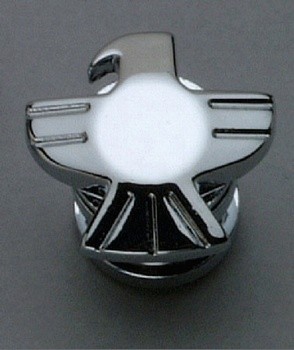
Sigh. Lusting after cheap, shiny, little blingy things like this always makes me feel like a drunken man whore with thirteen dollars in his pocket stalking Zippo lighter vendors at the county fair. Which I know nothing about, of course.
Thunderbird Strap Lock | Allparts.com
Sigh. Lusting after cheap, shiny, little blingy things like this always makes me feel like a drunken man whore with thirteen dollars in his pocket stalking Zippo lighter vendors at the county fair. Which I know nothing about, of course.
I haven't had any significant difficulty with the standard 3 point bridge, but I am contemplating using a Hipshot for the same reasons.
Based off my very limited experience, i find that the Hipshot is an improvement all around, got mine used, but is in great shape.
I think you'll like it very much PillO.
hillerup
There are basses, and there are Thunderbirds!
Until you use strings with E and A exposed cores...
Didn't know they still made those - I thought it was just a passing fad...
Last time I saw a set of those was over 20 years ago - Rotosound I believe, but don't remember the name of the strings, only remember that they came without mounted ball ends, which you had to put on yourself after cutting the core to the right length - Totally PITA strings...
Last edited:


