• TalkBass has been independent since 1998. Add your voice.
    Create a free account to reply to discussions, view embedded media, and browse with fewer display ads.
    Join freeLog in
    Want zero display ads or expanded classifieds tools? Compare plans.

Thunderbird Club

The thing about standard gauge strings and Drop C is that they tend to be more rubbery than I can stand. That's one feature of the Heavy Core that I love: the thicker core wire makes them feel like a medium light set tuned to standard tuning when they're tuned down.

Good info! But I’m talking about normal guage tuned down. I’m talking about a 128 tuned UP to C. Shouldn’t that be ok?
 
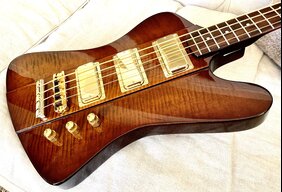
(random cool pic)

419004072_f61cccba9c.jpg

(Gina Collins - McQueen)
 
Delayed response.

@GBassNorth did you get any further on the aesthetic fine tuning?
( I envy that pickguard, mine has the Celtic Cross scratched away. :( )

On the Goth stnd pickups. I hear of people running mods (on other basses) of series / parallel, with a switch. Do you think that is possible with the stnd pickups? Any benefits ? Or more likely to turn to merde?
Actually, I haven't had five spare minutes to work on the Goth since the last update.

As for series/parallel switching - I tried both hardwired as well as switching and in the end decided to just go with series hardwire. Every bass I've had that has series/parallel switching ends up in the series mode 90% of the time. So I simplified things and just wired it that way.

Parallel wiring comes in handy if you're doing chord or harmonic type playing where you want a lot of detail in each note. However, it comes at the price of heft. Series wiring has a bolder stronger more aggressive tone more fundamental and less detail. That's more in line with how I play my birds anyway.

That said, I did wire in a coil split that allows me to select the single neck coil of the neck Humbucker and the single bridge coil of the bridge Humbucker. In essence this allows me to run in single coil mode and solo either pup or blend as needed. It basically gives me the option to dump the humbuckers and go single coil that 10% of the time I might want to do some chord type work where humbuckers would be to overpowering. The coil switch combined with the vol/vol layout is very effective and super simple - great for gigging. I haven't looked at the stock Goth pups but I suspect you could wire those in series or parallel.

If I ever get around to installing a new pickguard on the Goth and no longer need the stock one I'll ship it out to you.
 
Actually, I haven't had five spare minutes to work on the Goth since the last update.

As for series/parallel switching - I tried both hardwired as well as switching and in the end decided to just go with series hardwire. Every bass I've had that has series/parallel switching ends up in the series mode 90% of the time. So I simplified things and just wired it that way.

Parallel wiring comes in handy if you're doing chord or harmonic type playing where you want a lot of detail in each note. However, it comes at the price of heft. Series wiring has a bolder stronger more aggressive tone more fundamental and less detail. That's more in line with how I play my birds anyway.

That said, I did wire in a coil split that allows me to select the single neck coil of the neck Humbucker and the single bridge coil of the bridge Humbucker. In essence this allows me to run in single coil mode and solo either pup or blend as needed. It basically gives me the option to dump the humbuckers and go single coil that 10% of the time I might want to do some chord type work where humbuckers would be to overpowering. The coil switch combined with the vol/vol layout is very effective and super simple - great for gigging. I haven't looked at the stock Goth pups but I suspect you could wire those in series or parallel.

If I ever get around to installing a new pickguard on the Goth and no longer need the stock one I'll ship it out to you.

Cool info! Thanks!

On the question of how 'true' is 'true bypass'? it seems not at all. Pull power from the Cioks PSU and there is no signal passing through.

I must misunderstand ‘true bypass.’ I thought it meant when the pedal isn’t engaged you get the same signal as is there were no pedal? Not being much of a pedal guy, I could be a mile off!
 
On the question of how 'true' is 'true bypass'? it seems not at all. Pull power from the Cioks PSU and there is no signal passing through.
My experience on guitar pedals (don't really use many bass pedals) is that every input and output jack you go through degrades the signal to a degree, even on true bypass pedals. Does it make a noticeable difference? Depends on the number of pedals and just how true of a bypass they have. I'm of the mind that not all true bypass designs are equal, some may be more robust than others. Just an experienced opinion, no actual facts to back it up. It would be interesting to check the resistance in bypass mode across a number of pedals and compare that to the resistance in a similar length of instrument cable.
 
My experience on guitar pedals (don't really use many bass pedals) is that every input and output jack you go through degrades the signal to a degree, even on true bypass pedals. Does it make a noticeable difference? Depends on the number of pedals and just how true of a bypass they have. I'm of the mind that not all true bypass designs are equal, some may be more robust than others. Just an experienced opinion, no actual facts to back it up. It would be interesting to check the resistance in bypass mode across a number of pedals and compare that to the resistance in a similar length of instrument cable.

Agreed. I used to solder cables when I was younger. Got sick of it. Now I have whatever is available down the road, and their selection is always terrible. A 40m 1/4" speaker cable? Really?

bass > 6m cable > pedal > patch lead > pedal > patch lead > pedal > 3m cable > amp
 
Actually, I haven't had five spare minutes to work on the Goth since the last update.

As for series/parallel switching - I tried both hardwired as well as switching and in the end decided to just go with series hardwire. Every bass I've had that has series/parallel switching ends up in the series mode 90% of the time. So I simplified things and just wired it that way.

Parallel wiring comes in handy if you're doing chord or harmonic type playing where you want a lot of detail in each note. However, it comes at the price of heft. Series wiring has a bolder stronger more aggressive tone more fundamental and less detail. That's more in line with how I play my birds anyway.

That said, I did wire in a coil split that allows me to select the single neck coil of the neck Humbucker and the single bridge coil of the bridge Humbucker. In essence this allows me to run in single coil mode and solo either pup or blend as needed. It basically gives me the option to dump the humbuckers and go single coil that 10% of the time I might want to do some chord type work where humbuckers would be to overpowering. The coil switch combined with the vol/vol layout is very effective and super simple - great for gigging. I haven't looked at the stock Goth pups but I suspect you could wire those in series or parallel.

If I ever get around to installing a new pickguard on the Goth and no longer need the stock one I'll ship it out to you.

Cheers G :thumbsup:

Just wondering about my Goth to take my mind off the clock waiting for the 9th; started thinking about various things that I could try.
Like mini switches for pickup selection, series parallel or now I’m thinking of your idea above.

The other thing I was wondering about is a mini switch to take the tone pot out. So switch one way it acts as it does now, the other it is out of circuit.

That’s my thought after Kats ‘remove tone pots’ and your various Goth tone experiments. I do use the tone at times; but the no tone option sounds cool. Be nice to change at the flick of a switch.
 
Agreed. I used to solder cables when I was younger. Got sick of it. Now I have whatever is available down the road, and their selection is always terrible. A 40m 1/4" speaker cable? Really?

bass > 6m cable > pedal > patch lead > pedal > patch lead > pedal > 3m cable > amp
Would be interesting to see what the resistance is on that signal chain vs lets say a single 10m cable run directly from guitar to amp. Again, no real bass related data on my part but I did occasionally use a super long coil cable when playing guitar. The signal loss due to resistance of the longer cable made a noticeable difference in the distortion of the guitar.
 
?.. A 40m 1/4" speaker cable? Really?
Makes perfect sense. You never know when you might want to walk out of the pub and get some fresh air in the parking lot while still playing your bass. Heck, with that cable you'd even be free to pop into the next pup over for a pint of non-comp beer without missing a beat. :roflmao:
 
Cheers G :thumbsup:

Just wondering about my Goth to take my mind off the clock waiting for the 9th; started thinking about various things that I could try.
Like mini switches for pickup selection, series parallel or now I’m thinking of your idea above.

The other thing I was wondering about is a mini switch to take the tone pot out. So switch one way it acts as it does now, the other it is out of circuit.

That’s my thought after Kats ‘remove tone pots’ and your various Goth tone experiments. I do use the tone at times; but the no tone option sounds cool. Be nice to change at the flick of a switch.
I think there's a quick easy fix for the tone pot delete. IIRC it's called a no load pot and basically works the same as any other tone pot until you turn it to the max position at which time it in essence drops out of the circuit. That might be the best of both worlds.

As far as the switching goes, I tried just about every logical switch configuration and the results fell into one of three categories.

1) Too complex to be messing with while gigging - anytime you have multiple toggles that interact with each other it becomes distracting to start messing with them during a song. G&L basses come to mind.

2) Not effective enough to warrant the extra complexity - I had one set up on the Goth that allowed selection of which coil in which Humbucker would be hot, I found there wasn't any significant difference between selecting the neck coil vs the bridge coil on either pup. The real difference was single coil vs Humbucker.

3) Very effective and gig friendly - that came down to two real options. Series/parallel switching (which I have on other basses but only use occasionally; or what I went with - dual series single coil/dual series humbuckers. It's a single switch with only two positions, so it's very gig friendly and the different positions deliver very different sounds. Best bang for the buck in my book.
 
Winter Build Off 2018 - Wallybird

Have you guys seen the tb build off thread? This build is frickin georgous!
Link?

Delayed response.

@GBassNorth did you get any further on the aesthetic fine tuning?
( I envy that pickguard, mine has the Celtic Cross scratched away. :( )

On the Goth stnd pickups. I hear of people running mods (on other basses) of series / parallel, with a switch. Do you think that is possible with the stnd pickups? Any benefits ? Or more likely to turn to merde?
Series is awesome. I usually run my T-bird in series. Doing it with Thunderbuckers required some imaginative wiring by my tech, though.
 
  • Like
Reactions: hillerup and RedVee