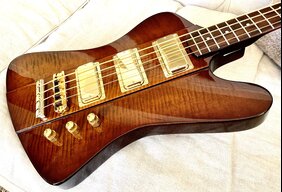
The machine doesn't determine any variation, that's purely as a result of either wear in the machine or a lose workpiece. The program for a Tbird for example would be quite complex so making an assumption it wouldn't be changed ad-hoc, I would think that given that Scott's white VP was smaller than the VSB then that would indicate an intentional difference in the program, or a mis-set tool/tools. I can't see a mistake on one guitar and not the other due to a programming error, why would you change a perfectly good program without reasonI see what you're saying. But at the same time, if a dimension is only good to .01" how will a machine determine if it's .010" or .019", that's where variation from the CAD drawing happens. And in written program, I've seen CNC'd nylon that was out over .035", it was completely due to the written program. The programmer used climb milling instead of conventional, but also only dimensioned to one decimal place (again, Imperial) (took a far bit of marks off that group project).
Machines in production environments tend to be a lot more sturdy than those found in smaller shops, another assumption I'm making is that the makers of the birds are using a reasonable robust machine, direction of cut is less critical, finish and or dust control tends to be the deciding factor