
Besides, GonePlaids are more accurateWell played sir!
As long as folks post in foreign languages it's fair game to post rough translations.

TalkBass has been independent since 1998. Add your voice.
Create a free account to reply to discussions, view embedded media, and browse with fewer display ads.
Join free Log in
Want zero display ads or expanded classifieds tools? Compare plans.
Besides, GonePlaids are more accurate
As long as folks post in foreign languages it's fair game to post rough translations.
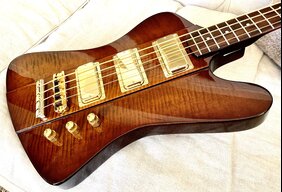
Morning! Just finished my second mug of Builders. Time for a bacon buddy now, then off to do a deep cleaning of the guitar room and maybe some bass maintenance.Who woke him up?
Morning G

I have a live in Japan BBA bootleg recording I got many years ago. Beck's Boogie live tears it up!!Yeah! I've enjoyed pickin' up a lotta stuff here that I hadn't found previously. My favorite crumbs from this club have been Cactus & BBA! I'm mystified as to how I'd made it so far through life before hearing them!
LOL - if some asshat strapped an accordion on me I'd look that pissed off too!


If you're thinking about the white bass he sold Jeff, that was a Classic Pro he put the Badbird Bridge on.
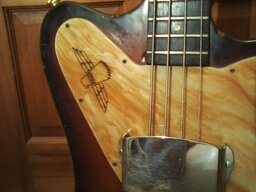
Why are you letting one of the stadium custodians hold your bass?Almost all 60's Thunderbirds will not intonate on the upper register due to limited travel of the saddles or it being installed on the wrong spot, either description gives you the same result. I designed and manufactured the first Badbird bridge in 1983. I started manufacturing in 2003
The Badbird installs without modification " intonation without modification " is my mantra. The Badbird has been accepted by collectors and professionals alike. You might recognize this guy .View attachment 3001275


Sounds like it could be tolerances on their program, if they use two decimal points (in inches) a typical tolerance would be +/- .05" (nearly 1/16") but it'll still machine it flat(ish) across the whole surface. Also at 1/16" even the paint can account for a decent portion of that.
In my last job I had to program some CNCs (Homag BOF 511) because no one else could get their heads round it (says it all!) Those machines were accurate to 0.02mm over the entire bed surface, I think even a really badly set up and maintained machine would be capable of being accurate to 0.1mm (4 thousandths of an inch). It really sounds like either a program change or maybe and possibly more likely thinking about it some goon in the factory changing a tool without resetting the machine settings
If the CAD file was dimensioned to two decimal places (imperial) than the accuracy of the machine doesn't matter as the file is only good to two decimal places, which a typical two decimal place tolerance would be between .01 and .05" On all the stuff I've done, I set untoleranced two decimal place dimensions to +/- .05"
A change of tool without zeroing the offset is a good possibility too.
Yes I would agree but Epiphones are made in sunny Asia where they use metric so it's more probable they used a metric program but that is just a guess, there might well be an army of Korean elves hand shaping them for all I really know
The only difference would be the numbers. But the tolerance equivalent would still be relevant.
Well if it is Korean elves, there's one that should be fired
That's kkoma yojeong (elf in Korean)
I suspect you are off thinking that it is in the CNC machines. I would suspect that the difference is in finish thickness. Spraying, although probably done by machine, is a much less certain process than machining. Colour could also account for a difference as well. White requiring enough spray to be opaque, but the burst requiring at least two finishes (black and clear).
Finishes aren't that thick though, I don't think it would add much more that 1/32" to the thickness front and back but my knowledge is confined to nitro finishes on guitars
Sorry I don't understand? If a machine was programmed to cut to a line then the tolerance of that machine should be within a maximum of plus or minus some number irrelevant whether it was imperial or metric. If that number is as big as 0.4mm then there is something very wrong with that machine.
There will be at least two CNCs involved making a Tbird, one for the neck and one for the wings. If there is a general increase of about 1/16" then I would think that it might be a programming change.
Of course there may be those elves at work too
That sounds like I'm arguing, I'm not, just discussing with a mate
My point is that .05" tolerance is the same as 1.3mm tolerance. The fact that it's metric doesn't really matter as long as the numbers are the same conversion. I've just been using imperial because Scott referred to the difference in imperial, and I'm more familiar with imperial.
But I'm not saying it's the machine, I'm saying it could be the tolerance in the programming. If the program is running that particularly bass at the high end of the tolerance, it will not change during flat milling as there's no reason for the z-axis to move on a flat object.
If they're using 6-axis machines than they may just use one machine per bass.
All good here
But a CNC program is to a dimension, any variation from that is going to be machine error and never anything that big unless there's been a PLC fault and that would be catastrophic if the machine's safety functions didn't shut it down. I've never ever seen a CNC that varied off dimension more that 0.1mm and that needed stripping down to change bearings
I see what you're saying. But at the same time, if a dimension is only good to .01" how will a machine determine if it's .010" or .019", that's where variation from the CAD drawing happens. And in written program, I've seen CNC'd nylon that was out over .035", it was completely due to the written program. The programmer used climb milling instead of conventional, but also only dimensioned to one decimal place (again, Imperial) (took a fair bit of marks off that group project).
I'm not gonna tolerate much more of this tolerance discussion!The machine doesn't determine any variation, that's purely as a result of either wear in the machine or a lose workpiece. The program for a Tbird for example would be quite complex so making an assumption it wouldn't be changed ad-hoc, I would think that given that Scott's white VP was smaller than the VSB then that would indicate an intentional difference in the program, or a mis-set tool/tools. I can't see a mistake on one guitar and not the other due to a programming error, why would you change a perfectly good program without reason
Machines in production environments tend to be a lot more sturdy than those found in smaller shops, another assumption I'm making is that the makers of the birds are using a reasonable robust machine, direction of cut is less critical, finish and or dust control tends to be the deciding factor
Ya know what... I'm in!
As long as folks post in foreign languages it's fair game to post rough translations.

Ya know what... I'm in!
Postings to the club in languages other than English, may henceforth endure unqualified interpretation. Proceed with caution!
That is very possible, unless the shop used the same type of CNC that used the same programming interface then yes small variations may creep in on things like shape and radii. I do struggle with things like body thickness, if Epiphone state say the wing thickness will be say 30mm then you'd expect that to be pretty close at least. But yes that is a very reasonable explanation.I'm not gonna tolerate much more of this tolerance discussion!
Seriously, it might be possible that Epiphone had to scramble to increase production due to much better than expected demand. Remember the price bump, probably done to trim the demand by a few percent (while not hurting the bottom line). And remember the tuner change up in mid stream, probably also in an effort to meet increased demand that outstripped their original inventory. I wouldn't be at all surprised to find out that some production has been shopped out to other CNC shops in the area in order to meet demand. I've had to do that in the past with my machine shops in China and Korea. What I ended up with was exactly what we're seeing on the newer Eppis - slightly different products close enough to the original design specs to approve but at the limit on acceptability. Different shops have different equipment, different operators, different programmers, different QC processes and different production goals. That stack up in differences could easily result in the minimal body and neck thickness dimensions we are seeing.
Oz has a pass. Just cuz we don't understand it, doesn't mean it's not EnglishAs long as the same applies to Ozz'ish, Wales'ish, Welsh'ish, Scottish and Yiddish.
Oy Veh!As long as the same applies to Ozz'ish, Wales'ish, Welsh'ish, Scottish and Yiddish.
I told the Epi CEO years ago about this reissue. Wouldn't have it..I'm not gonna tolerate much more of this tolerance discussion!
Seriously, it might be possible that Epiphone had to scramble to increase production due to much better than expected demand. Remember the price bump, probably done to trim the demand by a few percent (while not hurting the bottom line). And remember the tuner change up in mid stream, probably also in an effort to meet increased demand that outstripped their original inventory. I wouldn't be at all surprised to find out that some production has been shopped out to other CNC shops in the area in order to meet demand. I've had to do that in the past with my machine shops in China and Korea. What I ended up with was exactly what we're seeing on the newer Eppis - slightly different products close enough to the original design specs to approve but at the limit on acceptability. Different shops have different equipment, different operators, different programmers, different QC processes and different production goals. That stack up in differences could easily result in the minimal body and neck thickness dimensions we are seeing.
It's OK, Welsh lessons start tomorrow morning, you can start when you log in tomorrow by saying "Bore da Christine"As long as the same applies to Ozz'ish, Wales'ish, Welsh'ish, Scottish and Yiddish.
(good morning...) See... you don't wanna start with that. I'd translate that to "Bored of Christine", which quite simply, is not the case!It's OK, Welsh lessons start tomorrow morning, you can start when you log in tomorrow by saying "Bore da Christine"
Only kidding
Then your as daft as everyone says thenSee... you don't wanna start with that. I'd translate that to "Bored of Christine", which quite simply, is not the case!
Just teasingI've never hidden the fact that my bum's out the windowThen your as daft as everyone says then
I knew someone would say that, that's why I put the translation in
I've never hidden the fact that my bum's out the window
What kind of saying is that?Scotch...