
Oh yeah baby!....this thing is scary quick...
View attachment 3169396
View attachment 3169397
View attachment 3169399
That's a beaut, Clark!

TalkBass has been independent since 1998. Add your voice.
Create a free account to reply to discussions, view embedded media, and browse with fewer display ads.
Join free Log in
Want zero display ads or expanded classifieds tools? Compare plans.
Oh yeah baby!....this thing is scary quick...
View attachment 3169396
View attachment 3169397
View attachment 3169399
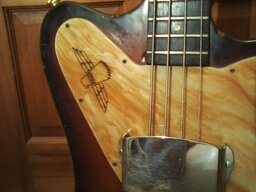
Not a 'band'wagon!Oh yeah baby!....this thing is scary quick...
View attachment 3169396
View attachment 3169397
View attachment 3169399



Saw an Olds 442 Wagon on the road the other day. Rare and Uber cool..It will be, especially since it’s plywood with a veneer. Probably gonna get it smooth then use some kinda filler.
66 Chevelle wagon, black with red interior.
View attachment 3169264
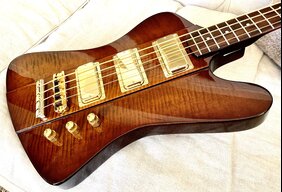
Carlo - I'm aware of the Entwistle FenderBird history, but thanks for the refresher. I was just trying to shorten an already too long post. However, for the record and to circumvent further propagation (intended or not) of the myth surrounding John's FenderBird, I've modified my original post to read..."install a Fender or Epiphone Bolt on neck (the NR FenderBird look worked well for John Entwistle)."Entwistle NEVER used Gibson bodies for his FenderBirds, I wish people would stop perpetuating that myth. Peter Cook and he redesigned the shape slightly WITH NO RAISED CENTER and scratch built bodies to go with TBird guts and Precision necks (no Jazz necks, JAE used 1.75 inch wide at the nut basses for the rest of his life.) Many sources and direct quotes will back that up...and 'FenderBirds' is his spelling.
Otherwise, good advice.
OP contacted me on FB and I was negative about attempting repairs. IMO 2007 is the middle to end of the run of very common still depreciating TBird model. If it were a car, no collector would be interested. Needing that much work it's never going to be worth the money put into repairs. Get it as playable as possible, live with it, or pass it on to another dreamer....

RIGHT?!Oh, the humanity! How can anybody live without a derelict bulldozer as a yard ornament?

Hmm. Don't remember seeing that pic b4, cool! BTW, any luck w/ video from the Pt.T. gig?Can't remember if I've posted this before, Mr. Brian Wheat of Tesla with a custom Non Reverse.
View attachment 3169415
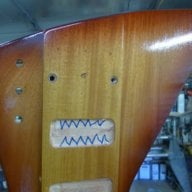
Carlo - I'm aware of the Entwistle FenderBird history, but thanks for the refresher. I was just trying to shorten an already too long post. However, for the record and to circumvent further propagation (intended or not) of the myth surrounding John's FenderBird, I've modified my original post to read..."install a Fender or Epiphone Bolt on neck (the NR FenderBird look worked well for John Entwistle)."
I suspected the owner contacted you and I also agree with your assessment about throwing good money after bad. That's why I suggested he do the free things first and hope for the best. If he goes down the neck replacement route with a luthier he will likely be out at least another $500 to $600 and will have a bass that can be played but probably isn't worth as much as he has in it.
If it were me, I'd go down the free route first and if I wasn't satisfied I'd part out the bass to offset my losses and buy a new or used Epiphone Thunderbird VP for about the same money or less than what it would take to fix this one.
Also sorry to hear about your car costs, I think we've all been there. I just sunk $5000 in repairs in a Porsche Cayenne that's probably only worth $10,000. That's the magic number for me. When repairs exceed 50% of the value of the car it's time to let go. Now I'm in the market for a low mile 2014 Cayenne GTS.


From a purely economic/investment standpoint, you are absolutely right. However, he got it for $650, which is dirt cheap for a 'Bird anywhere, and he's in Central America where prices are higher for a Gibson Thunderbird. Given the purchase price, I doubt that he would be able to find another player for what he has in it already plus the price of repairs. Even with that said, if he's able to repair the cracks to a stable condition and get it completely playable without putting much into it, so much the better. That's my shade-tree mechanic's view of the world.
There's a small little difference between a van and a pony car. I bought a 1968 Camaro convertible in 1980. It was a rusty old Chevy at the time. I still have it, although it needs a bit of work to move under its own power. I got it cheap, blew it up twice, replaced the transmission twice, and the rear end once. A van doesn't get that kind of use, but it also doesn't deserve that kind of attention. It's a tool far more than a toy. The car is more of a toy. Of course, that's why it needs some work that I haven't got around to for 15 years or so.Compare to classic cars. Who in their right mind would have bought a used 1966 Mustang in 1972. It would have been reaching the time in its life when expensive repairs will start being needed, although cheap, it would be nearly fully depreciated. But, buy it and hang onto it for another 14 years, keep it running and the price starts to go up.
Thanks Lenny! LOL!!!That's a beaut, Clark!

Probably true if he can fix the existing neck. Unfortunately a neck replacement on a Through neck bass would equate more to an entire drive line replacement on a 1966 Mustang. Not worth nearly as much without the original engine, transmission and rear end. That would be called a daily driver vs a collector and adjusted for inflation probably wouldn't be worth much more than you had put in it over the years.Compare to classic cars. Who in their right mind would have bought a used 1966 Mustang in 1972. It would have been reaching the time in its life when expensive repairs will start being needed, although cheap, it would be nearly fully depreciated. But, buy it and hang onto it for another 14 years, keep it running and the price starts to go up.

Once saw a sofa come flying of a pickup on I-95 in Hallandale...
Oh yeah baby!....this thing is scary quick...
...(pics of HAWT AMC)...

RIGHT?!
Just can't believe the "Go Package" in these included the 390, Positraction, 4 speed Hurst manual, front discs and a Holley 790CFM four barrel all stock from the factory....crazy...Dual intakes!
There is nothing quite like a late 60s/super early 70s muscle car.


