
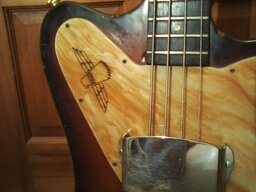
Took them off the VP. Just didn't see a need to leave them, and they might stain the white. It's not going anywhere so there's nothing to prove to a prospective buyer.Do you folks leave the stickers on the back of your Epi 'Bird headstocks?

Enjoy the benefits of a premium membership!
Upgrade Account
-
TalkBass has been independent since 1998. Add your voice.
Create a free account to reply to discussions, view embedded media, and browse with fewer display ads.
Join free Log in
Want zero display ads or expanded classifieds tools? Compare plans.
You are using an out of date browser. It may not display this or other websites correctly.
You should upgrade or use an alternative browser.
You should upgrade or use an alternative browser.
Thunderbird Club
- Thread starter TBird1958
- Start date
-
- Tags
- club thunderbird
More options
Who Replied?
I have really got to get one of these. While I'm almost always very satisfied with my tone, I'm dying to hear what they can do. I can't play great, so I always want to at least sound great.+1 to this. The H/LPF has made it possible for me to use instrument/ effect/ amp configurations that were previously unplayable / unlistenable / untenable.
Yeah, I'm kinda riveted to the mic, so mobility's not a necessity.For live use? I'm only really thought about inexpensive ones like JIO's for home use. Live, I like to keep it really simple, plus I never play on a big enough stage to move around much anyway.

red AMC?.....hmmmm..I won't/can't disagree, but in this area you are your own sound person and there is no FOH at any place we play. Most of our gigs are at small-ish restaurant/lounges, where, if there's a house PA, it's used for announcements:"Farquhar party of 4, your table's ready" or "will the owner of the red AMC please move....". They aren't real sound systems; we gots to bring our own. These days that's usually 2 'daisy chained' Bose L1's set in a position to act as both PA and monitors. We hear exactly what the crowd hears[only we hear it first]. Also, 'cos of the size of the room(s)-and age of audience-there's no need to mic the instruments-not even my THUNDERBIRD.
I find playing at church less "fun" (which isn't the point), because you work on a few songs, get one maybe two practices and you go. Next week all different songs and likely a new one to learn. Repeat every week. Cohesiveness is a little more challenging under those circumstances. I like outside gigs in that you go over your set frequently until you can play without thinking about it (the Ronnie Van Zant method!). It just comes more naturally when at the gig.In general, other than the lead singer issues, I think these are true. I think a really tight bands tends to have less disparity in terms of gig perception. That's very seldom a problem on our worship team, but I've been in band situations where it was almost always true.
Being happy with the situation is key to a good gig. Part of that is being flexible, but good monitors and a good monitor mix as well as FOH mix are key. A good sound person is worth their weight in THUNDERBIRDS.
Speaking of which, if yours isn't cutting through, you need a better amp, sound guy, or something.
And playing a Thunderbird helps greatly is either situation. Never had a problem being heard or felt with a Thunderbird in either setting, so I agree with Bird comment as well.
Last edited:
Interesting. I didn't know this was another option. I've found some pretty cheap filters online, but didn't know if that was going to be a waste of money. More pondering necessary. Good thing my Thunderbirds sound good as is!I use the BBE Sonic Stomp which is essentially the same thing - it really makes a big difference and I use it 100% of the time situated between my pedal-board and amp. Setting remain consistent with all my basses other than a hollow-body - Lo Contour = 11:00, Process = 1:00
View attachment 3537550

I have really got to get one of these. While I'm almost always very satisfied with my tone, I'm dying to hear what they can do. I can't play great, so I always want to at least sound great.
My sentiments exactly.
Stop! Now I'm interested in the HPLP Filter AND this cool toy!There are many more expensive similar devices out there which I'm sure are better in one way or the other, but this set was affordable enough to take a chance. Even if it isn't suitable for live gigs or rehearsals, it'll be worth it having it at home free from a cord.
 Interested in how well they work.
A much underused skill.Management(s) at our places like us partly because people don't bit.., er, complain that we're too loud.


And we look as cool as it gets with....a Thunderbird!My sentiments exactly.
....
Thunderbirds can cut through with the right eq. I have found that a Broughton Hi/Low pass filter makes a huge difference. I'm not sure what magic is stuffed into the little box, but somehow the bass sounds the same, but has far more presence without turning up. I think what it does is cut the lower frequencies that a Thunderbird can make, but that suck the life out of amps. It leaves the thunder and meat, but takes away any unnecessary rumble. Once that went into the signal chain, problems with cutting through or disappearing in the mix at certain points went away.
All this talk of hi/low pass filters has me second guessing myself.I use the BBE Sonic Stomp which is essentially the same thing - it really makes a big difference and I use it 100% of the time situated between my pedal-board and amp. Setting remain consistent with all my basses other than a hollow-body - Lo Contour = 11:00, Process = 1:00
View attachment 3537550
I've always assumed the semiparametric equalizer section of my Thunderfunk amp served the purpose of a HLPF. The way it's set up you can dial in any specific frequency you want in any of four ranges of frequencies and either cut or boost those frequencies. Here's a pic of the EQ section...
...I just select the Hz setting on the top row and cut or boost that setting by as much as 15dB.
So is that the same general function as an HLPF or am I missing out on something more???

My transmitter lives in this pouch, so clumsy as I am, it has not been destroyed. Mind you, the belt clip was broken when I got it.My wireless is a Shure something or another. I was debating a Line 6 but went with Shure in spite of the cost because of the housing. Both the transmitter and receiver are metal and tough as nails. I read reviews about Line 6 transmitters breaking when you drop them. I figured I wouldn't drop mine, but why not be prepared? Well... I have dropped it enough and it has been hit by who knows what enough that it has holes in the paint now. The receiver has a huge dent in it. I don't know how that happened. But, everything still works fine and sounds the same. Plus, it doubles as a tuner, so that takes a box off the board.
Last edited:

I find playing at church less "fun" (which isn't the point), because you work on a few songs, get one maybe two practices and you go. Next week all different songs and likely a new one to learn. Repeat every week. Cohesiveness is a little more challenging under those circumstances. I like outside gigs in that you go over your set frequently until you can play without thinking about it (the Ronnie Van Zant method!). It just comes more naturally when at the gig.
We often include a new song, but we also have a collection of songs that we pull from regularly, so most weeks at least half the songs I already know pretty well. We have a good setup to make sure we're ready by the time we play the set- or occasionally we'll just wing a song. The next time I'm scheduled, it might be with a partially or completely different team, so the song might have a very different feel. It works great for us, and I love it.
We typically have drums, one or two guitars (occasionally three), keys, maybe electric piano, maybe violin, and one to three vocalists. With a sparser band, or if the song really wants it, I'll open up the bridge pickup somewhat, maybe turn the tone knob up. But mainly I run the neck (ha!) pickup and hold down the low end. Hey, it's a THUNDERbird, right? (I have my EQ set up to allow a bit of a mid-bass boost vaguely reminiscent of an old Phil Lesh tone.)
All this talk of hi/low pass filters has me second guessing myself.
I've always assumed the semiparametric equalizer section of my Thunderfunk amp served the purpose of a HLPF. The way it's set up you can dial in any specific frequency you want in any of four ranges of frequencies and either cut or boost those frequencies. Here's a pic of the EQ section...
View attachment 3537857
...I just select the Hz setting on the top row and cut or boost that setting by as much as 15dB.
So is that the same general function as an HLPF or am I missing out on something more???
That's it in a nutshell!
I won't/can't disagree, but in this area you are your own sound person and there is no FOH at any place we play. Most of our gigs are at small-ish restaurant/lounges, where, if there's a house PA, it's used for announcements: "Farquhar party of 4, your table's ready" or "will the owner of the red AMC please move....". They aren't real sound systems; we gots to bring our own. These days that's usually 2 'daisy chained' Bose L1's set in a position to act as both PA and monitors. We hear exactly what the crowd hears[only we hear it first
Donner, your table is ready. Donner, party of 90, 89, 88, 87...
Thunderbird!
Donner, your table is ready. Donner, party of 90, 89, 88, 87...
Thunderbird!
What happens when the party of 62 arrives?
Oh, i just had to.
Last edited:
as tempted as I am I better not but thanks!!No, and I never found the the time to look at why.
You want it?

Exactly. And thus it sits on the floor for crawlers and toddlers to play with.as tempted as I am I better not but thanks!!
That's sick. I love it!Donner, your table is ready. Donner, party of 90, 89, 88, 87...
Thunderbird!


