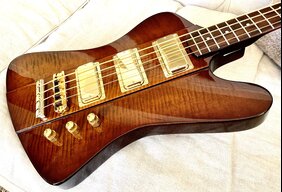
Nice! Looks like it even has the string through body option.Sure, but I bet it's not better than THIS:
View attachment 3659837
But congrats anyway! It's A BEAUTY!


TalkBass has been independent since 1998. Add your voice.
Create a free account to reply to discussions, view embedded media, and browse with fewer display ads.
Join free Log in
Want zero display ads or expanded classifieds tools? Compare plans.
Nice! Looks like it even has the string through body option.Sure, but I bet it's not better than THIS:
View attachment 3659837
But congrats anyway! It's A BEAUTY!

Good tip jar.Played the Fano-Bird tonight and it was kind of awesome, even with pretty dead rounds on it. Tons of compliments, so that must be ok
View attachment 3659286 View attachment 3659287
I found similar surprises when removing the neck from my Goth. I'd swear the Epiphone facility that makes the Goth must shop out their neck mounting process to the local school for the blind. But hey, at a $300 price point I guess perfection is a lofty goal.View attachment 3659781 View attachment 3659781
Hi guys, checking in. Yes this is the "forever build" right before I drilled the neck I decided it kight be smart to scrutinize the neck pocket for break angle, level etc. good thing I did! I dont understand how Epi gets away with such horrible QC! This thing was twisted up like a roller coaster. So I am either going to have something that works good or not at all. This is a good school boy lesson giver for sure. This is my first ever neck pocket and lots, I am learning.

Yep, and an actual branch for a neck, not just some run-of-the-mill broom handle! Talk about a DELUXE model. Perfect for stoner rock.Nice! Looks like it even has the string through body option.

Yes. It does.Sorry Imposted the same pic twice. Does that make my post twice as good?

Yep. Both are mostly mythical in reality.
Sorry Imposted the same pic twice. Does that make my post twice as good?
'Bird through ACC amplification - the voice of God.
I found similar surprises when removing the neck from my Goth. I'd swear the Epiphone facility that makes the Goth must shop out their neck mounting process to the local school for the blind. But hey, at a $300 price point I guess perfection is a lofty goal.
Yeah, the wise-assery was slightly mis-directed. Tip jars are generally a pretty good proportion of whatever we get paid sometimes. It was making more of a comment about the fact that musicians often don't get paid, and nearly never get paid what they are worth.A band has to be pretty bad or pretty obnoxious, for me not to tip. And if you tip, that usually gets some others tipping. Seed money and ringers help.
Yeah, the wise-assery was slightly mis-directed. Tip jars are generally a pretty good proportion of whatever we get paid sometimes. It was making more of a comment about the fact that musicians often don't get paid, and nearly never get paid what they are worth.

I found similar surprises when removing the neck from my Goth. I'd swear the Epiphone facility that makes the Goth must shop out their neck mounting process to the local school for the blind. But hey, at a $300 price point I guess perfection is a lofty goal.

The point is an intriguing one.Yeah, the wise-assery was slightly mis-directed. Tip jars are generally a pretty good proportion of whatever we get paid sometimes. It was making more of a comment about the fact that musicians often don't get paid, and nearly never get paid what they are worth.
That is rather cool.Just completed this project and have posted it in the Luthier Corner but thought fellow T-birders may be interested in checking it out. A few of you have already seen it. It's a late '60s ('66-'68) Silvertone 1443 Hornet full-scale bass, made by Danelectro. Here's the project thread: "How bad is it?" Silvertone Hornet resurrection Yes, it has tort...
[note: it is not for sale and is now one of my personal basses]
View attachment 3660039
That is rather cool.

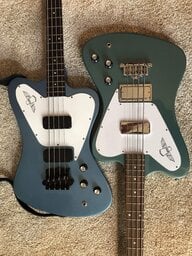
When I started back playing in earnest about six years ago, my small hands only wanted to work on thin necks. After getting and playing wider necks they've adapted. Really don't think about it anymore. But the '15 Gibby 1.5 neck is the fastest neck I own, and my favorite.I have hands and feet like a gorilla, according to a junior-high biology teacher. My hands get along just fine with baseball bat necks as well as noodle necks like Thunderbird necks. It took a bit for my hands to get used to the smaller size. It's an amazingly easy neck to play now. What's most difficult for me is a neck with a flat back like a road-kill 7ender neck. My Precision has a neck like that, and although it is a keeper, it would get more exercise if the neck was a bit deeper. The width is 1-3/4" but isn't a problem.
For the record, hand size is independent of anything else, so far as I know.
The point is an intriguing one.
What is a musician "worth"? There are several methods of answering that could be applied that would result in figures ranging from $0 (or possibly negative) to $100,000 per show. Perhaps the biggest difficulty is that "musicians" are not a commodity - they can't be easy interchanged with no meaningful change in operation. The next greatest problem is "to whom"; that is if we look for a market clearing price for "musician" that relies upon each consumer valuing "musicians" the same. Whereas I may value Geddy at $100,000 per show, others would value him at $0 per show.
In the end, there is no one right answer for the worth of any particular "musician". I am pretty sure that the value of my playing music to me is very high. And to others it is probably very low (and could be negative).
That turned out great! I followed your progress and man, you do great work.Just completed this project and have posted it in the Luthier Corner but thought fellow T-birders may be interested in checking it out. A few of you have already seen it. It's a late '60s ('66-'68) Silvertone 1443 Hornet full-scale bass, made by Danelectro. Here's the project thread: "How bad is it?" Silvertone Hornet resurrection Yes, it has tort...
[note: it is not for sale and is now one of my personal basses]
View attachment 3660039


