as beautifully answered by @LetItGrowTone and @PillO, electrical resonance can indeed be modeled mechanically as well (everything in life has a resonant frequency). other mechanical examples could include a flywheel or a pendulum. electrically, a capacitor
C connected with an inductor
L (L is used because H is used for magnetic field strength much as j is used to denote an imaginary number because i is used to denote current) in either series or parallel will create a circuit that will resonate at
some frequency. because guitar/bass pickups are generally wired in parallel i'll stick to this configuration also referred to as a "tank" or "antiresonant" ckt.
View attachment 3687416
at DC an inductor is an electrical
short and a capacitor is an electrical
open.
at AC on the other hand, inductors and capacitors (unlike resistors which will have the same value independent of frequency) start to exhibit a resistive (there is no real Ohmic loss as in resistors but that gets a little more involved) effect called
Reactance (
X) which as in resistors, is also measured in Ohms. For capacitors it's noted
Xc (Capacitive Reactance = 2Pi fC), for inductors
Xl (Inductive Reactance = 2Pi fL) where f denotes frequency.
With rising frequency Xc decreases while Xl increases. it therefore follows that at
some frequency, Xc will equal XL. this is known as the resonant frequency of that particular circuit and can be determined (as mentioned by PillO) by;
View attachment 3687437
now we add the third component which is resistance (
R) which is as most folks know is measured in Ohms and will be a major influence on the quality factor (
Q). this factor is a trade off between high Q (a very narrow bandwidth response with no loss) or lower Q which will extend the bandwidth but reduce the magnitude of the resonance. mechanically, using a pendulum model, R would equate to the friction in the pivot which will dampen the oscillation of the pendulum decreasing it's "swing" limits and how long it "swings" and similarly wastes this energy in heat. to sum it up, in a pendulum
C could be represent gravity,
L inertial velocity and
R pivot friction loss (damping)
because a pickup is wound as a coil it inherently possesses all three of these physical attributes;
R and
L in the wire and
C because to augment the
L (which will ultimately pick up the magnetic signal of the vibrating string so more
L more signal strength) more wire needs to be added resulting in a coil that will have an intrinsic interwinding capacitance
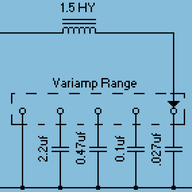
C due to it's construction and will define it's self resonance characteristics. adding an external parallel (tone) capacitor
tunes the pickup.
Playing with these ratios (tricky because they are so closely related) will ultimate yield the response of that particular pickup. further, adding a magnetic core (magnets) will increase the
L.
this is a cool little simulation site that will allow you to play with L and C values to observe the response of the question you asked about "decreasing the
L would push the resonance upwards."
Parallel Resonance
in a pickup the
R would be in series but since it represents loss it can be modeled in parallel as well.
apologies for the length of this post. hope it helps..











 .
.