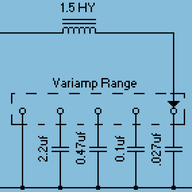
Resonance is more of a mechanical engineering topic so I'm pretty well versed on that at least.
@GBassNorth, it's a lot of questions. But if you're comfortable with *mechanical* resonance you're in good shape because there's a nice analogy between mechanical and electrical resonance, and your intuition with regard to mechanical resonance should serve you.
Familiar with the intro level mass-spring model, right? The mass stores a variable amount of gravitational potential energy - more when it's high, less when it's low - and the spring stores a variable amount of energy proportional to how much it is stretched (can't remember exactly what this is called, but it is also a form of potential energy). Then, as the mass oscillates up and down, the mass and the spring are exchanging this energy between them, taking turns storing it. If there is no resistance to the motion (in an idealized model), it will continue oscillating like that. But every real world system has some resistance, and this will eventually absorb the available energy and the system will stop.
L
L is the symbol for inductance. Can't remember why.
If current is passing through a wire, a magnetic field forms around the wire. There's energy in this **magnetic** field, so the space around the wire can be seen as a storage space for that energy. And inductance, L, is proportional to how much energy can be stored. And just as the mass when raised (gaining gravitational potential energy) gains a potential to do *work*, that magnetic field around the wire can be made to do work. If you want to, you can "feel" this in your intuition, like a rock in your hand.
(To make a long story shorter, this energy can be concentrated if the wire is formed into a coil, and this coil can store more energy if it has certain materials like iron inside or nearby.)
C
C is the symbol for capacitance.
If two conductors have a potential difference (a voltage) between them, then an **electric** field is formed between them, and energy is stored in this field. And just as above, *work* can be done by this energy. More energy can be stored if the conductors are close together and have more surface area, thus "plates" with an insulator between them.
R
Resistance. It is present in all conductors (that are relevant here). It dissipates those energies described above, converting it into heat. If collected, heat can do work, but in cases relevant here it is just dissipated into the air. The wire in the pickup has this resistance.
Analogy with the mass-spring problem:
--The 1) mass and the 2) spring exchange their energy between them (oscillating), and any 3) resistance (present in all real systems) eventually damps the oscillation as the energy is lost.
--The 1) magnetic field around the wire, and the 2) electric field in the capacitor exchange their energy between them (oscillating), and the 3) resistance in the wire dissipates the energy, damping the oscillation.
More:
--The mass and spring will oscillate at some frequency determined by the mass and the spring constant.
--The inductor and capacitor will also oscillate at some frequency determined by their amount of inductance, L, and capacitance, C.
Oh, there's more of course. Is this kind of stuff what you were wanting?











 (The
(The