
My guess is that's why they were added to the 2012's.


TalkBass has been independent since 1998. Add your voice.
Create a free account to reply to discussions, view embedded media, and browse with fewer display ads.
Join free Log in
Want zero display ads or expanded classifieds tools? Compare plans.
My guess is that's why they were added to the 2012's.
And there are no known antibodies for this condition....Actually, I trying to hold back a serious bass boner for that gene Simmons model with flat top, modern bridge and white binding. It looks like a combo of Nikki sixx, Spector birds and his black bc rich with white binding. Unless they put out something cooler, I may be dropping way to much $ on one of those. This bird thing is really becoming an addiction. Thanks a lot guys.

Although, Fender would like to help.And there are no known antibodies for this condition....
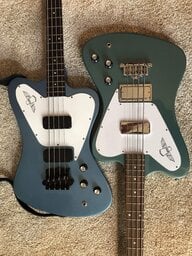
My NR angles back like all my Tbirds and has the addition of the volute. Are we talking about the same thing? Anyway, are you finding the playability of the neck good for you?Interesting thing I hadn't realized. Unless I'm wrong, the NR Thunderbird's neck isn't angled back like the standard reverse one is.
I’m sure they would. And I like ‘em just fine (have 3) But no GAS at all for another one at this point.Although, Fender would like to help.

I can't figure out what's up with that pickguard logo. But I love the fretboard inlays.
I could see myself maybe wanting the one with the red binding. Waiting to see what else there might be...
Are you thinking the headstock? I mean the entire neck with respect to the body.My NR angles back like all my Tbirds and has the addition of the volute. Are we talking about the same thing? Anyway, are you finding the playability of the neck good for you?
I can't figure out what's up with that pickguard logo. But I love the fretboard inlays.
Curious indeed. I guess we'll know after NYE since the first posting said something about Gene playing them at the show then.As prototypes they're kind of curious, note the single knob and plugged holes where you'd normally have two volume knobs....
Ok. Mine looks to have a slight pitch. I’ll try to get a pic after work.Are you thinking the headstock? I mean the entire neck with respect to the body.

You prefer the neck not angled back?
True. But it won't help any more than salamander tails will cure Covid. Resistance is futile.Although, Fender would like to help.
That would be a lot of distilled spirits in that tank car (if from the distillery by that name)!

You prefer the neck not angled back?

doesn’t set back go back to bow playing? would prolly explain the reason for a floating three point and why Hipshots are so “thick” when compared to a Fender bridge for instance..The 'set-back' hs is a dyed-in-the-wool characteristic of Gibson basses - it's often referred to as 'Gibson style' hs. Leo Fender pretty much invented the 'straight'/'Fender-style' hs to save money making them. (less wood if all one piece, one less step if scarf-jointing the hs) Also because it was a 'bolt-on' neck compared to 'neck-thru' or 'set-neck' design. FTR, if done correctly a scarf-joint is just as strong if not stronger than a single piece on a set-back hs, and requires no string retainer. The angle can vary from minimal to max and the tension created at the nut is more dynamic/even as a result. I prefer the set-back design for any bass neck string-thru, set-neck or bolt-on.
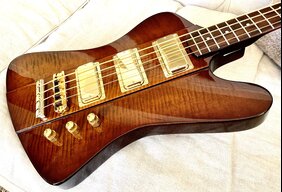
Fender actually did a darn good job of capturing that Gibby sound with their Telecaster Modern Player bass. Unfortunately they discontinued it after a couple of years. If you see one on the sale block grab it. Very nice playing and sounding bass that fits right in if Fender looks and ergonomics are what you're going after.Although, Fender would like to help.
You're right. Those are plugs in the volume holes, I just assumed they were black knobs.As prototypes they're kind of curious, note the single knob and plugged holes where you'd normally have two volume knobs....
FWIW - my BaCH NR does indeed have a pitched neck, looks about the same as my other birds. And it does not have a volute. In fact none of my birds have a volute. Also, FWIW my Jazz bass strings sit about 1/4" closer to the body (measured just in front of the bridge pup) than my Thunderbird basses. So not a monster difference, but certainly noticeable.Ok. Mine looks to have a slight pitch. I’ll try to get a pic after work.
Never heard of an angled headstock being referred to as "Gibson Style". Its pretty much the traditional way of making just about any string instrument for about as far back as string instruments have been made. The angle of the headstock can vary quite a bit from instrument type to instrument type.The 'set-back' hs is a dyed-in-the-wool characteristic of Gibson basses - it's often referred to as 'Gibson style' hs. Leo Fender pretty much invented the 'straight'/'Fender-style' hs to save money making them. (less wood if all one piece, one less step if scarf-jointing the hs) Also because it was a 'bolt-on' neck compared to 'neck-thru' or 'set-neck' design. FTR, if done correctly a scarf-joint is just as strong if not stronger than a single piece on a set-back hs, and requires no string retainer. The angle can vary from minimal to max and the tension created at the nut is more dynamic/even as a result. I prefer the set-back design for any bass neck string-thru, set-neck or bolt-on.
Ok. Mine looks to have a slight pitch. I’ll try to get a pic after work.


