
Enjoy the benefits of a premium membership!
Upgrade Account
-
TalkBass has been independent since 1998. Add your voice.
Create a free account to reply to discussions, view embedded media, and browse with fewer display ads.
Join free Log in
Want zero display ads or expanded classifieds tools? Compare plans.
You are using an out of date browser. It may not display this or other websites correctly.
You should upgrade or use an alternative browser.
You should upgrade or use an alternative browser.
Thunderbird Club
- Thread starter TBird1958
- Start date
-
- Tags
- club thunderbird
More options
Who Replied?

How does your capo work on the Drake?Tried a set of the SIT Power Flats on my Gibson ‘Bird, but the tension was a bit too high, so I put em on my 35” scale Andrew Drake/Jio collaborated bass and they seem fine. Trying a set of Dunlop Super Brights on my TBird. Thinking of taking em both on the road this weekend to see what works best in this roots/country band I’m playing with. The SIT Power Steels sounded awesome on my TBird (thanks again, Ken!), but they’re just a bit dead after five gigs, which is more than I normally get out of rounds
View attachment 4312715

Gaolee
Official leathers tester and crash dummy
Hold my beer...!Just looking out for Gaolee safety! Although I did just buy a Generator.
What's inbound Gordon?

- Mar 8, 2011
- 12,232
- 51,187
- Disclosures
- Authorized greenboy designs builder/Owner of BNA Audio
How does your capo work on the Drake?
Only Gibsons need those. No other headstocks have ever broken ever
Exactly.Only Gibsons need those. No other headstocks have ever broken ever
Although for a very short period Fender did try to embrace the unique Gibson design feature, and on a very limited run offered their own detachable headstock design. It fell flat with Fender loyalists and was quickly discontinued.
Man. Is nothing sacred?Exactly.
Although for a very short period Fender did try to embrace the unique Gibson design feature, and on a very limited run offered their own detachable headstock design. It fell flat with Fender loyalists and was quickly discontinued.
View attachment 4312780

We would expect nothing else since you live life on the edge. Rule breaker.Interesting... Thank you.
For the record, I do use them without gloves and occasionally use them to clean the stainless steel sink when the usual cleaner doesn't seem to be doing an adequate job.

Did you get all of them? In some places out west you can just walk out with that kind of thing without paying. But there is a limit on how much you can steal, so be careful. I wouldn't try it with watermelons though.Hadda go to Walmart today:
View attachment 4312719

It’s always interesting to me to find out about different methods for these sorts of things. It’s one of the reasons I’m here.If reconditioning a fb, (especially if a vintage and neglected neck/bass) I address the frets and then use a new/sharp flat-blade to scrape the fb. I then use Gerlitz Guitar Honey. I've found that steel wool can get stuck in the wood grain and it can also stain wood. Removing a very thin surface layer with a flat-blade (for me) does the best job.
I’ve never had a problem with 0000 steel wool and picked up the method from a traditional luthier in a guitar repair course years ago.
Thanks for this. Considering the ease-of-use and the price, I ordered one to try out. How do you use it differently than their directions?Aside from a good belt sander I've had good success with Gorgomyte cloth (but don't used it like the directions and rub the fret dirt into the wood).
Gorgomyte Fret And Fingerboard Conditioner
GHS has a version as well.
You're very welcome Ken. I hope it meets your expectations.Thanks for this. Considering the ease-of-use and the price, I ordered one to try out. How do you use it differently than their directions?
It will have a slight dampness to it. Somewhat sticky. So keep the container sealed well. (I got a dry one once. Still worked great on the frets, but didn't moisturize the FB. I think I recall reading someplace that you can add some water to the cloth if it is dry, but I never tried it.)
They say to cut a small section off and rub it all over the frets and the FB, then buff with a clean cloth of some kind. The problem is is that it gets a lot of black junk off of the frets, so why in the world would you want to rub that into the pores of the fret board? That makes no sense to me. Apparently that is the way to use it, and for some people who are not weird like me it works just fine apparently. I cut a section and just go over the frets, constantly rotating and flipping the little section so the cloth keeps cleaning and not just smearing around the junk. Buff with a clean cloth of some kind. Once they are clean shiny, I take another clean piece and rub the FB in between the frets, not worrying about getting on the frets or avoiding them, just not intentionally going back over them as more black will come off. This way the magic in the cloth is clean and gets worked into the wood minus the black junk from the frets. Your fingers will get black as well.
I don't recall seeing what is actually in the cloth, but it seems to work as a good moisturizer and is not like a lot of oils that are acidic and/or essentially dry up in short order, possibly making it dryer than it was before depending upon what oil was used.
Having said that, you can certainly use it as directed, and it goes really fast that way. But the way I do it is still quicker than tape or holding a protector while polishing a fret (like the other product--which does work well). I would only use steel wool if the frets were out of shape and needed more help than cleaning.
Hope that helps!
Thanks! I was thinking that maybe the black stuff stays on the rag and doesn't come off? Have you actually seen it come back off onto the fretboard?You're very welcome Ken. I hope it meets your expectations.
It will have a slight dampness to it. Somewhat sticky. So keep the container sealed well. (I got a dry one once. Still worked great on the frets, but didn't moisturize the FB. I think I recall reading someplace that you can add some water to the cloth if it is dry, but I never tried it.)
They say to cut a small section off and rub it all over the frets and the FB, then buff with a clean cloth of some kind. The problem is is that it gets a lot of black junk off of the frets, so why in the world would you want to rub that into the pores of the fret board? That makes no sense to me. Apparently that is the way to use it, and for some people who are not weird like me it works just fine apparently. I cut a section and just go over the frets, constantly rotating and flipping the little section so the cloth keeps cleaning and not just smearing around the junk. Buff with a clean cloth of some kind. Once they are clean shiny, I take another clean piece and rub the FB in between the frets, not worrying about getting on the frets or avoiding them, just not intentionally going back over them as more black will come off. This way the magic in the cloth is clean and gets worked into the wood minus the black junk from the frets. Your fingers will get black as well.
I don't recall seeing what is actually in the cloth, but it seems to work as a good moisturizer and is not like a lot of oils that are acidic and/or essentially dry up in short order, possibly making it dryer than it was before depending upon what oil was used.
Having said that, you can certainly use it as directed, and it goes really fast that way. But the way I do it is still quicker than tape or holding a protector while polishing a fret (like the other product--which does work well). I would only use steel wool if the frets were out of shape and needed more help than cleaning.
Hope that helps!

- Mar 13, 2008
- 18,894
- 142,211
- Disclosures
- Endorsing Artist Mike Lull T Bass pickups, The Bass Shop, Seattle WA.
Exactly.
Although for a very short period Fender did try to embrace the unique Gibson design feature, and on a very limited run offered their own detachable headstock design. It fell flat with Fender loyalists and was quickly discontinued.
View attachment 4312780
There were at least two made!
Seriously though, since when is a musical instrument's ability to be dropped a criterion for quality - Pianos don't seem to take that sort of abuse well. Brass or woodwinds?
There were at least two made!
Seriously though, since when is a musical instrument's ability to be dropped a criterion for quality - Pianos don't seem to take that sort of abuse well. Brass or woodwinds?
View attachment 4312871
But what about the headstock?
I may be assuming facts not in evidence! I just think it would require some form of magic for a small cloth to retain all of the black junk. (FBs being dark it would be hard to tell.) I just don't have that much faith and don't want even a small amount of junk in the grain. The only empirical evidence I have is that it gets on your fingers, so there's clearly no way that it is retaining all of the dirt. (Which actually defies logic to my mind unless there is some chemical reaction/attraction taking place that does that work on a chemical/molecular level.) But if you use a large surface to clean with, then that would obviously dilute the dirt over a larger surface on the cleaning rag and would be less of a problem. But since they suggest using about an 2x2 inch (I think--been a long time since I read the directions), that small level of disbursement doesn't make sense to me. But that doesn't mean it's not true. Just seems hard for me to believe that all the junk stays on the cloth. However, buffing it off after using the cloth may get rid of most all of it, so it may not be an issue. Once you use it, you might better see why I say this. Then again, you might question my intelligence--which is likely warranted! It clearly works the way they advise, it just seems a little odd to me.Thanks! I was thinking that maybe the black stuff stays on the rag and doesn't come off? Have you actually seen it come back off onto the fretboard?
And the Steinberg was born of necessity!There were at least two made!
Seriously though, since when is a musical instrument's ability to be dropped a criterion for quality - Pianos don't seem to take that sort of abuse well. Brass or woodwinds?
View attachment 4312871
Last edited:


- Jun 30, 2010
- 49,588
- 221,962
- Disclosures
- musician/artist/owner - Gildaxe
Yep, we play hard. Like the saying goes, if you can't run with the big dogs stay on the porch!
(For the record, people in that part of the state are often a little different than the rest of the state.)
that's a very diplomatic way of saying that
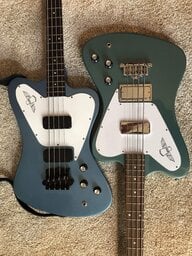
What does "the truss rod responds but the guitar is not playable" even mean? Couldn't they at least say why? $25 to ship?If anybody's looking for a "for parts or not working" VP/60s Thunderbird, a tobacco burst one, with the usual cracks near the nut, has shown up on the auction? site.
Epiphone Thunderbird 60s Bass Guitar Tobacco Sunburst | eBay
I'd bid on it, but I got other plans, that need that cash....
As an eBay Associate, TalkBass may earn a commission from qualifying purchases.


