I've been 'cut off' frequently.define better...depends on what you are looking for....you would be affecting you cutoff freq..


TalkBass has been independent since 1998. Add your voice.
Create a free account to reply to discussions, view embedded media, and browse with fewer display ads.
Join free Log in
Want zero display ads or expanded classifieds tools? Compare plans.
I've been 'cut off' frequently.define better...depends on what you are looking for....you would be affecting you cutoff freq..

i meant the 2021 case.....can't see it being that different from the 2013 case which fits the 68 perfectly from what you can see in the pic of post 196208..Nah, I mean the 65/67. The Coffin Case is kinda unwieldy, and the gig bag ain't protective enuff. There ain't no 2021 in my foreseeable future.

I've been 'cut off' frequently.
I've been 'cut off' frequently.

define better...depends on what you are looking for....you would be affecting you cutoff freq..

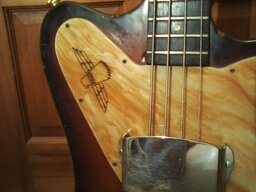
Looking good - you'll want to bevel the sides a bit. You can make a jig by connecting a #11 Exacto blade to a piece of wood at the same angle as your original as a guide for the correct angle.
View attachment 4561581
capacitors like to pass high frequencies and try to impede lower frequencies. the larger the value of a capacitor is (.047 is larger than a .022 for example) the less it will impede lower frequencies….it follows that if a cap is in series with the jack, the larger that cap, the more signal (more lows) will get through. if conversely, the capacitor is in parallel with the jack, it’s going to “steer” frequencies to ground and not allow them out of the instrument. for simplicity of the explanation, the pots act as a volume control to these signals..ok, how is one vs the other responsible for cutting-off high frequencies or low frequencies? (if that is relevant - sorry for my ignorance here)

Harrumph! Can't be that great if ya gotta mic it.
Nah, I mean the 65/67. The Coffin Case is kinda unwieldy, and the gig bag ain't protective enuff. There ain't no 2021 in my foreseeable future.

i meant the 2021 case.....can't see it being that different from the 2013 case which fits the 68 perfectly from what you can see in the pic of post 196208..

once saw a dude make a capacitor out of cigarette pack foil and wax paper for a broken radio in Jamaica in the early 80’s…….it worked…
yeah, got deterred from trying the 68 because it wouldn’t fit the BaCH..…2021 case fits the 66 (almost perfect)…
View attachment 4561806
100% Certified Nerd, actually I think Dork is likely more apt.
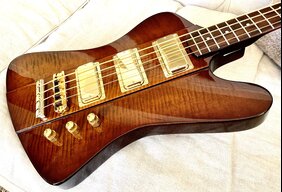
Very good info!I successfully merged two different pots into a stacked-pot, a 250k/100k - a stacked combo that isn't available. (250k for a P-pu/100k for the lipstick pu) The trick was the (white plastic) shaft interface. Some pots have a 'slot' shaft (lower one in this pic), and some have a 1/2 moon shape opening. (as the other had) I glued in a plastic cap cut flush from a superglue tube (shown) and drilled, filed and x-acto'd a correct opening. Once that was done I superglued the two pots together.
View attachment 4561394
Top cap/resistor is a treble bleed. V/V T - It was mostly successful but a P-pu has more winds than a lipstick so they will always be unmatched in output. I could have gone w/a stereo preamp but chose not to to keep it passive.
View attachment 4561419 View attachment 4561430
There’s a lot going on with that bridge…Strange how all the strings are off the slots in the bridge saddles. I wonder if the bridge is mounted off center?
There’s a lot going on with that bridge…
View attachment 4561823
The strings are all off, but might just have been pulled aside for the photos. At least two different types of saddles used. The E and A string saddles look to be the wrong saddles for those strings as the groove on each is quite small compared to the G and D grooves. The E string spring looks like it might be a larger diameter than the rest. Is that countersunk screw in the center of the bridge supposed to be there?
capacitors like to pass high frequencies and try to impede lower frequencies. the larger the value of a capacitor is (.047 is larger than a .022 for example) the less it will impede lower frequencies….it follows that if a cap is in series with the jack, the larger that cap, the more signal (more lows) will get through. if conversely, the capacitor is in parallel with the jack, it’s going to “steer” frequencies to ground and not allow them out of the instrument. for simplicity of the explanation, the pots act as a volume control to these signals..

I don't keep up with NR prices, but I didn't think that was too far off if the guy was flexible--assuming the pickup checks out and there were no real concerns. I'd rather not have poly, but if the price was right I wouldn't walk away. More info would help with a sale. Some answers to good questions wold need to be satisfactory first. The odd things you find the less you might pay. But the guy may not move much or any.OK, serious question, What does the collective think something like this should fetch?
no pics of the "non-original hard case"
I do believe if I were to get an older bass I'd get sumfin refinished or sumfin needs work
Out of curiosity, how would you suggest aging a pickguard? I've never needed to do it, but wondered what you thought. I've heard of some pretty weird methods.Looking good - you'll want to bevel the sides a bit. You can make a jig by connecting a #11 Exacto blade to a piece of wood at the same angle as your original as a guide for the correct angle.
View attachment 4561581
Very good info!
There’s a lot going on with that bridge…
View attachment 4561823
...Is that countersunk screw in the center of the bridge supposed to be there?

And all the saddles are as far forward as possible. The intonation issue could probably be remedied with one of Scott’s Badbird bridges.Very good info!
There’s a lot going on with that bridge…
View attachment 4561823
The strings are all off, but might just have been pulled aside for the photos. At least two different types of saddles used. The E and A string saddles look to be the wrong saddles for those strings as the groove on each is quite small compared to the G and D grooves. The E string spring looks like it might be a larger diameter than the rest. Is that countersunk screw in the center of the bridge supposed to be there?


