
- Jun 30, 2010
- 49,589
- 221,967
- Disclosures
- musician/artist/owner - Gildaxe
I have always loved those Aria Pros but never owned one and have no idea why
I've never played one but like you have always thought they look like good basses.

TalkBass has been independent since 1998. Add your voice.
Create a free account to reply to discussions, view embedded media, and browse with fewer display ads.
Join free Log in
Want zero display ads or expanded classifieds tools? Compare plans.
I have always loved those Aria Pros but never owned one and have no idea why

There is a lot of variation in “parchment” pickguard material. Some has more grey, some leans toward beige.Sorta', but parchment is a bit tan compared to vintage 'aged'. It would seem someone could produce an "aged" pg plastic sheet but I haven't seen it so far.
I do believe if I were to get an older bass I'd get sumfin refinished or sumfin needs work
It’s amusing how touchy some people can get about other people’s instruments!some of the ric purists get really douchebaggy about the stickers, but I really can’t tell if it’s for or against.
if I get a chance to poke the bear, I’m gonna do it, and piss in the punch bowl.
There is a lot of variation in “parchment” pickguard material. Some has more grey, some leans toward beige.
If you’re going for a faux aged look, it’s better than bright white.
View attachment 4562559

that's what I do -
1967 WEM/Watkins 24 fret ss - before: basket case - what you see is what you get. Original bridge cover but no original bridge - string stop only. (bridge it came with was a cheap beat-up Hofner type)
They have a very solid feel to them. My SB600 was my main bass when I played hardcore in the early 80’s, and it easily survived a few falls, multiple contacts with mic stands…and audience members.I've never played one but like you have always thought they look like good basses.

Sweet! I like the original finish, but I can see the bass needed too much work to save it.that's what I do -
1967 WEM/Watkins 24 fret ss - before: basket case - what you see is what you get. Original bridge cover but no original bridge - string stop only. (bridge it came with was a cheap beat-up Hofner type)
View attachment 4562514
neck glued in the pocket... possibly original white poly finish.
View attachment 4562517
full-length body crack sloppily glued together...
View attachment 4562519
stripped the thick degraded clear-coat - frets needed a lot of work to be playable...
View attachment 4562520
truss-rod was very hard to turn - had to do some surgery to free it up. (note zero-fret)
View attachment 4562522
After:
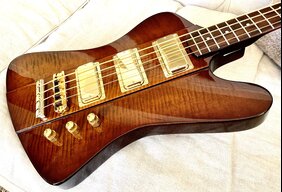
View attachment 4562523 View attachment 4562524 View attachment 4562538 View attachment 4562540

For sure you don’t really know the colour until you open the packageI agree - yours looks nice. It's hard to tell what you are going to get ordering on-line from pics which may not look anything like what yo get. Used parchment on my Teiscobirds.
View attachment 4562575

I tried the coffee grounds and tea leaves route on a white PG. After a month of soaking I pulled the PG out and let it dry. Color was nicely aged - until I washed it off - then right back to the original color. So in my experience that option was a fail.It's a matter of experimentation. That means having access to material (the same as the pg) to experiment with. Plastic is somewhat porous so staining* is possible, shooting a very faint lacquer patina is also a option, leaving it in the sun (heat/UV rays) may end up shrinking the plastic and will take a long time.
*thinner-based stains, coffee, shoe-polish, diluted dyes...possibly something unexpected...
He just wanted to make his case perfectly clear.But is the case made in Canada where real cases are made? It has to be stated twice or it's not official or apparently not clear.
View attachment 4562442
Hey, I could be his roadie!There's always this:
View attachment 4562476
I tried the coffee grounds and tea leaves route on a white PG. After a month of soaking I pulled the PG out and let it dry. Color was nicely aged - until I washed it off - then right back to the original color. So in my experience that option was a fail.
Beautiful restoration! I would have completely written that one off as a basket case slash fire wood.that's what I do -
1967 WEM/Watkins 24 fret ss - before: basket case - what you see is what you get. Original bridge cover but no original bridge - string stop only. (bridge it came with was a cheap beat-up Hofner type)
View attachment 4562514
neck glued in the pocket... possibly original white poly finish.
View attachment 4562517
full-length body crack sloppily glued together...
View attachment 4562519
stripped the thick degraded clear-coat - frets needed a lot of work to be playable...
View attachment 4562520
truss-rod was very hard to turn - had to do some surgery to free it up. (note zero-fret)
View attachment 4562522
After:
View attachment 4562523 View attachment 4562524 View attachment 4562538 View attachment 4562540
I tried the coffee grounds and tea leaves route on a white PG. After a month of soaking I pulled the PG out and let it dry. Color was nicely aged - until I washed it off - then right back to the original color. So in my experience that option was a fail.
It sure didn’t smell particularly good.Good thing you washed it off, or it would have aged your hands.
Beautiful restoration! I would have completely written that one off as a basket case slash fire wood.
 Thanks! I've done a couple as "lost cause" including that one. Regardless of condition, I try to find ones that have as many original parts as possible. Some parts are nearly impossible to find.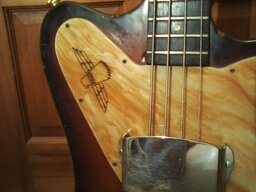
This?It sure didn’t smell particularly good.
I have wondered if I had lightly sanded the top of the guard first would it have been more porous and taken in the stain better, but then I’d have to spray it after the fact to seal it in, and that probably would have ruined the aged look.
edit: just saw JIO’s post. Makes sense.
Wow, looks great! And as there's so much room beneath the pickguard it's no wonder the late great Pekka Pohjola's WEM was easy to modify:
View attachment 4562591
 Because of the glare on the hs face, it's hard to tell the branding. Sometime in '67 they switched the brand name from Watkins to Wilson, otherwise mostly the same bass. My guess it's a Wilson Sapphire (they changed the model name also) because of the 'blocked' fb that a Watkins Rapier (like mine) didn't have, and the tuners were different at that transition. It has the finger-rest bar too, which I fabricated based on pics. He removed the thin chromed metal plate that had the toaster-style pu's attached to and it looks to be a white plastic plate with J-style pu's angled tp line-up with the narrow swing spacing. It has the original bridge with the 'horseshoe' mute that looks like an early Ric pu-cover.
It sure didn’t smell particularly good.
I have wondered if I had lightly sanded the top of the guard first would it have been more porous and taken in the stain better, but then I’d have to spray it after the fact to seal it in, and that probably would have ruined the aged look.
edit: just saw JIO’s post. Makes sense.


