• TalkBass has been independent since 1998. Add your voice.
    Create a free account to reply to discussions, view embedded media, and browse with fewer display ads.
    Join freeLog in
    Want zero display ads or expanded classifieds tools? Compare plans.

Truss rod maxed - what are my options?

Like Joe said. I use my fingers only to feel the threads. You can also harden them with a couple small drops of thin ca glue down the sides of the holes. Allow it to cure for an hour, to be safe, before putting the screws in.

Yeah, I did most of the threads with my fingers, but when I got into the neck it did get noticeably stiffer but I can still do it for most of the way, but when maybe 1/2" was sticking out then I'd use a screw driver.

And that's a great idea about the superglue, next time I have her off I will do that for sure. Thanks
 
That makes sense. I just hope I'll be able to tell.

Something I just thought of, in case the neck threads get damaged over time, is there anyway to drill out a bigger hole and put some steel threads into the neck and then machine screws into them? Seems like a decent idea, but there are graphite rods and the truss rod in this neck but I'm not sure how close they are to the screw holes.

But I guess this is just more for peace of mind.

Why, yes, of course. Here's my thread on that topic. I don't claim to be an expert, but this installation worked nicely. If I did it again I'd use one size smaller inserts and bolts.

http://www.talkbass.com/forum/f18/installing-threaded-inserts-insert-nuts-neck-long-612671/
 
Nice informative thread, thank you.

I'm interested to learn more about the process of back-clamping (for instance, is there any heat involved?) as well as any potential hazards.
 
It sounds like you'll be willing to spend several hundred dollars to repair a neck that might be unrepairable; try the washer mod first and if that doesn't work...I would just use that money to get a new neck.

I have owned a few great sounding J basses with bowed necks and I know the feeling...what can I do to make this great sounding bass playable...trust me, trash the neck.
 
  • Angry
Reactions: permissiontoland
I doubt anyone is still following this thread, but purely for the sake of closure...

I spoke with a number of TB'ers who experienced the same issue and consulted with 2 different techs. The second tech I went to had run across this bass before (not mine, but the same model) and he told me the truss rod was probably fine, just very hard to turn. He offered to tweak mine as long as I waived my right to scream if he was wrong and it broke!

I really wanted the bottom line at this point, plus the bass was of no use to me if the truss didn't work, so I agreed. He muscled it down to where the neck was completely flat, then loosed it and tightened it again. No problem. It definitely took some effort, but it's do-able. Apparently the issue has to do with the bullet digging into the wood and causing a lot of resistance. He told me the original 70's Fenders had the same design quirk.

Fender would probably say this was "period correct" for this bass!

In any event, I ended up trading this bass so it's no longer an issue for me, but if you have one of these and think you have a truss problem...well, you might, but you might not.
 
Yesterday I picked up a set of TI Jazz Flats and put those on. They immediately solved the tension issue, the tiny amount of bow in the neck flattened right out and it's dead straight now.

That's not a good idea. The correct amount of relief is a good idea. Unless you are playing a Ric, in which case there's no point talking about it - we'll only disagree.
 
That's not a good idea. The correct amount of relief is a good idea. Unless you are playing a Ric, in which case there's no point talking about it - we'll only disagree.

I prefer my necks dead straight also. You don't have to have relief in a neck, it's a personal preference and more about feel.

What works for you is the correct way to do it.
 
I prefer my necks dead straight also. You don't have to have relief in a neck, it's a personal preference and more about feel.

What works for you is the correct way to do it.


I agree - what works for the player is what is right. It's just that most often people that are fussing about their necks are the ones that want the lowest possible action. Relief is part of that equation.
 
I agree - what works for the player is what is right. It's just that most often people that are fussing about their necks are the ones that want the lowest possible action. Relief is part of that equation.

To get very low action you need perfectly level frets, and little to no relief.

The lowest action I ever felt on a bass was Jeff Berlin's Dean bass. He had the frets ground down to almost nothing, and a dead straight neck.
 
To get very low action you need perfectly level frets, and little to no relief.

The lowest action I ever felt on a bass was Jeff Berlin's Dean bass. He had the frets ground down to almost nothing, and a dead straight neck.

I would say to get the lowest possible action you need perfectly level frets and just the right amount of relief to suit the player's playing style. But I know there are players out there that insist a dead-flat neck is best. If it works for them, great. Doesn't work for me.
 
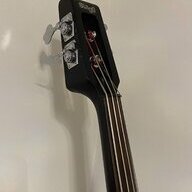
My current problem is this: bought a used Squier VM J-Bass fretless with substantial bow, and a maxed out truss rod nut. I tried adding two small washers under the nut and re-tightened, and it still just hits a point where it will not turn any more, and no change in the bow, and I mean noticeably curved even with no string tension at all. I like just a slight bit of relief, how can I get there now? More washers? Turn it over to a pro?
 

Latest posts