

Enjoy the benefits of a premium membership!
Upgrade Account
-
TalkBass has been independent since 1998. Add your voice.
Create a free account to reply to discussions, view embedded media, and browse with fewer display ads.
Join free Log in
Want zero display ads or expanded classifieds tools? Compare plans.
You are using an out of date browser. It may not display this or other websites correctly.
You should upgrade or use an alternative browser.
You should upgrade or use an alternative browser.
U.S. Peavey Club
- Thread starter Soundchaser11460
- Start date
-
- Tags
- club
More options
Who Replied?

There are two Patriots on feeBay for the same price. I'd guess a GC rookie looked there to assess the value. I wonder what they gave the seller for it.[Invalid or Expired Link Removed]
overpriced! cool color!
That GC is about a half hour from me. I might have to go check it out. I won't have to hurry.
Last edited:
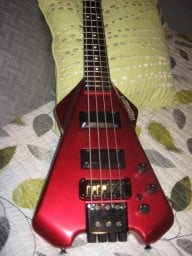


GC has decided that all the Peaveys are worth $200 more than they were 6 months ago.
The Patriot is a complete swing and a miss.
The Patriot is a complete swing and a miss.

A Classic Vibe Squier is now $500 and a Fender Mexico Player is $850
So there's that.
So there's that.
Wow. I haven't been cruising GC (or any other sites) like I used to. But a quick search verifies your claim. $200 Foundations and Furys are no more. Starting price looks to be $400.GC has decided that all the Peaveys are worth $200 more than they were 6 months ago.
The Patriot is a complete swing and a miss.

Wow. I haven't been cruising GC (or any other sites) like I used to. But a quick search verifies your claim. $200 Foundations and Furys are no more. Starting price looks to be $400.
I know I feel lucky to have found my Forum for 299.00.
Everything is going up.
It is a Bass Guitar, so a limited range instrument.
No need for Bass response below lowest string frequency produced, some 40Hz, nor higher frequency than highest significant harmonic of the highest note, so some 5kHz.
So any "improved" Op Amp will be wasted, except if you get a lower noise one, but nothing beyond.
It is not a Hi Fi preamp where minimum spec to deserve that label is ruler flat from 20Hz (which you don´t have) to 20kHz (neither) .
Hi Fi preamps often boast of even more extended response, say 2 or 5Hz to, say, 50kHz or 100kHz, mainly to guarantee perfect response in the Audio band, not needed here.
Same about aiming to sub-zero distortion: in fact string Musical Instruments can benefit from "a little" distortion even when used nominally "clean", or sound is often labelled as "boring clinical", go figure.
Tubes are well liked , in part because they introduce some nonlinearity (a.k.a. distortion) to add some "flavour".
Of course it doesn´t hurt having a cleaned and flatter Op Amp, simply you won´t enjoy any audible "improvement"
For the same reasons, it is not worth going to film caps, besides the obvious size problem.
In a nutshell: using "better parts" often leads to no or minuscule improvement, the REAL improvement comes from bettering THE DESIGN.
Of course, anybody who can solder can replace parts, now to improve the design requires knowledge and experience, so it´s not very popular.
For example, that Millenium preamp has a somewhat crude design which has a real effect on sound and quality, yet you are not addressing that by any means.
millenium improve.png
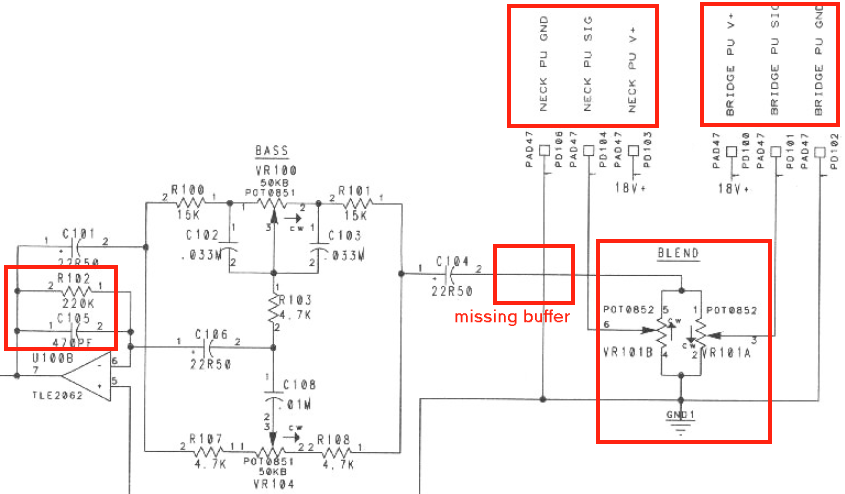
visible errors (or at least areas to improve):
1) "the most important Op Amp is the first one" since it processes the weakest signal .... but those are active pickups, there is at least one Op Amp embedded in each one (fed by that 18V rail), yet you can´t touch it, not even see it, it´s potted inside, let alone replace it with a better one.
2) it uses a crude Blend pot.
Normal pots get signal at the hot terminal, which exits through the wiper, which among other things allows for a relatively constant load to signal source , as low as possible output impedance (for a passive part) and when set to 0 shorts the output, for lowest hum and noise.
None of that here where signal enters through the wiper and exits through "hot", so:
* signal source gets variable (and always too low) load, including shorting it when set to 0 and very very low load when set to lower levels.
* network output impedance is high over most of the travel, and maximum when both pickups are set for same level (50%) .... which is a very common setting.
* which leads to problem #3:
3) Baxandall tone controls need being fed from as low an impedance as possible for best results, but here signal comes from that cheesy Blend pot network.
It would improve if a buffer were inserted between them, I show the best place for it.
4) tone control Op Amp shows a treble murderingnetwork: R102//C105.
220k plus 470pF have a turnover frequency of 1500Hz

In practice somewhat higher because the whole EQ network is in parallel with R102, and it uses 50k pots, but hey, that will severely mask any possible "improvement" brought by using "better parts".
In a nutshell: real improvements are far away from what an average user can do, because they are achieved at the design bench.
Part swapping is justified only if VERY old or incompetent parts are present, say replacing a very noisy 741 by a more modern one, or dried up caps by fresh ones, not much beyond that
No need for Bass response below lowest string frequency produced, some 40Hz, nor higher frequency than highest significant harmonic of the highest note, so some 5kHz.
So any "improved" Op Amp will be wasted, except if you get a lower noise one, but nothing beyond.
It is not a Hi Fi preamp where minimum spec to deserve that label is ruler flat from 20Hz (which you don´t have) to 20kHz (neither) .
Hi Fi preamps often boast of even more extended response, say 2 or 5Hz to, say, 50kHz or 100kHz, mainly to guarantee perfect response in the Audio band, not needed here.
Same about aiming to sub-zero distortion: in fact string Musical Instruments can benefit from "a little" distortion even when used nominally "clean", or sound is often labelled as "boring clinical", go figure.
Tubes are well liked , in part because they introduce some nonlinearity (a.k.a. distortion) to add some "flavour".
Of course it doesn´t hurt having a cleaned and flatter Op Amp, simply you won´t enjoy any audible "improvement"
For the same reasons, it is not worth going to film caps, besides the obvious size problem.
In a nutshell: using "better parts" often leads to no or minuscule improvement, the REAL improvement comes from bettering THE DESIGN.
Of course, anybody who can solder can replace parts, now to improve the design requires knowledge and experience, so it´s not very popular.
For example, that Millenium preamp has a somewhat crude design which has a real effect on sound and quality, yet you are not addressing that by any means.
millenium improve.png
visible errors (or at least areas to improve):
1) "the most important Op Amp is the first one" since it processes the weakest signal .... but those are active pickups, there is at least one Op Amp embedded in each one (fed by that 18V rail), yet you can´t touch it, not even see it, it´s potted inside, let alone replace it with a better one.
2) it uses a crude Blend pot.
Normal pots get signal at the hot terminal, which exits through the wiper, which among other things allows for a relatively constant load to signal source , as low as possible output impedance (for a passive part) and when set to 0 shorts the output, for lowest hum and noise.
None of that here where signal enters through the wiper and exits through "hot", so:
* signal source gets variable (and always too low) load, including shorting it when set to 0 and very very low load when set to lower levels.
* network output impedance is high over most of the travel, and maximum when both pickups are set for same level (50%) .... which is a very common setting.
* which leads to problem #3:
3) Baxandall tone controls need being fed from as low an impedance as possible for best results, but here signal comes from that cheesy Blend pot network.
It would improve if a buffer were inserted between them, I show the best place for it.
4) tone control Op Amp shows a treble murderingnetwork: R102//C105.
220k plus 470pF have a turnover frequency of 1500Hz
In practice somewhat higher because the whole EQ network is in parallel with R102, and it uses 50k pots, but hey, that will severely mask any possible "improvement" brought by using "better parts".
In a nutshell: real improvements are far away from what an average user can do, because they are achieved at the design bench.
Part swapping is justified only if VERY old or incompetent parts are present, say replacing a very noisy 741 by a more modern one, or dried up caps by fresh ones, not much beyond that

Speaking of the Millennium Pre-Amp, does anyone know the EQ points of the bass & treble controls and the frequency range of the mid sweep control?
And I just found a new preamp with sweepable mids! gonna give it a try 
Wherever Monroeville is....get there now![Invalid or Expired Link Removed]
Huh!?!
Yeah, no shippingWherever Monroeville is....get there now!


Going to check out a USA Fury tomorrow, $250 with a hardshell case and some accessories. Seller says it's been sitting in an attic unplayed for 20 years. Black with a maple fingerboard. I'm pretty excited! US made goodness for less than used Squiers are going for these days...
I'll post pics when/if I take it home!
I'll post pics when/if I take it home!

Just in case anyone is interested. Great Deal!:
For Sale - USA Cirrus 4. WOW! Only 5 shipped. | TalkBass.com
For Sale - USA Cirrus 4. WOW! Only 5 shipped. | TalkBass.com
Fretboard looks like someone tried to clean the frets with something and messed it up.80s Foundation in rough shape ($120 in western MA):
[Invalid or Expired Link Removed]
Otherwise it's probably salvageable.


