
Enjoy the benefits of a premium membership!
Upgrade Account
-
TalkBass has been independent since 1998. Add your voice.
Create a free account to reply to discussions, view embedded media, and browse with fewer display ads.
Join free Log in
Want zero display ads or expanded classifieds tools? Compare plans.
You are using an out of date browser. It may not display this or other websites correctly.
You should upgrade or use an alternative browser.
You should upgrade or use an alternative browser.
Double Bass Upright Intonation
- Thread starter Ian Votaw
- Start date
More options
Who Replied?
Are you studying with a teacher? I have you done some work with Simandl?

Yes I am studying with a teacher. UNT grad he's a fantastic upright player. But I still run into the same problem of having good pitch in our lessons after doing exercises but the next day it's gone.Are you studying with a teacher? I have you done some work with Simandl?
Some comments:
* Hand shape for intonation should be a feeling that has to be experienced and felt, and to recall that feeling of that shape when you play. It's an evisceral thing, like riding a bike or dancing. Memorize not just the notes but that feeling that the hand takes when you play in that shape.
* With DB, you can't exactly expect to put your fingers in the right place consistently and always be in tune. There's a mental game in play where you need to expect the right pitch so your hands will automatically correct to it. If you can sing it (especially in your head) in tune, you'll have a better chance to play it in tune. Sing a pitch first, play it on the piano, and then self-correct your mental expectation of how that pitch should sound. If you dont' remember how something should sound, you're going to be challenged from the get-go. Can you single all the scales in tune (at least in your head)?
* Drones can be useful but can also lead you astray by becoming a crutch if used incorrectly. I would advise using drones sparingly, esp to turn the drone off and practice material without the drone and turn it on again to see how well you do. It's like coaching your body to play the correct pitches automatically without mental effort.
* Also be careful with any habits of looking at your hands. Don't look at them. As John Clayton said in a clinic I was at once, "What are you looking for? There's nothing to see".
* Hand shape for intonation should be a feeling that has to be experienced and felt, and to recall that feeling of that shape when you play. It's an evisceral thing, like riding a bike or dancing. Memorize not just the notes but that feeling that the hand takes when you play in that shape.
* With DB, you can't exactly expect to put your fingers in the right place consistently and always be in tune. There's a mental game in play where you need to expect the right pitch so your hands will automatically correct to it. If you can sing it (especially in your head) in tune, you'll have a better chance to play it in tune. Sing a pitch first, play it on the piano, and then self-correct your mental expectation of how that pitch should sound. If you dont' remember how something should sound, you're going to be challenged from the get-go. Can you single all the scales in tune (at least in your head)?
* Drones can be useful but can also lead you astray by becoming a crutch if used incorrectly. I would advise using drones sparingly, esp to turn the drone off and practice material without the drone and turn it on again to see how well you do. It's like coaching your body to play the correct pitches automatically without mental effort.
* Also be careful with any habits of looking at your hands. Don't look at them. As John Clayton said in a clinic I was at once, "What are you looking for? There's nothing to see".

It might be wise to manage expectations on this problem, it's not one that goes away. Some new players think that learning correct form, fingering and positions brings good tuning automatically. It doesn't. The bass is a live thing, always a moving target. Even what sounds right to you now will be less so with experience. Just keep working on your ear training and listening to your bandmates, it will get easier.
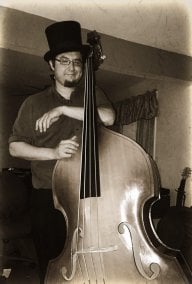
It's traditional to tape the fingerboard for younger students to learn appropriate finger positions. Don't know if that would work in your case; might be better to inquire with the teacher.
Thanks.
Thanks.
That's a great point. We don't ever really truly master this. It's always a work in progress. Even the greats got their percentages for consistency way up but everybody always makes a clam or two every now and then.It might be wise to manage expectations on this problem, it's not one that goes away. Some new players think that learning correct form, fingering and positions brings good tuning automatically. It doesn't. The bass is a live thing, always a moving target. Even what sounds right to you now will be less so with experience. Just keep working on your ear training and listening to your bandmates, it will get easier.
Doesn't mean you don't stop trying tho.

It might be wise to manage expectations on this problem, it's not one that goes away.
Student at a master class with Ray Brown: "I've really been struggling to play in tune."
Ray: "We all are."
Student at a master class with Ray Brown: "I've really been struggling to play in tune."
Ray: "We all are."
great, comforting, quote.
* With DB, you can't exactly expect to put your fingers in the right place consistently and always be in tune. There's a mental game in play where you need to expect the right pitch so your hands will automatically correct to it. If you can sing it (especially in your head) in tune, you'll have a better chance to play it in tune. Sing a pitch first, play it on the piano, and then self-correct your mental expectation of how that pitch should sound. If you dont' remember how something should sound, you're going to be challenged from the get-go. Can you single all the scales in tune (at least in your head)?
Tho shalt not disregard the internal procedures when playing music.
People tend to focus on the external parameters because they are more obvious and supposed to get easier 'under the hood'.
The secret problem-solver is mental/emotional projection; imagination. It is a key-ingredient when it comes to sound or improvisation. The clearer you hear it, the easier it is to play.
The primal musical instrument is oneself, then it traduces to the instrument.
I've practiced playing with a bow and playing over drones and I play perfectly in tune but a day later my tuning will be completely off again.
I would tend to think that this is because you are relying more on the physical side, the 'muscle-memory' then on the inner proceedings. The neuronal control circuits used for tone control need more time to be built via repetition then the ones that responsible for moving fingers. Patience & persistence are good features to be developed.
It is also reported by the allmighty neuroscientists that having the most fun when doing things is the best way to progress; opposed to self-hatred and frustration.
For me a successful practise in intonation training has been (and still is): singing my own drones while playing intervals and scales.
To counteract a shift in the sung drone it helps to go into 'throatsinging-mode'.

If you've only been playing for a year, you're supposed to be struggling! 
But in all seriousness, it just takes time - and focused practice. I don't play the most complicated music, but there are days when I my intonation just sucks. There are just so many variables when it comes to developing pitch and muscle memory, and trying to manage the beast physically. I don't think that many of us have a eureka moment where it all just clicks. It's a slow climb.
My advice is to make practice count. I've watched plenty of master classes on the web, and nearly every player makes mention about how important the approach to practice is. Get the most you can out of it, and don't treat the exercises as going through the motions. What ever it is you are working on, work on it until you have it licked. Don't move to the next thing until you do.
But in all seriousness, it just takes time - and focused practice. I don't play the most complicated music, but there are days when I my intonation just sucks. There are just so many variables when it comes to developing pitch and muscle memory, and trying to manage the beast physically. I don't think that many of us have a eureka moment where it all just clicks. It's a slow climb.
My advice is to make practice count. I've watched plenty of master classes on the web, and nearly every player makes mention about how important the approach to practice is. Get the most you can out of it, and don't treat the exercises as going through the motions. What ever it is you are working on, work on it until you have it licked. Don't move to the next thing until you do.
Student at a master class with Ray Brown: "I've really been struggling to play in tune."
Ray: "We all are."
See the clip Impossible to Sing and Play the Bass by Jay Leonhardt
Ear training. Learning to play "in tune" is just another kind of ear training. And singing is the best way to internalize your sense of pitch. Do you have a piano or keyboard at home? Or marimba or vibraharp, even? Any instrument with a reliable set of pitches will do. Play the scales on the piano (you don't need fantastic keyboard chops to do this) and sing the pitches using solfege syllables. Gradually wean yourself from singing every note with the keyboard. Maybe sing all the pitches, but only play the chord tones. Then maybe just play the root...I dunno, you'll find what works best for you. Just go slow and don't worry if you sound like $#!* at first. You'll notice improvement even from ten minutes a day of this kind of thing.
Do a search for the ear training posts by @Ed Fuqua if you want better and more thorough advice on this topic than just about anyone else here can give.
Do a search for the ear training posts by @Ed Fuqua if you want better and more thorough advice on this topic than just about anyone else here can give.
One of the dangers of the drone is that you may end up relying on it to provide good intonation while using it. Typically we instinctively listen for the beats where the notes are off along with the drone and self adjust. The problem is that this takes time. You play, listen, correct, and then maybe listen again and then fine tune. Now this may be good to get us into the general physical ballpark of where the correctly intonated note may lie, but we all know that it just takes a millimeter or two to be out of tune. It's hard to consistently nail it physically with absolute accuracy, especially if you consider that where the note intonates on the finger changes depending on which direction your hand came from and the distance involved. The longer the distance, the more inaccurate it gets (this is called Fitt's Law among Usability experts).
Anyways, the above listen-finetune-listen-finetune process will not just be a bad habit to engrain, but that process is extremely slow, esp when you have to deal with fast passages.
Meanwhile if the body is allowed to be relaxed and trained in a way to hit the right notes, automatically without effort, it will self correct innately. The problem the is to allow the mind and body to work together but you have to provide the right expectation or intention of pitch. Much of what Ed writes about, and what he gets from Joe Solomon, touches on this aspect - that you are building the imagination and the mind. The physical/evisercal part needs to be remembered as a feeling, but it's secondary to the imagination/expectation side.
Anyways, the above listen-finetune-listen-finetune process will not just be a bad habit to engrain, but that process is extremely slow, esp when you have to deal with fast passages.
Meanwhile if the body is allowed to be relaxed and trained in a way to hit the right notes, automatically without effort, it will self correct innately. The problem the is to allow the mind and body to work together but you have to provide the right expectation or intention of pitch. Much of what Ed writes about, and what he gets from Joe Solomon, touches on this aspect - that you are building the imagination and the mind. The physical/evisercal part needs to be remembered as a feeling, but it's secondary to the imagination/expectation side.
Yeah I do have a keyboard at home and also use Theta music trainer.Ear training. Learning to play "in tune" is just another kind of ear training. And singing is the best way to internalize your sense of pitch. Do you have a piano or keyboard at home? Or marimba or vibraharp, even? Any instrument with a reliable set of pitches will do. Play the scales on the piano (you don't need fantastic keyboard chops to do this) and sing the pitches using solfege syllables. Gradually wean yourself from singing every note with the keyboard. Maybe sing all the pitches, but only play the chord tones. Then maybe just play the root...I dunno, you'll find what works best for you. Just go slow and don't worry if you sound like $#!* at first. You'll notice improvement even from ten minutes a day of this kind of thing.
Do a search for the ear training posts by @Ed Fuqua if you want better and more thorough advice on this topic than just about anyone else here can give.

I've practiced playing with a bow and playing over drones and I play perfectly in tune but a day later my tuning will be completely off again.
This may be your problem as it's doubtful to me that you are playing "perfectly in tune" one day and "completely off" on another. Do any of us play perfectly in tune? You should keep working with relative pitch which is what drones are very good for. Quick micro-shifts to correct those out of tune notes will eventually help you with hearing and playing more in tune. That said, you really have to be able to hear it when you're in and out of tune.

I found when I first started on URB and for a few years, that if I took a day off from practicing, I would back-slide a fair amount. These days, it's not like that but I still need to warm up before I play anything seriously. I also found that practicing for multiple hours per day was necessary to really make progress, but, that's me, you might be different.

Make sure your bass is at a consistent height-for me barefoot is endpin all the way in, regular shoes require it to come out 1/2", and western boots add 1/2" to that.
The use of external drones strikes me as little more than auditory "training wheels", in that the use of them prohibits you from experiencing the thrill and possible horror of pedaling through the intonation pitch-scape with no "safety net", and may falsely convince the player that they now can play "in tune". (Yes - in an artificial universe, I guess.)
They may be useful in the short-term, but it seems like they are taking the place of the "internal drone". The use of your "internal drone", your singing voice, is a much more reliable/portable/durable/adaptable tool to develop, nurture and explore.
IMO.
They may be useful in the short-term, but it seems like they are taking the place of the "internal drone". The use of your "internal drone", your singing voice, is a much more reliable/portable/durable/adaptable tool to develop, nurture and explore.
IMO.
The use of external drones strikes me as little more than auditory "training wheels", in that the use of them prohibits you from experiencing the thrill and possible horror of pedaling through the intonation pitch-scape with no "safety net", and may falsely convince the player that they now can play "in tune". (Yes - in an artificial universe, I guess.)
They may be useful in the short-term, but it seems like they are taking the place of the "internal drone". The use of your "internal drone", your singing voice, is a much more reliable/portable/durable/adaptable tool to develop, nurture and explore.
IMO.
I wonder if drones might provide a different type of "ear/mind training"? Matching external sources? Useful for out-of-tune pianos, horn, and other string players. I remember a gig once in which the singer was so off-pitch, I stared at my left-hand for a good minute or so trying to figure out how I could be SO far off-pitch. Turns out, for once, it wasn't me!
Last edited:
I like to warm up with scales and a drone. This helps me clear my mind and settle in before starting the real work. I also find a drone useful when working out a tough (for non-legit-trained me) lick. Latest example: Beethoven 4, 2nd mvmt, 2 bars before B. It's basically an F7 chord resolving to Bb, so I worked with an F as the drone note.


