@agedhorse Here's to the future? Invalid Link Removed
Was hoping there might be updates on nano tubes since this write up from 2012!
Was hoping there might be updates on nano tubes since this write up from 2012!

TalkBass has been independent since 1998. Add your voice.
Create a free account to reply to discussions, view embedded media, and browse with fewer display ads.
Join free Log in
Want zero display ads or expanded classifieds tools? Compare plans.

What are the environmental issues? The only one I can find is thorium, but the production of rare earth magnets produces mountains of thorium waste.
Is silicon a clean industry?

Class D only rules the market for guys who have to carry their own amps.I don't see a comeback.
Unless it was hired in for a festival, I've not seen a tube bass amp on a gig this century. There are still a few SS amps out there, doing good service, but D class is ruling the market.

Nah. I've tried most modeling systems and they don't come close to the attack of actual tube power sections.
And my dad was an electronic engineer...we had this debate several times. I have no real interest in the charted sine wave pattern which is supposed to please my ear. I'm interested in the actual pleasure of my ear.

I don't see a comeback.
Unless it was hired in for a festival, I've not seen a tube bass amp on a gig this century. There are still a few SS amps out there, doing good service, but D class is ruling the market.
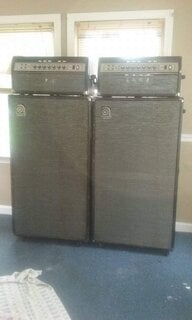
Strange. I mostly see SVTs and fridges on stage.

 . Again, because I’m on IEMs, I wouldn’t ask for a rig if my boss and bandleader strongly insist that I use a bass amp. Which I’m perfectly happy to do. Either my own Class D Mesa Subway rig or the supplied SVT (where I have no control over the grin on my face when I see it….).

Yeah, the magnetron is, I think a ceramic resonant cavity device, but I still think that Magnetron would be a good name for an amp. (I just Googled "magnetic amplifier. It does exist). (Now to google Ampleon).
Just say "Mesa Magnetron" once. It kind of rolls off the tongue, doesn't it?
"Mesa Ampleon" for the solid state version.
There is an existing OTL (output transformer less) technology but it’s not often used. Transformers are used to match high impedances of tubes to low impedance of speakers.
As an example, Philips made some tube consoles (you know, the stereo furniture of grandma) with like 800 ohms custom speakers…
Haha, give me a break.... There is even this little gem to show the not irrelevant level of commonality:
Home Brew Vacuum Tubes Are Easier Than You Think
Where does someone find the THD specs of a phone, tablet or computer? I also guess it’s a moot point as it has to go through the horrible tiny integrated speakers.
I've read Simplifier's blog before, it's pretty interesting and I like the work they do. But I don't think their processes are scalable to industrial quantities and I don't know whether they could make them consistently enough for matched sets to be economical.
You can make tube amps without output transformers. Peavey used to offer one a few years ago. (VB-3 I think).
Question for @agedhorse : Is the current difficulty sourcing new tubes, and the lack (or dwindling) of manufacturing facilities impacting companies that manufacture tube amps, such as Fender, Ampeg, Marshall, Mesa, etc.?
I ask this because I’m planning to buy a new Ampeg SVT.
Do you ever see the models of tubes that are popular in guitar and bass preamps, and the tubes that are most commonly used in the power sections of tube amps ever going to disappear?
Wasn’t mesas rationale for canceling the strategy and prodigy tube amps that they couldn’t get enough reliable KT88s to support manufacturing and warranty claims?
What are the environmental issues? The only one I can find is thorium, but the production of rare earth magnets produces mountains of thorium waste.
Is silicon a clean industry?
@agedhorse Here's to the future? Invalid Link Removed
Was hoping there might be updates on nano tubes since this write up from 2012!

I find this highly suspect I've seen a Ampeg Svt and Marshall stack at almost every show I've been to including pub gigsYou havent seen a tube bass amp on stage in 20+ years? You must not get out much. Or only going to a very narrow range of shows. I saw two this week and I know I don’t get out much.
Class D is certainly dominating the market, but even there many manufacturers and designers - some of whom have commented here - are using tube preamp/hybrid designs. I don’t see a big tube manufacturing comeback, but as long as they’re being manufactured somewhere the demand on the amp side will still exist in the market at some level, however niche it may be.

That's it. The optics industry went through a change-over to lead free glass. I remember a whole bunch of part changes that I had to approve. But I don't know if anybody came up with a good glass for tube seals. The folks who bought the Western Electric brand say that they've worked past the environmental issues, but I don't know any details.Thorium is one, but it's the processing of the steel, the acids, the plating, the coating of the anode and cathode, and especially the lead in the base glass (called fritt glass) which is used to manage the rate of expansion so that the pins and the glass track more closely. It also makes the glass more "sticky" when forming the lead seals.
Hired, or if there are roadies/stage hands, it all makes sense, because they are fine sounding amps.Strange. I mostly see SVTs and fridges on stage.
Thanks! All I've been able to find about tube manufacturing is that Western Electric claims that the components and process are not environmentally toxic. As to the silicon industry...we're screwed. String bass and candlelight from now on.What are the environmental issues? The only one I can find is thorium, but the production of rare earth magnets produces mountains of thorium waste.
Is silicon a clean industry?

i.e., probably 90% of amps purchasedClass D only rules the market for guys who have to carry their own amps.



Where are guitar players getting their tubes?
They seem to care far more than bass players about their tube amps.
I find this highly suspect I've seen a Ampeg Svt and Marshall stack at almost every show I've been to including pub gigs

It does.Your right, I 'm not good with names. Well this amp. I believe it has tubes....