• TalkBass has been independent since 1998. Add your voice.
    Create a free account to reply to discussions, view embedded media, and browse with fewer display ads.
    Join freeLog in
    Want zero display ads or expanded classifieds tools? Compare plans.

Vertical cab stacking---the only way to play

The comb-filtering thing is interesting. I'm kind of with Ken Jung on this. I'm not sure it's really a major practical concern to most guys playing small to medium clubs. I've played many gigs with friends/family, other bass players, prosound engineers in attendence sitting in various places in the club and I usually solicit feedback by asking them several questions:

Can you hear the bass? Yes
Is the bass too loud? No
Can you hear every note distinctly, low and high? Yes
When I switch from fingerstyle to slap is there a noticeable
volume difference? No
Is the slap sound clear? Yes
Can you feel the bass? Yes

Granted some people may be getting a different mix in different parts of the room due to the comb-filtering but apparantly not significant enough to require some correction on my part.
It matters to some more than others. If you're getting the sound you like the way you're doing it now, keep on with it. I will say I think comb filtering matters more in some rooms than others. And hey, a good 810 and I'm in pants-pooping heaven regardless of comb filtering. But I really notice the difference onstage when I set up with it in mind.
 
I didn't read your whole PhD dissertation, but yes SVT cabs are vertical stacking at it's finest as you said, I also use two 15"s sometimes, one on top of the other, one on the floor for added bottom and the other at ear level so the highs don't blow right by me. I like to hear my bass very clearly.
Incidentally those old PA's with the big 18" scoops sounded great, now that was real bottom.
There is a medium sized club around here that has double 18"s in ported bass reflex cabs along with two horns and this PA sounds great. I saw a blues band there a few years ago (Kim Wilson) and heard the best amplified upright sound I've ever heard through this PA and the guy was using Piezos not a magnetic pickup.
IMHO Bass bins do not belong on the ceiling you lose the bottom octave, bass should come from the floor.
 
I didn't read your whole PhD dissertation, but yes SVT cabs are vertical stacking at it's finest as you said, I also use two 15"s sometimes, one on top of the other, one on the floor for added bottom and the other at ear level so the highs don't blow right by me. I like to hear my bass very clearly.
Incidentally those old PA's with the big 18" scoops sounded great, now that was real bottom.
There is a medium sized club around here that has double 18"s in ported bass reflex cabs along with two horns and this PA sounds great. I saw a blues band there a few years ago (Kim Wilson) and heard the best amplified upright sound I've ever heard through this PA and the guy was using Piezos not a magnetic pickup.
IMHO Bass bins do not belong on the ceiling you lose the bottom octave, bass should come from the floor.

I'm curious who's PHD dissertation are you referring too? :confused:
 
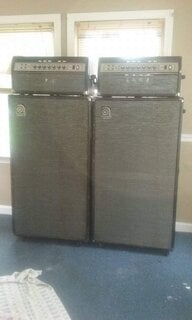
DSC00316.gif


Can't beat vertical stacking! :)

Jake
 
It matters to some more than others. If you're getting the sound you like the way you're doing it now, keep on with it. I will say I think comb filtering matters more in some rooms than others.
I keep bringing it up, but for whatever reason it keeps getting overlooked: avoiding comb filtering is only half of the reason for vertical stacking/driver alignment. Midrange dispersion is the other half, and is the more significant of the two. The midrange dispersion angle is inversely proportional to the width of the radiating surface, so a vertically aligned 2x will have twice the horizontal dispersion as a horizontally aligned 2x. Just as significant, vertical drivers reduce vertical midrange dispersion, so more of your sound goes into the audience, less into the floor and ceiling.
I didn't read your whole PhD dissertation, but yes SVT cabs are vertical stacking at it's finest as you said,
They are a textbook example of horizontal clustering, with drivers side by side.
 
Bill, I probably won't understand but that never stopped me before. :) Anyway, I have two questions:

1. Would say (in general) that a 4x10 cab w/ the drivers aligned vertically would be as good or better than a SVT styled cab w/ 8x10 (2 side by side) for the reasons innumerated above?

2. Were you to design a 4x10 cab (and perhaps you have) what would be dimensions (hxwxd)?
 
Bill, I probably won't understand but that never stopped me before. :) Anyway, I have two questions:

1. Would say (in general) that a 4x10 cab w/ the drivers aligned vertically would be as good or better than a SVT styled cab w/ 8x10 (2 side by side) for the reasons innumerated above?
Yes, assuming the cab is sized so that the drivers are able to work to their potential.

2. Were you to design a 4x10 cab (and perhaps you have) what would be dimensions (hxwxd)?
48 high, 20wide, 18 deep would be a reasonable guesstimate, depending on the driver used.
 
Is the slap sound clear? Yes

Admittedly I'm older than sand but one of the reasons I dislike slap is I've never heard it done live where I didn't feel the bottom of the band completely drops out. The only exception (and I've not seen him live) is Larry Graham. I don't know what it is that he does differently but somehow when Larry does it there is more midrange or thump and less twang. I'd love to hear from someone who does a lot of slap to find out how Larry's technique is different.
 
Yes, assuming the cab is sized so that the drivers are able to work to their potential.

48 high, 20wide, 18 deep would be a reasonable guesstimate, depending on the driver used.

Interesting. I would expect then you'd have at least equal the performance of the standard 8x10 SVT style cab and a lower cost and less weight.

P.S. what effect would it have if the cab were made wider?
 
Admittedly I'm older than sand but one of the reasons I dislike slap is I've never heard it done live where I didn't feel the bottom of the band completely drops out. The only exception (and I've not seen him live) is Larry Graham. I don't know what it is that he does differently but somehow when Larry does it there is more midrange or thump and less twang. I'd love to hear from someone who does a lot of slap to find out how Larry's technique is different.

There are three reasons IMO and IME that sometimes you hear the bottom drop out when a player slaps live through a backline rig.

1) Technique... many times, the player has not put in enough time to make the thumb hits sound even with his/her fingerstyle technique. There is no reason that you can't go from a great fingerstyle tone to a thumb hit slap tone without touching a knob or making any EQ or volume adjustments.

2) Wattage and cabinet size... a thumb hit and pluck is the definition of an extreme transient peak. This technique will quickly push an amp and a speaker cab to its limits. You need LOT's of headroom to propel that tone cleanly through a mix, and you need a cab that can push some air. I've never had any luck using slap style at even moderate volumes with less than a 410.

3) EQ.... many players, for some reason, think that a slap tone with scooped mids (smiley face EQ) is the way to go. I believe this is due to the fact that this type of EQing covers up technique problems. Players who are known for great slap tone (Marcus Miller, Graham, as you point out, etc.) have LOT's of mid mid's in their tone to provide 'note clarity' along with the 'boom and sizzle'.

I have great luck pushing a nice, full, deep but punchy slap tone into a room with a nice, high quality moderate SPL 410 and around 500 nice clean SS watts. Of course, like any other style, once the venue gets very large or the volume gets very high, front of house support is your friend.

Interestingly, I more often hear a slap style player having plenty of bottom, but no upper mid articulation or treble snap (i.e., slapping away and all you hear is rumble). It's amazing how a room full of people can suck up the higher frequencies, and it can be quite shocking how much upper mid and treble response you have to dial into a rig in order for it to propel a clean, crisp top end out into a room.
 
KJung, thanks for your input. Just a couple of follow ups and observations.

1. You indicate that there is no need to eq or adjust volume when going from fingerstyle to slap but subsequently indicate that you need plenty of headroom to push the sound out to audience. The implication (to me anyway) is that more power is needed for slap than fingerstyle.

2. While I agree that Larry probably has (or had) more midrange in his tone (back during Sly Stone era) to my ears Marcus Miller practically invented the smiley face eq.

3. I'm still curious as to what it is that Larry does that makes his slap more defined and articulate than the rest.

There are three reasons IMO and IME that sometimes you hear the bottom drop out when a player slaps live through a backline rig.

1) Technique... many times, the player has not put in enough time to make the thumb hits sound even with his/her fingerstyle technique. There is no reason that you can't go from a great fingerstyle tone to a thumb hit slap tone without touching a knob or making any EQ or volume adjustments.

2) Wattage and cabinet size... a thumb hit and pluck is the definition of an extreme transient peak. This technique will quickly push an amp and a speaker cab to its limits. You need LOT's of headroom to propel that tone cleanly through a mix, and you need a cab that can push some air. I've never had any luck using slap style at even moderate volumes with less than a 410.

3) EQ.... many players, for some reason, think that a slap tone with scooped mids (smiley face EQ) is the way to go. I believe this is due to the fact that this type of EQing covers up technique problems. Players who are known for great slap tone (Marcus Miller, Graham, as you point out, etc.) have LOT's of mid mid's in their tone to provide 'note clarity' along with the 'boom and sizzle'.

I have great luck pushing a nice, full, deep but punchy slap tone into a room with a nice, high quality moderate SPL 410 and around 500 nice clean SS watts. Of course, like any other style, once the venue gets very large or the volume gets very high, front of house support is your friend.

Interestingly, I more often hear a slap style player having plenty of bottom, but no upper mid articulation or treble snap (i.e., slapping away and all you hear is rumble). It's amazing how a room full of people can suck up the higher frequencies, and it can be quite shocking how much upper mid and treble response you have to dial into a rig in order for it to propel a clean, crisp top end out into a room.
 
Interesting. I would expect then you'd have at least equal the performance of the standard 8x10 SVT style cab and a lower cost and less weight.
With the right drivers, easily.

P.S. what effect would it have if the cab were made wider?
The baffle step frequency would be shifted lower, but insignificantly so. A 20" wide cab gives the necessary cab volume for tens, assuming a deep enough cab, and matches the width of rackmount gear. But a pair of 2x10s half the height, and weight, is more practical. There's no reason to use more than two woofers in any cab, if you need more output than what they can give just add another cab, or two.
 
KJung, thanks for your input. Just a couple of follow ups and observations.

1. You indicate that there is no need to eq or adjust volume when going from fingerstyle to slap but subsequently indicate that you need plenty of headroom to push the sound out to audience. The implication (to me anyway) is that more power is needed for slap than fingerstyle.

2. While I agree that Larry probably has (or had) more midrange in his tone (back during Sly Stone era) to my ears Marcus Miller practically invented the smiley face eq.

3. I'm still curious as to what it is that Larry does that makes his slap more defined and articulate than the rest.

I consider 'headroom' and EQ totally different things. I never touch a knob on the bass or the amp. However, if the amp doesn't have enough reserve power for that transient, things can quickly get ugly. This is not an 'EQ' issue IMO and IME.

For example, my LMII or F1 or Thunderfunk550 head running at 8ohms through a nice 210 sounds very good played fingerstyle, and sounds very similar to my LMII running at 4ohms through my similarly voiced 410 (although obviously not as loud and full). However, when slapping, the huge transient caused by that percussive 'hit' on the E or A string causes the 210 to 'compress' and the amp running at lower power to also compress due to lack of available 'peak' power, even at moderate volumes (hence, the 'thinness' you describe in the low end in some live slap tones IMO). Through the 410 at 500 watts... no problem.. full, clear, wide and deep.

And, if you really listen to Marcus' tone, he has LOT's of mids in his sound. Yes, he has massive deep bass and lot's of sizzle, but you can hear the 'note center' of every note he's playing due to him not 'scooping the tone'. It's interesting to note that when you see Marcus live, he typically has the midrange boosted on his EBS rig (he's moved to different amplification now, but that's what he was using last time I saw him). Of course, the EBS rig he uses has an inherent 'scoop' to the tone anyway when set flat (to my ear), but Marcus and others who have IMO a great slap tone, punch a lot of 300-600hz in their tone. (Edit: I do agree with you that Marcus 'launched a thousand bad scooped slap tones' due to players focusing too much on the lows and highs of Marcus' tone, and also trying to propel a 'too scooped tone' through a mix without enough cone area or power behind them.... again, a really bad combination of things).

Regarding Larry's slap tone... it's great.. I don't hear it as 'more defined or articulate' myself... just a touch darker than some others due to a lack of upper treble extension in his tone choice.

IMO... fun discussion, and an interesting topic for me, since as you correctly point out, pushing a good, authoritative slap tone with good low end, nice mid articulation and sizzle you can hear in the audience is the hardest job for a moderate sized backline rig IMO and painfully IME!
 
I assume the 2x10 cab would be the same depth and width just half the height?

That's a pretty standard measurement spec for a 210 cab IMO and IME. And +1 to Bill's suggestion that if you prefer a taller, vertical stack on stage, stacking two 210's makes much more sense than trying to cram 4 speakers in a single, tall box. That would be a pain to schlep.
 
I consider 'headroom' and EQ totally different things. I never touch a knob on the bass or the amp. However, if the amp doesn't have enough reserve power for that transient, things can quickly get ugly. This is not an 'EQ' issue IMO and IME.

But you also mentioned volume which I consider at least strongly related to volume no?

As for Marcus not being scooped, I'll defer to you on this, since you are obviously more familiar with him than I am.
 
Interesting I just did a down and dirty measurement of my SWR Goliath Jr II (2x10). Roughly speaking the cab is approximately 20-22" wide, which unless I've completely misunderstood is the approximate width Bill suggest his 2x10 (vertically stacked) box to be. Which would seem to indicate that the SWR is about half as wide as it should be.
 
But you also mentioned volume which I consider at least strongly related to volume no?

IMO and IME no... I do not consider headroom the same as volume. Put another way, the thumb slap technique puts a strain on an amp and speaker that requires more WATTAGE and CONE AREA to achieve the SAME VOLUME with no distortion/compression/ugliness versus a less percussive fingerstyle tone.

That's why the 'doubling the wattage gives you only 3db more volume' is an oversimplification. It's about a lot more than volume... it's about a non-compressed open tone, and handling those 'peaks' that come from some styles of playing.

Here's another way to look at it. My fingerstyle and slap volume sound the same with a high powered amp and a large cab. My fingerstyle volume is 'louder' than my slap volume with a small rig, IMO due to either the amp going into its limiting mode when it reaches its 'peak output' running at lower power into 8ohms, or due to that 'power compression' thing that happens to speakers (especially small boxes) pushed to their limits.

So, again, it's not that you need to turn the volume knob up when slapping versus playing in a less aggressive fingerstyle mode, but rather that the amp can replicate those strong peaks without folding.

A similar situation occurs with those that like HUGE low end in their tone. An extra couple of hundred watts can make a HUGE difference in the low end open, clean, wide, full tone when going from 300 to 500 watts, for example... even though the volume will not get significantly louder (maybe 2db on average).
 

Latest posts